
Here is a moment that catches a lot of first-time multiplex builders off guard. The building is finished, the units are rented, and then the bank’s appraisal comes back lower than expected. The gap between what you thought it was worth and what the appraiser wrote down is not a rounding error. In a soft market it can be several percent of the value, and it lands as cash you have to find.
Multiplex appraisal does not work the way a house appraisal works. If you understand that going in, you can design and underwrite around it instead of getting surprised at the finish line.
Three ways to value the same building
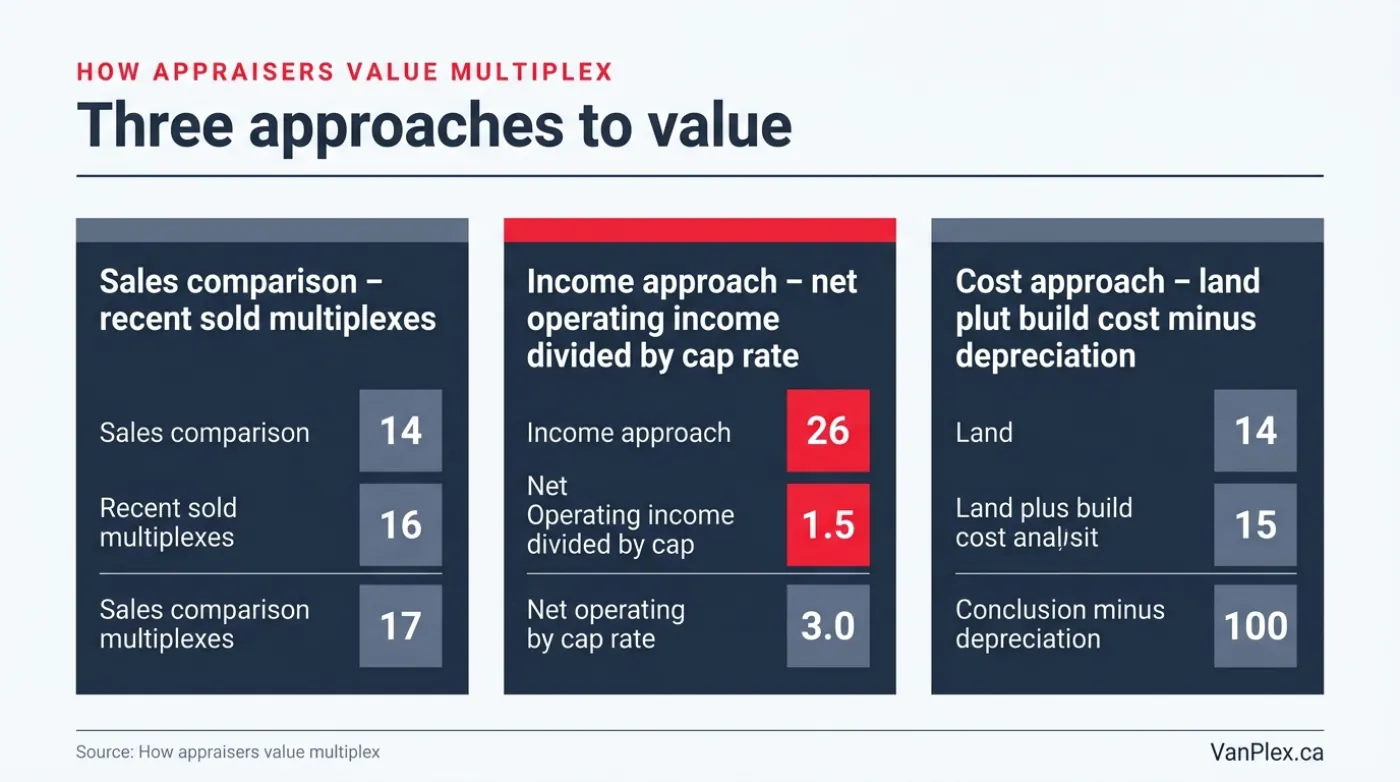
Every appraiser has three tools. The sales comparison approach looks at recent sales of similar properties and adjusts for differences. The income approach takes the net operating income the building produces and divides it by a market cap rate to get a value. The cost approach adds land value to the cost of rebuilding the structure, then subtracts depreciation.
For a single-family house, the sales comparison approach dominates because there are lots of similar houses selling nearby. For a completed rental multiplex, the picture flips. Market participants price these buildings on the income they throw off, so the income approach usually leads, and sales comparison acts as a check. That single difference is why homeowners who think in “price per house on my street” terms get surprised.
Why the income approach rules a finished multiplex
Think about what a buyer of a fourplex is actually buying. They are buying the rent roll. So the appraiser follows the same logic. Add up the gross rents, subtract vacancy and operating costs to get net operating income, then divide by a cap rate that reflects what similar buildings trade at.
The math is unforgiving in one direction. If your rents come in below what you projected, or your operating costs run high, your net operating income drops, and the value drops with it. A small miss on monthly rent per unit gets multiplied across every unit and then divided by a small cap rate, which magnifies it. This is why rent assumptions are not a detail. They are the value.
The cost approach and the “why build” question
The cost approach matters most for new construction, and right now it carries a warning. Multifamily construction costs are more than 30% above where they sat five years ago. When it costs far more to build than to buy an existing comparable building, ground-up development starts to look irrational on paper.
A simple example makes it concrete. If a builder can buy a functionally similar existing building for a certain price per square foot, and it costs meaningfully more per square foot to build one new, the development spread does not support construction. The gap between build cost and finished value is the whole game. A well-chosen lot with strong rents and a controlled build closes that gap. A weak lot with soft rents and cost overruns leaves it open, and the appraisal shows it.
What a low appraisal does to your loan
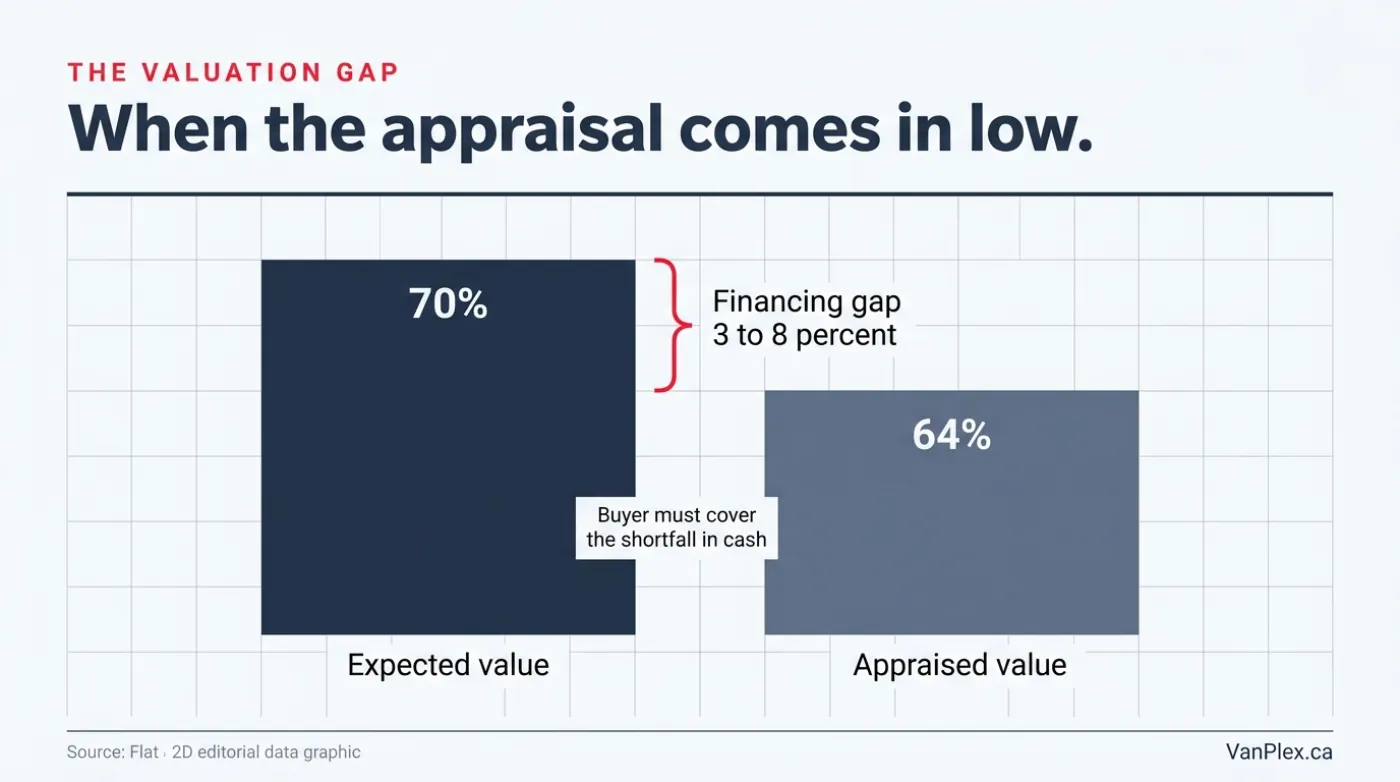
Here is the part that turns a number into a real problem. Your lender does not size your mortgage off what you paid or what you spent to build. It sizes it off the appraised value, up to whatever loan-to-value ratio your program allows. If the appraisal comes in low, the loan comes in low, and you have to cover the difference in cash.
Appraisals can come back significantly below the purchase price, and sellers get caught off guard when they assume their assessed value supports their asking price. The same trap catches builders who assume their cost supports the value. If you are counting on the finished appraisal to refinance out your construction loan, a shortfall can leave you short at exactly the wrong moment.
How to design for the appraisal, not against it
You have more control than you think, because you build the inputs the appraiser will use. Get the rents right by checking real market rents for your unit sizes, not hopeful numbers. Choose a unit mix that the market actually pays for. Control the build so your cost does not swallow the value. And pick a lot where the land basis leaves room between cost and finished value.
None of this happens at the appraisal stage. It happens at the lot selection and design stage, months earlier. The builders who never get a nasty surprise are the ones who underwrote the income approach before they broke ground, not after.
Common questions about multiplex appraisals
Why did my multiplex appraise lower than my single-family neighbour’s house? Different method. Your neighbour’s house is valued on comparable house sales. Your completed rental multiplex is valued mostly on the income it produces. If the income is soft, the value is soft, regardless of what houses sell for.
Can I challenge a low appraisal? Sometimes. If the appraiser used weak comparables or missed real rent data, you can provide better evidence. But you cannot argue away a genuine income shortfall. Fixing the number usually means fixing the rents or the cost, which is hard after the fact.
Does BC Assessment value equal appraised value? No. BC Assessment is a mass-appraisal figure for property tax. A lender’s appraisal is a specific market valuation for financing. They can differ, and sellers who assume the assessment supports their price often get surprised.
What is a realistic gap to plan for? In a market with strong appreciation, budget for a possible gap of 3% to 8% between expectation and appraisal. In a declining market, plan for more and keep a cash cushion so a low number does not stall your refinance.
The finished value is decided long before the appraiser arrives. It is decided by the lot you pick and the rents you can actually earn. Test your lot’s economics in about two minutes before you build to a number that may not hold.
David Babakaiff, Co-Founder, VanPlex | PlexRank™ | Profit with Multiplex