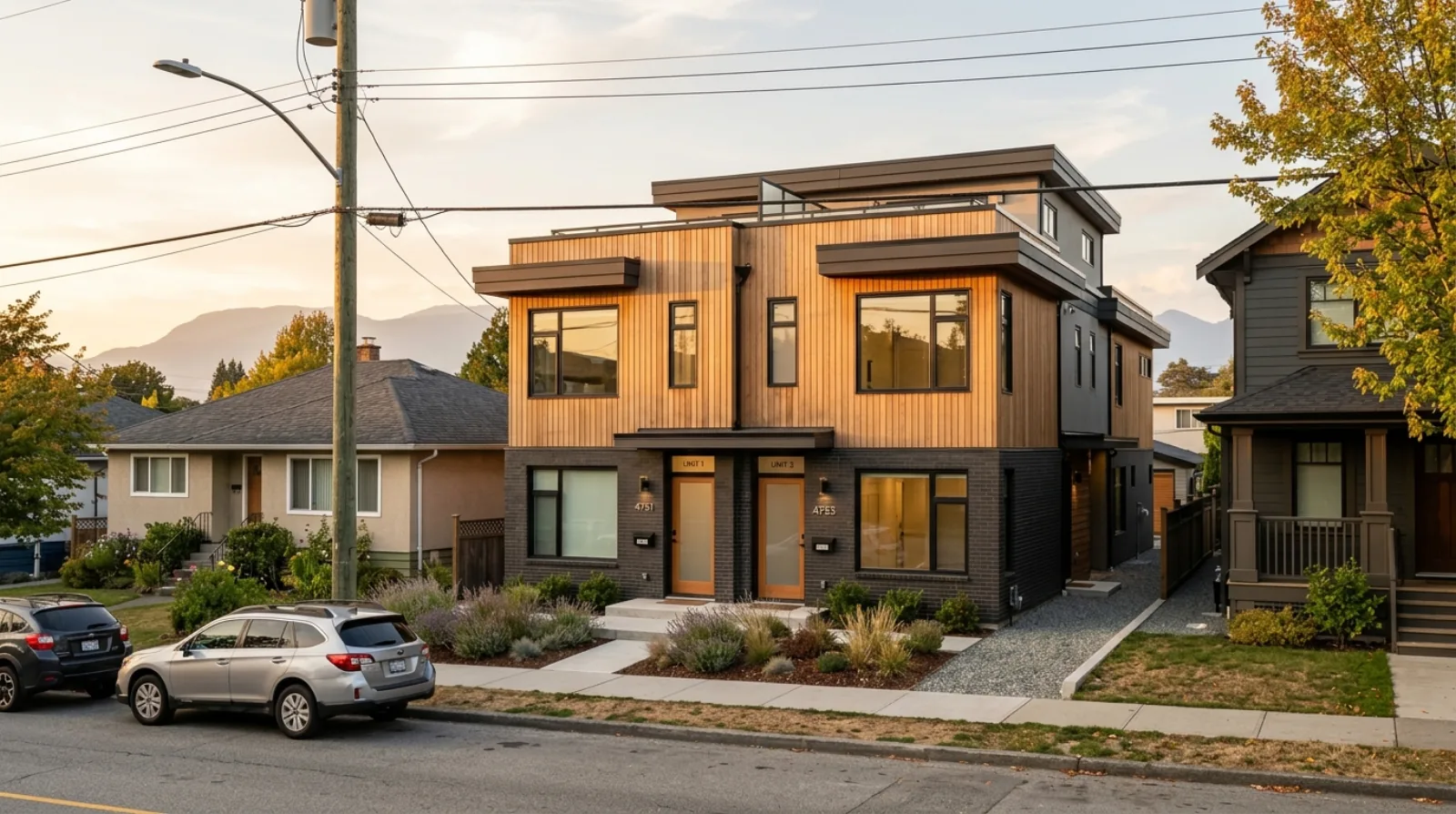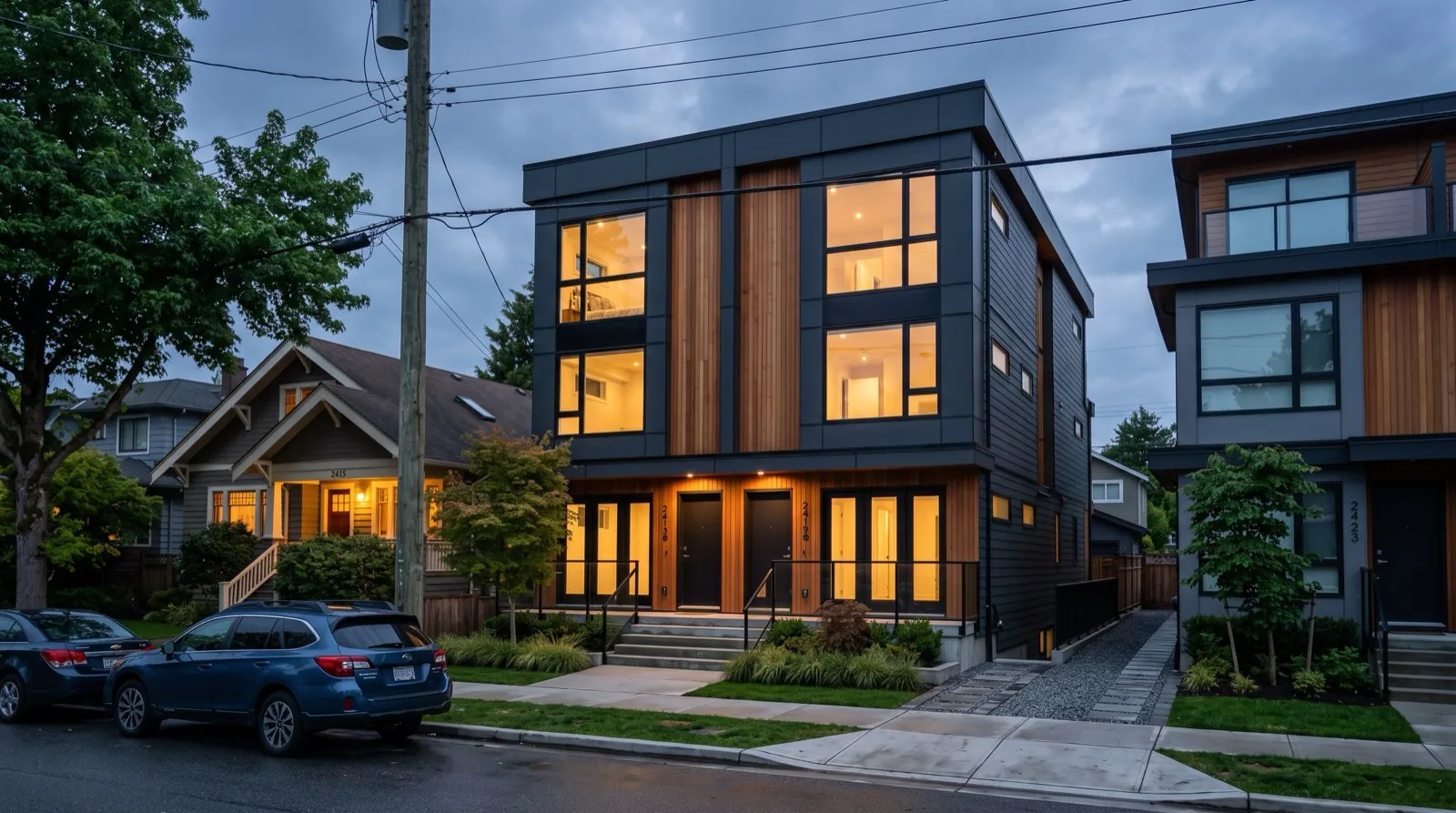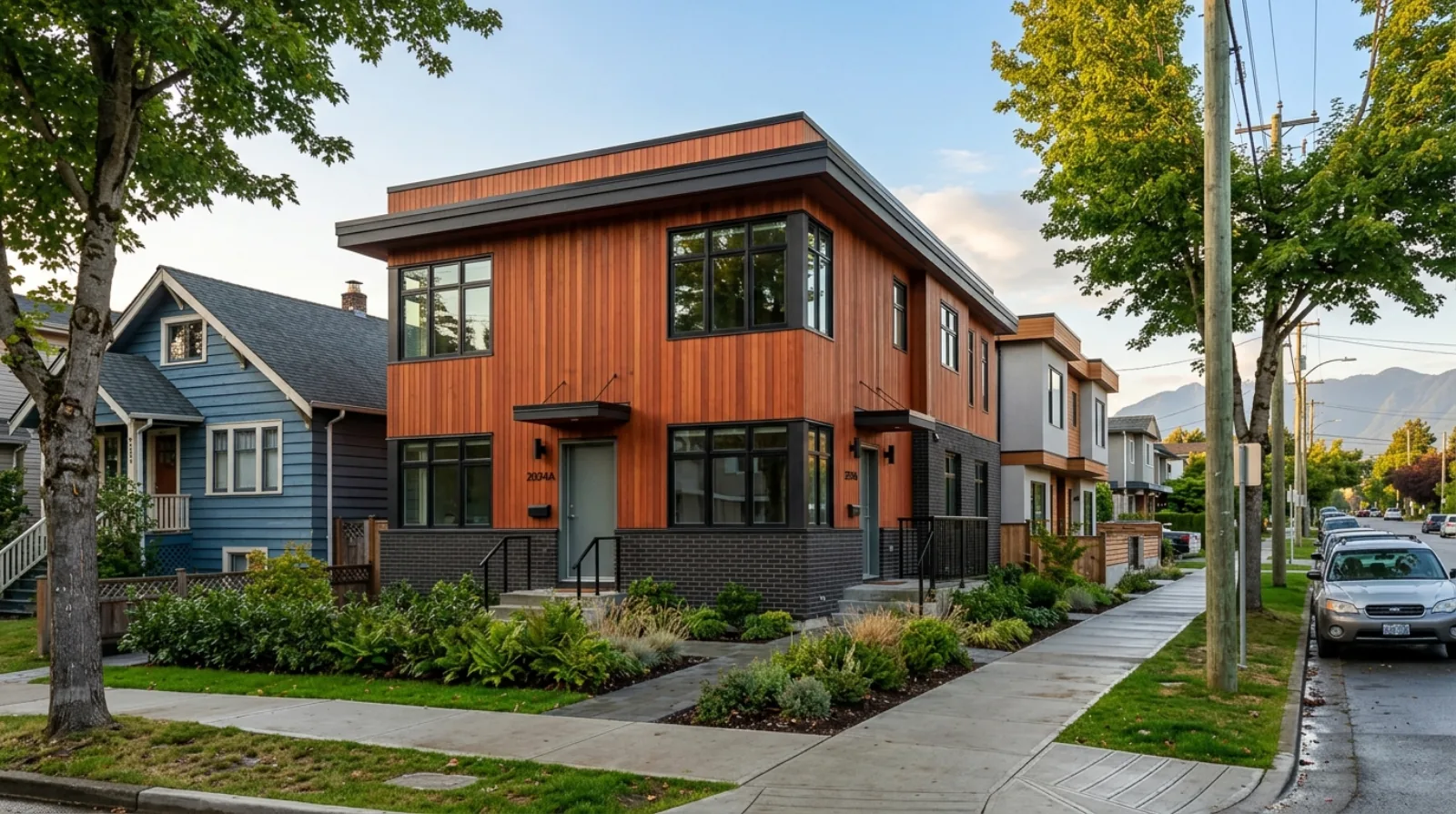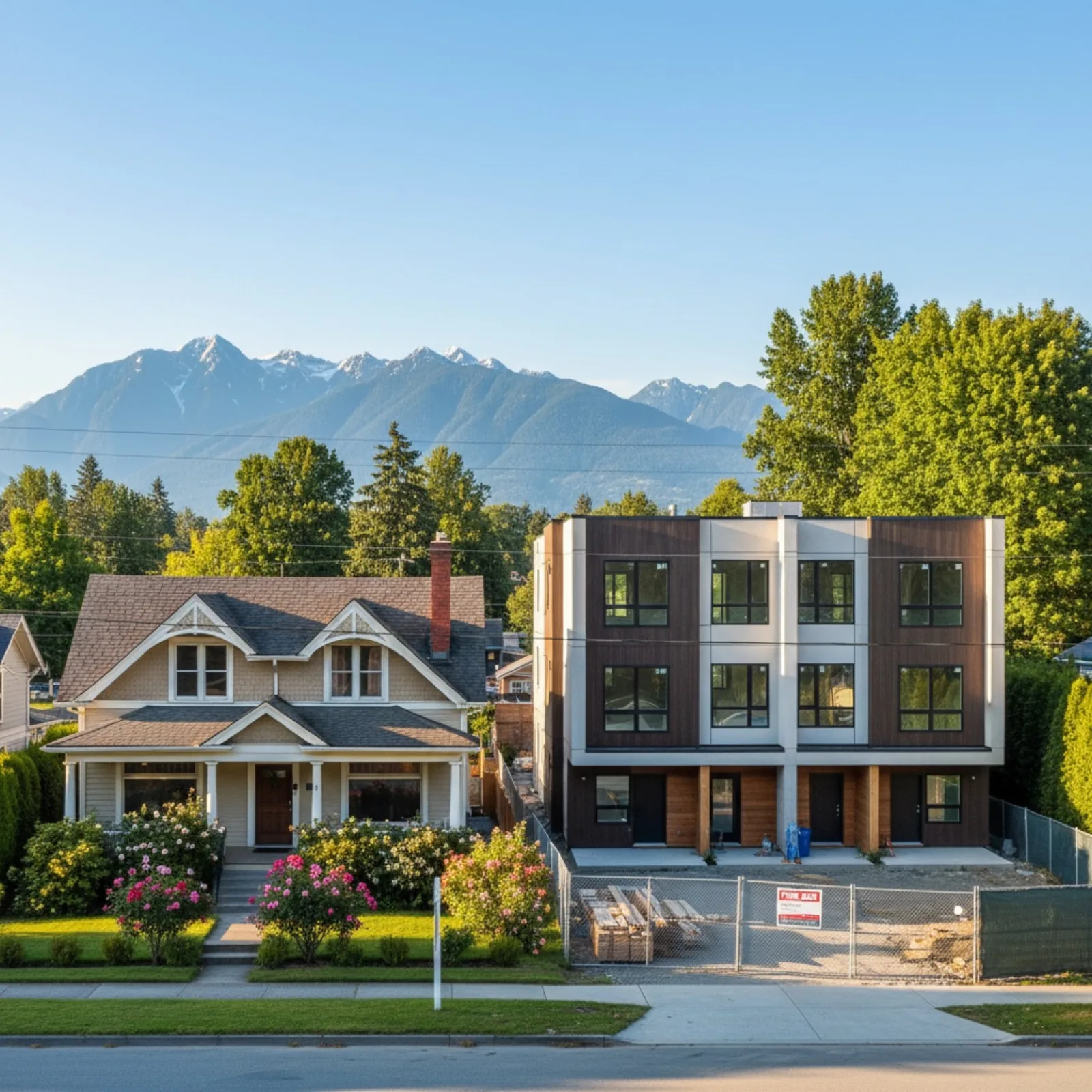

After 20 years selling Vancouver real estate at Rain City Properties, I’m sharing advice that might surprise you: if your home sits on a multiplex-eligible lot, selling to a builder could net you 10-20% more than listing on the open market. For a homeowner who wants to stay involved rather than simply sell, our development services explain how the co-development process works. In 2026, with Bill 44 fully implemented, multiplex builders are paying $200K-$500K premiums for the right properties. Here’s why—and how to know if yours qualifies.
TL;DR (Key Takeaways)
- Multiplex builders pay 10-20% premiums over market value for eligible lots
- They’re buying land value + development potential, not just your house
- Lots over 5,000 sqft in R1-1 zones are most valuable to builders
- Bill 44 allows 4-6 units, making your single lot worth multiple future homes
- The multiplex land rush is happening now—2026 is peak opportunity
Why Builders See Value Regular Buyers Miss
I had a listing last fall in Marpole. Nice 1960s rancher, original kitchen, decent bones but nothing special. We priced it at $2.4M based on recent comparables in the neighborhood.
A young couple came through. They loved the location but wanted $80K off because the roof needed work and the basement had moisture issues. Fair points. We were negotiating.
Then a builder called. He’d driven by, pulled the lot dimensions from BC Assessment, and ran his numbers. His offer: $2.75M, no conditions, 30-day close. The couple couldn’t compete.
What did the builder see that they didn’t? Not the house. The lot. At 6,100 square feet with lane access, he could build a sixplex under the new R1-1 zoning. Six units at $1.1M each is $6.6M in gross sales. Suddenly paying $350K over “market value” made perfect sense.
This scenario is playing out across Vancouver right now. Builders aren’t emotional buyers. They’re calculators with hard hats. And their math often works out better for you than a traditional sale.
The Fundamental Shift: Land Value vs. House Value
For decades, Vancouver real estate operated on a simple premise: you’re selling a home. Buyers evaluate the kitchen, the bathrooms, the layout, the curb appeal. They compare your place to the one down the street that sold last month.
Bill 44 changed that equation for certain properties.
If your lot qualifies for multiplex development, you’re no longer just selling a house. You’re selling development rights. And those rights have value that traditional buyers don’t factor in—because they’re not developers.
Think about it this way. A regular buyer looks at your 50-year-old split-level and sees renovation costs. A builder looks at the same property and sees the footprint for four townhomes. The house is irrelevant to them. They’re buying the land underneath it and the zoning that comes with it.
This is why two buyers can look at the exact same property and arrive at valuations $300K apart. They’re not buying the same thing.
What Builders Actually Calculate
I’ve worked with enough developers over the years to understand how they underwrite deals. It’s not mysterious—it’s just math most homeowners never see.
Here’s a simplified version of what goes through a builder’s head when they evaluate your property:
End Value Projection First, they estimate what the finished units will sell for. A fourplex in East Vancouver might yield four units at $1.0-1.2M each. That’s $4.0-4.8M in gross revenue.
Construction Costs Hard costs for a multiplex run $400-500 per square foot in Vancouver right now. A 4,000 square foot fourplex costs roughly $1.6-2.0M to build.
Soft Costs Permits, design, engineering, legal, financing—add another $200-300K.
Profit Margin Builders typically target 15-20% profit on the total project. On a $4.5M project, that’s $675K-900K.
Land Budget Work backwards from those numbers and you get what the builder can pay for the land while still hitting their margin. Often, that number is higher than what a traditional buyer would pay for your house.
| Factor | Regular Buyer | Multiplex Builder |
|---|---|---|
| What they’re buying | House + land | Land + development rights |
| Assessed value focus | Home condition | Lot potential |
| Typical offer | $2.5M (market) | $2.8-3.0M (10-20% premium) |
| Their end goal | Live in home | Build 4-6 units @ $1.2M each |
| Why they pay more | N/A | $4.8-7.2M end value justifies premium |
The premium isn’t charity. It’s rational economics. Builders can pay more because they’re extracting more value from the same dirt.
Why This Matters Right Now
Bill 44 passed in late 2023, but implementation took time. Municipalities needed to update bylaws. Builders needed to adjust their pipelines. Financing structures evolved.
We’re now in the sweet spot. The regulatory framework is in place, builders are actively acquiring sites, but most homeowners still don’t understand what their property is worth to a developer.
That information gap is your opportunity.
I’ve had clients who listed traditionally, sat on the market for 60 days, and eventually sold at asking to a regular buyer. Three months later, that buyer flipped the property to a developer for $200K more. My clients left that money on the table because they didn’t know to look for it.
The builders who are active right now — and there are dozens of them working across Vancouver — know exactly which lots work for multiplex development. Whether you want to sell or partner, understanding your options is critical for homeowners at this stage of the market. They have acquisition teams scanning listings, driving neighborhoods, and making calls. If your property fits their criteria, they’ll find you eventually. The question is whether you capture that value or the next owner does.
How to Know If Your Home Qualifies
Not every Vancouver property commands a builder premium. The zoning changes are broad, but the economics only work on certain lots.
Lot Size
This is the biggest factor. Under Vancouver’s R1-1 zoning, you can build:
- 4 units on lots under 6,000 sqft
- 6 units on lots 6,000 sqft and larger
Builders strongly prefer the 6-unit threshold. Two extra units dramatically improve project economics. If your lot is 5,800 sqft, you might get interest. If it’s 6,200 sqft, you’ll get attention.
Lot Dimensions
Width matters more than you’d think. A 50-foot-wide lot gives designers flexibility for unit layouts and parking. A 33-foot lot is buildable but constrains options. Anything under 30 feet gets difficult.
Depth matters for lane access. If you’ve got 120+ feet of depth with a lane at the back, parking becomes straightforward. No lane means front-loading cars, which eats into buildable area.
Location Factors
Builders care about where they can sell units, not just where they can build them. Properties near transit, schools, parks, and shopping command higher end prices. That flows back into what a builder can pay for land.
East Van, Marpole, Dunbar, Kerrisdale, Oakridge—these areas have strong demand for multiplex units because the neighborhoods are established and amenity-rich.
What Hurts Value
- Severe slopes (excavation costs kill margins)
- Heritage designation (development restrictions)
- Irregular lot shapes (inefficient layouts)
- Environmental issues (remediation costs)
- Locations without neighborhood amenities
The Process: What Selling to a Builder Looks Like
Some homeowners worry that selling to a developer is complicated or risky. In my experience, it’s often simpler than a traditional sale.
Timeline
Builders move fast when they’ve done their homework. Most offers I see from developers come with 30-45 day closing timelines. They’re not waiting on mortgage approvals or selling another property. They have capital ready to deploy.
Conditions
Sophisticated builders do their due diligence before making offers. They’ve already pulled the lot survey, checked zoning, and run preliminary numbers. Offers often come with minimal conditions—sometimes just a short inspection period for environmental review.
Negotiation
Builders negotiate differently than emotional buyers. They won’t lowball you over cosmetic issues. They also won’t overpay for sentimental reasons. Their offers reflect calculated land value. There’s usually less back-and-forth but less flexibility too.
Certainty
The biggest advantage of builder sales is closing certainty. Traditional deals fall through for financing, inspection issues, buyer cold feet. Builders have skin in the game and resources to close. In 20 years, I’ve had exactly two developer deals collapse—both due to environmental contamination discovered during due diligence.
A Real Example
Last year I represented a family in Renfrew-Collingwood. Parents in their 70s, kids grown, house was too big for them. Standard Vancouver story.
The house was a 1978 two-story, about 2,200 sqft on a 5,400 sqft lot with lane access. Updated in the early 2000s but showing its age. Market comparables suggested $1.9-2.1M.
We listed at $2.05M. Got some showings, a few lowball offers citing the kitchen and windows. After three weeks, we had one serious buyer at $1.95M.
Before accepting, I reached out to three builders I’d worked with before. Two passed—the lot was slightly under their threshold. The third came back with $2.15M, firm, 35-day close.
The family netted an extra $200K compared to the traditional offer. The builder is now developing a fourplex that’ll be worth $4.4M when complete. Both sides won.
Why I’m Telling You This
People sometimes ask why a realtor would encourage selling to builders. Don’t we make more money on traditional sales with longer timelines?
Honestly, no. My job is to maximize value for my clients. If that means connecting them with a builder who’ll pay more than the market, that’s what I do. The commission structure is the same either way.
What I’ve learned in 20 years is that the best outcomes happen when sellers understand all their options. Most people don’t know builder sales exist as a path. They list traditionally because that’s what everyone does.
But “what everyone does” isn’t always what’s best for your specific situation. If you’re sitting on a multiplex-eligible lot, you have leverage most sellers don’t. Use it.
Your Next Steps
-
Check eligibility: Visit My Multiplex Tool to see if your lot qualifies for multiplex development
-
Understand your value: Get a sense of what builders might pay versus traditional buyers
-
Make an informed decision: Whether you sell to a builder or not, know what you’re choosing
The multiplex land rush is real. Builders are actively acquiring sites across Vancouver. If your property fits the profile, you have options that didn’t exist five years ago. For investors buying at the land level and holding the completed building, our investment overview walks through the economics.
As a third-generation Vancouverite who’s spent nearly two decades in this market, I’ve learned that the best deals happen when sellers understand what buyers actually want. In 2026, multiplex builders want your land—and they’ll pay for it.
Greyden Douglas is a licensed realtor (PREC) with Rain City Properties, serving Vancouver homeowners for 18+ years. Contact him for personalized advice on maximizing your property’s value.