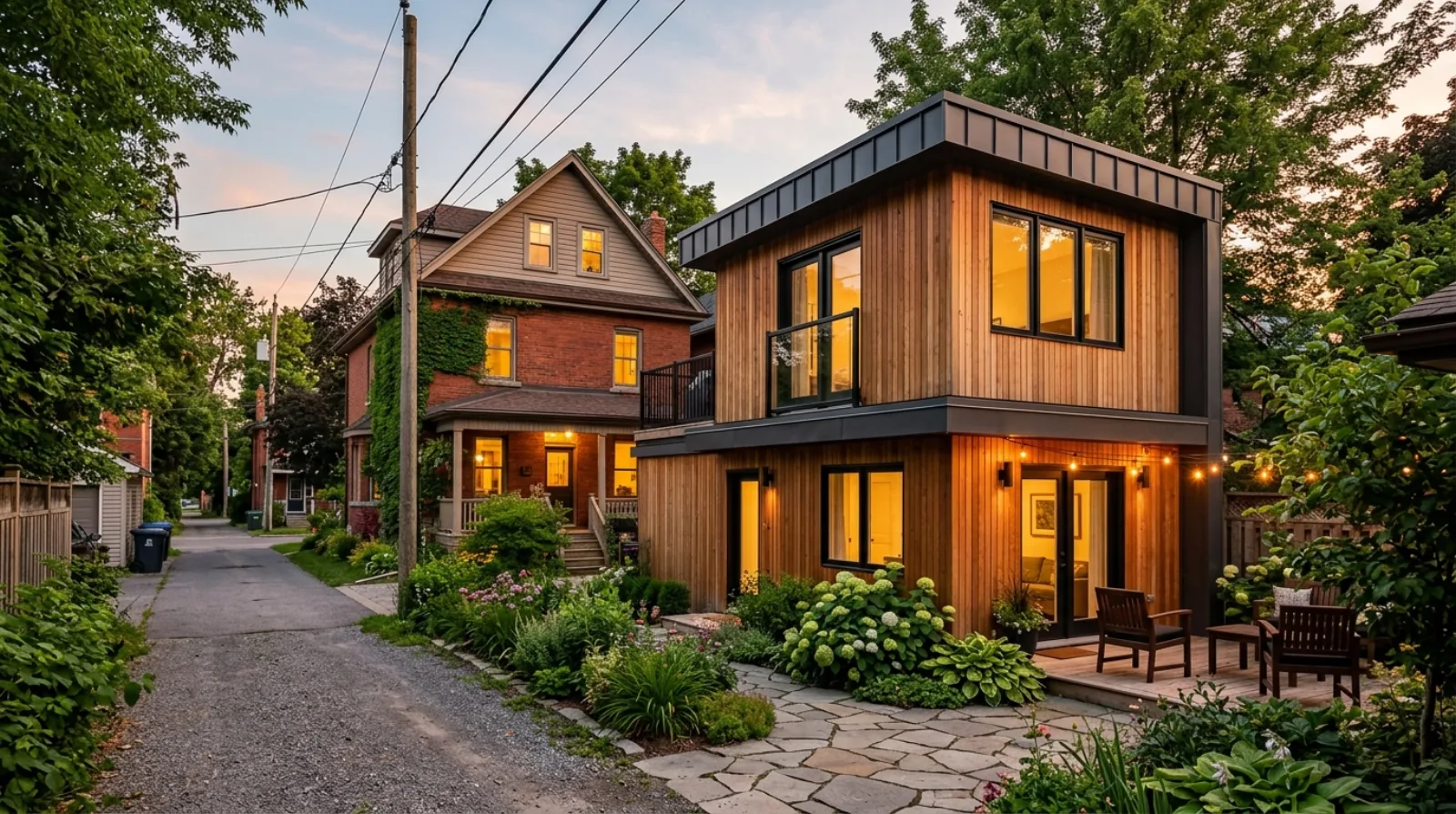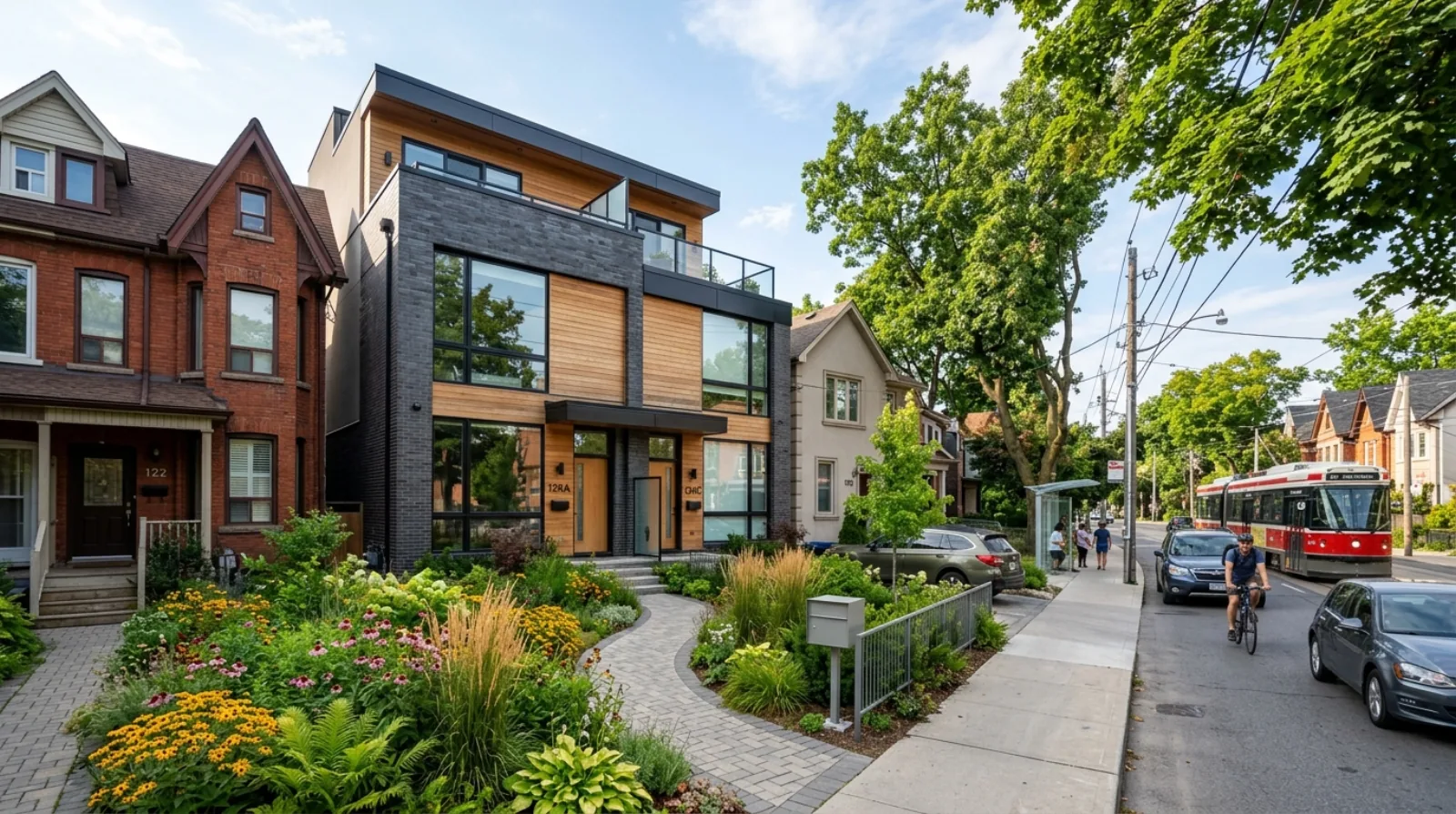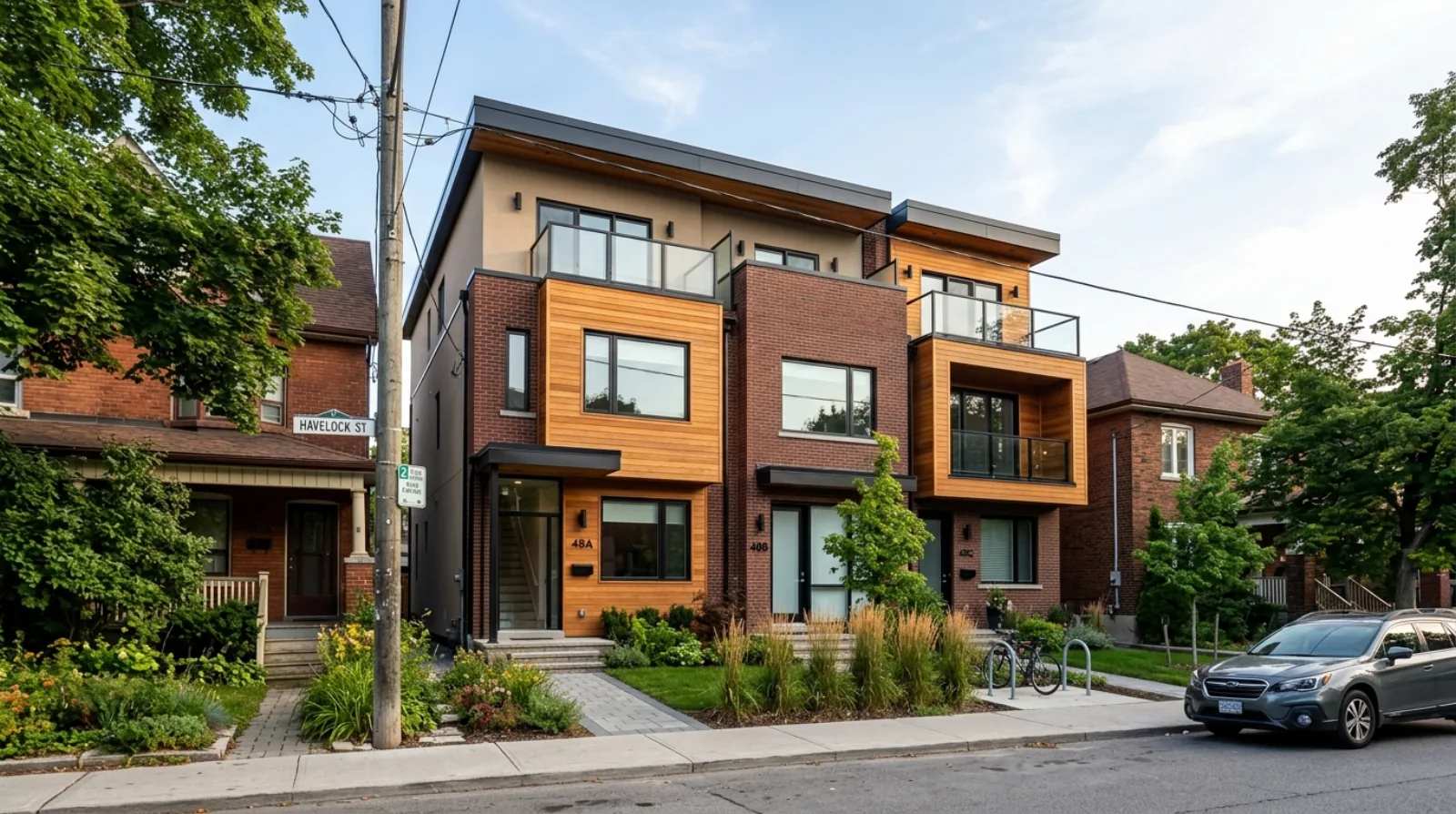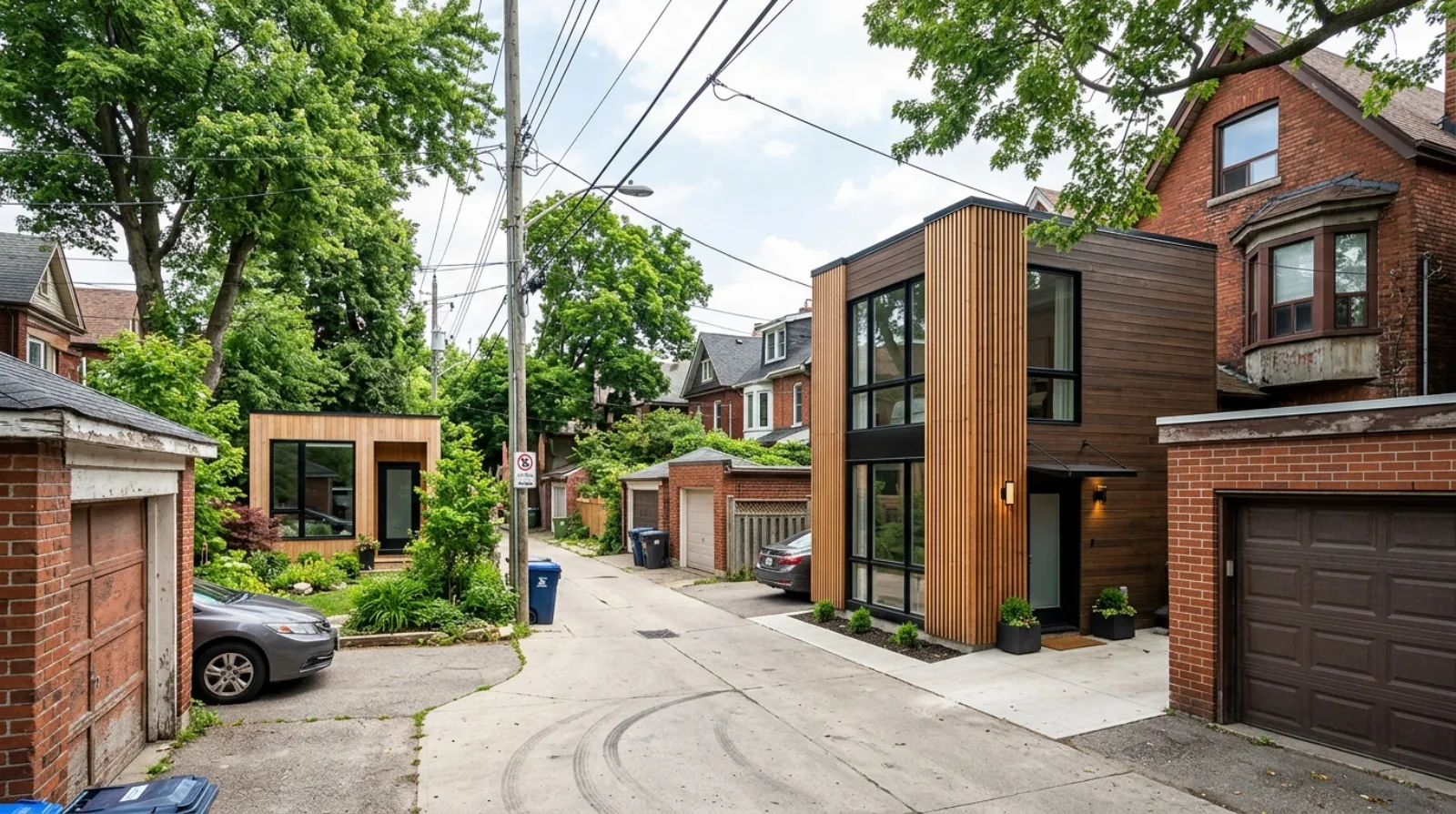

Both add a detached rental unit in your backyard. Both are as-of-right across Toronto. But a laneway suite and a garden suite are not interchangeable — one needs a public lane and the other can’t use it. The lane is the whole distinction. Here’s how to tell which one your lot can actually have.
TL;DR
- A laneway suite requires your lot to abut a public laneway — city-wide as-of-right since July 16, 2019.
- A garden suite sits in the rear yard with no lane — city-wide as-of-right since February 2, 2022.
- The deciding question is simple: does a public lane run behind or beside your lot? Lane = laneway suite. No lane = garden suite.
- Both are detached, subordinate, self-contained units, permitted in the R, RD, RS, RT and RM zones under By-law 569-2013.
- In Etobicoke, garden suites carry a 30 m minimum lot-depth nuance — worth checking before you plan one.
- Either one stacks on top of a fourplex, adding a unit beyond the main building.
The one distinction that matters
Forget everything else for a second. The difference between these two permissions is lane access. A laneway suite is, by definition, a unit on a lot that abuts a public laneway — it faces and is serviced off that lane. A garden suite exists because most lots don’t have a lane: it’s the version of the same idea for a rear yard with no laneway behind it. The City created garden suites in 2022 specifically to extend backyard housing to the roughly two-thirds of Toronto lots that laneway suites couldn’t reach.
So before you compare setbacks or sizes, walk to the back of your lot. If there’s a public lane, you’re in laneway-suite territory. If there isn’t, garden suite is your path. You don’t choose between them — your lot does.
Laneway suites: the original (2019)
Toronto adopted laneway suites city-wide on July 16, 2019, amending By-law 569-2013 to permit them in the R, RD, RS, RT and RM zones. The City’s Changing Lanes page is the source. A laneway suite is a self-contained unit in a separate building, subordinate to the main house, on a lot abutting a public lane. It’s served from the lane side — which is exactly why old-Toronto neighbourhoods with their dense laneway grids took to them first. The Annex, Leslieville, the Junction, Trinity-Bellwoods: narrow deep lots backing onto a lane are the natural home for this form.
Garden suites: the wider net (2022)
Garden suites came three years later, adopted February 2, 2022 (in force later that year), city-wide, same zones. Per the City’s garden suites page, a garden suite is an ancillary detached building, usually in the rear yard, not on a lane. Functionally it’s the same product — a small backyard rental — but it unlocks every lot without a lane, which is most of the postwar suburbs: Willowdale, Scarborough, the wide lots of North York and Etobicoke where there’s room behind the house but no laneway to build off.
Both permissions got 2025 housekeeping updates (Laneway By-law 847-2025 and Garden Suite By-law 849-2025, adopted July 24, 2025) aligning them with provincial O. Reg. 462/24.
The Etobicoke lot-depth nuance
One real gotcha. In Etobicoke, garden suites carry a 30-metre minimum lot-depth consideration that doesn’t apply the same way across the rest of the city. Etobicoke’s lots are often wide and deep — but if yours is shallow, the depth rule can knock a garden suite out before you start. If you’re in the old Etobicoke municipality (Mimico, New Toronto, Long Branch, Islington), confirm your lot depth against the current rule before you design anything.
How each one stacks with a multiplex
This is where it gets useful. A laneway or garden suite is a separate permission from the multiplex by-law — it doesn’t count against your fourplex’s four units. So a standard lot can run a four-unit main building plus one backyard suite, reaching five homes without a rezoning or a hearing. If you’re in one of the nine sixplex wards, the main building can hold six, and a backyard suite stacks on that too where the lot supports one. The backyard unit is the cheapest incremental door on most lots — you’re already on the property, and there’s no shared structure.
What a lot needs for each
For a laneway suite: a lot that abuts a public laneway, enough rear-yard depth and the required separation between the suite and the main house, and lane access usable for emergency services. For a garden suite: rear-yard space, the required setbacks and separation, and — in Etobicoke — sufficient lot depth. Both are detached, both must stay subordinate to the main house, and both follow the angular-plane and setback rules in By-law 569-2013 for your zone. Check the specifics against is your lot eligible before committing to a design.
The honest version
The choice between a laneway and a garden suite isn’t really a choice — it’s a fact about your lot. Lane behind you, laneway suite. No lane, garden suite. Once you know which, the rest is the same exercise: fit a small subordinate building in the rear yard, keep it as-of-right, and treat it as a fifth (or seventh) unit stacked on your multiplex. Confirm lot depth in Etobicoke, and price development charges before you build.
Start with the Toronto Multiplex hub, or check whether a lane runs behind your lot.