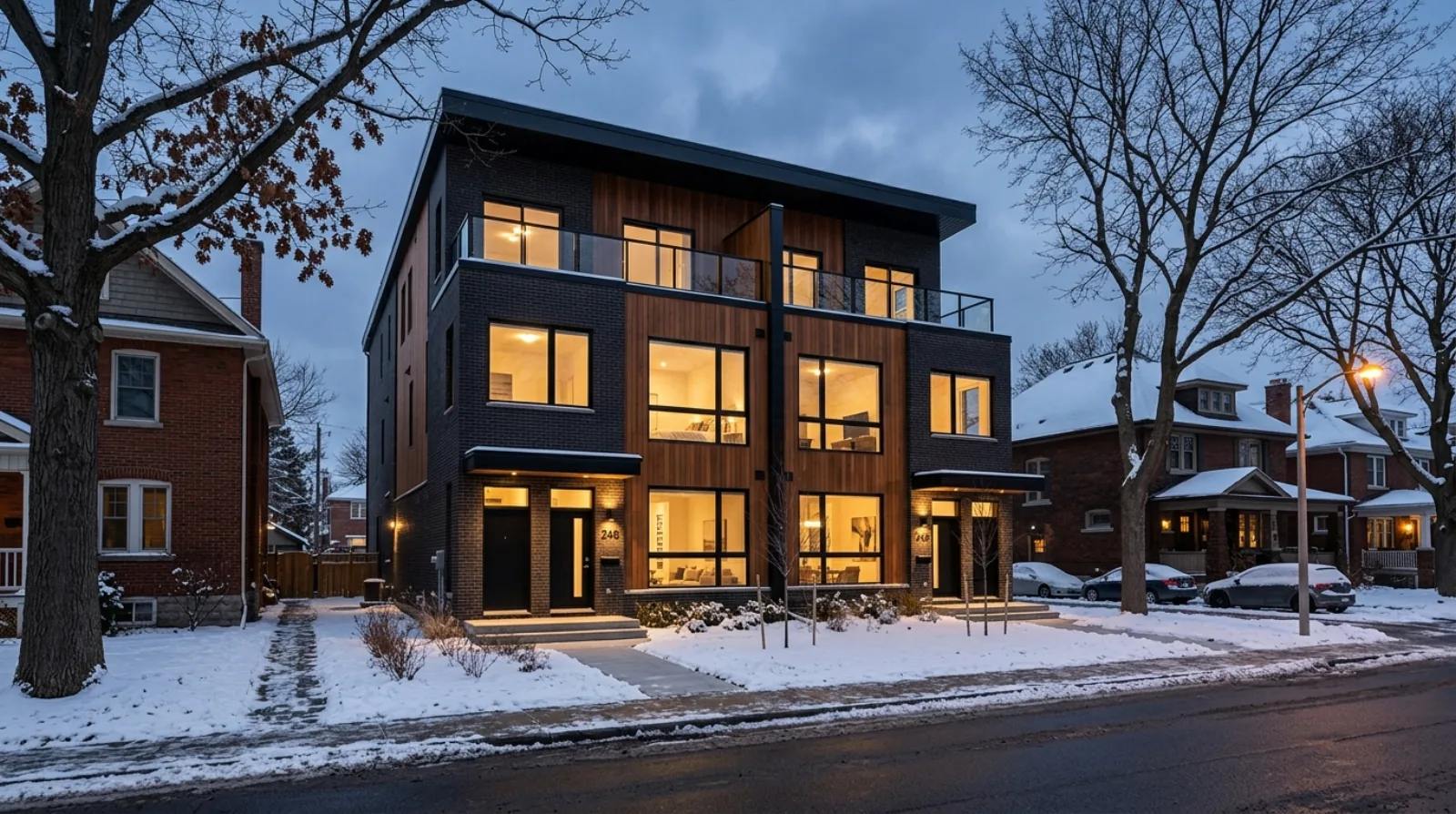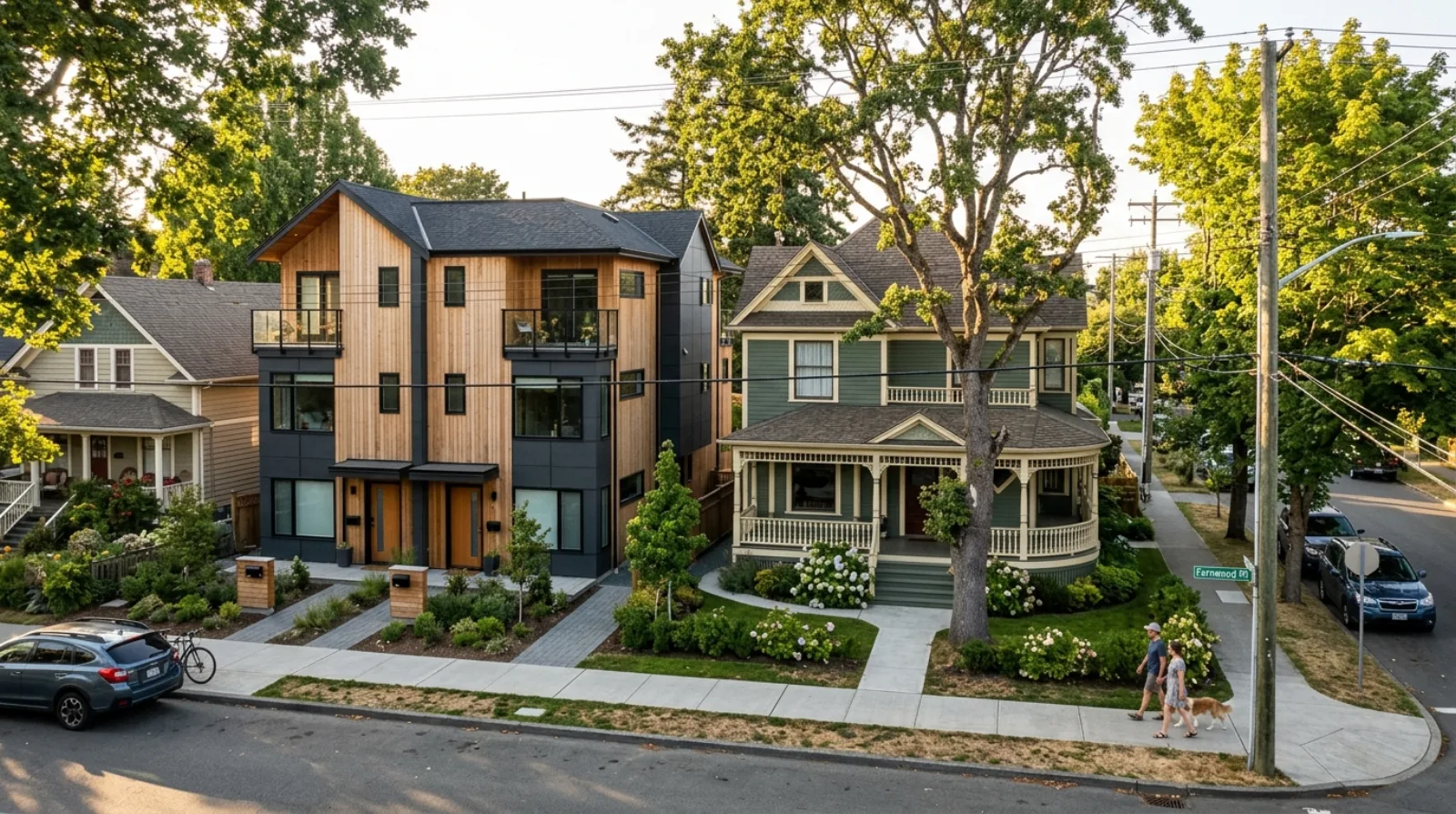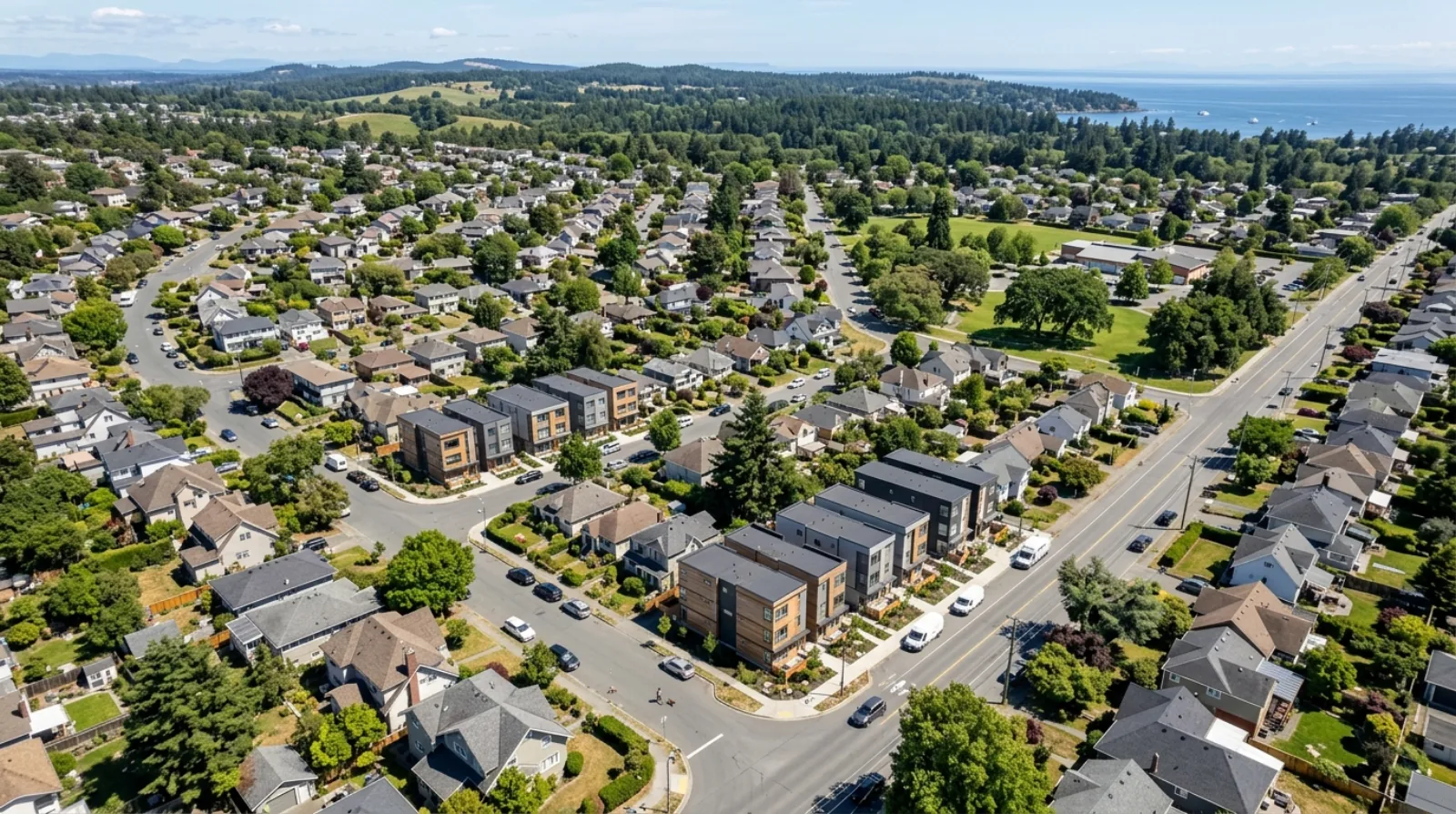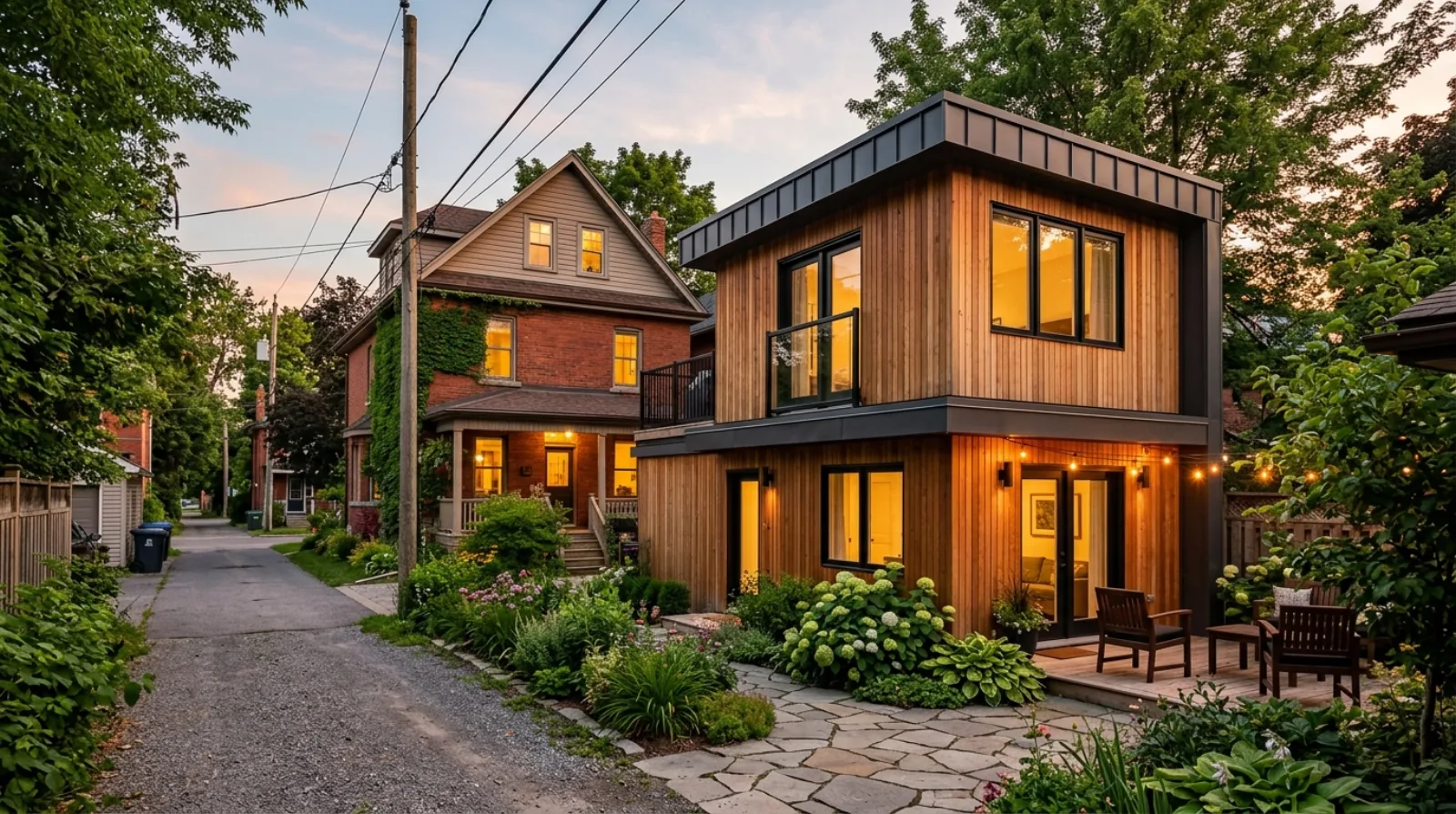

Not every Ottawa homeowner who wants to add density wants to tear down their house and build a fourplex. Some just want one more unit in the back yard. A garden suite — a small detached home behind the main house, sometimes called a coach house or laneway home — is the quietest way into the missing middle. And under Ontario’s rules, it’s also the unit that often gets a homeowner to the three-unit floor without touching the front of the lot.
TL;DR
- Ontario’s Bill 23 lets most serviced residential lots have up to 3 units as-of-right. One common path: 2 units in the main building plus 1 ancillary unit, such as a garden suite or coach house.
- Ottawa’s new zoning by-law goes further — up to 4 units as-of-right on a serviced lot — so a rear garden suite fits inside a wider four-units-as-of-right framework.
- A garden suite needs a rear yard, access to it, and servicing from the main home’s municipal water and sewer connection. The City of Ottawa states a lot can have up to two additional dwelling units total on full municipal services.
- Size and height are tied to your lot and the principal dwelling. Setback numbers vary by zone — confirm yours on the City’s tools before you draw anything.
- A garden suite is the missing-middle option for a homeowner who wants one more unit, not a full rebuild.
What Bill 23 actually requires
Ontario’s More Homes Built Faster Act, 2022 — Bill 23 — forced every municipality to allow up to three residential units on most serviced residential lots without a zoning amendment. The province set a floor. Cities cannot drop below it.
There are a few ways to hit three units. The one most relevant here: two units in the main building plus one ancillary unit. The ancillary unit can be a garden suite, a coach house, or a laneway home in the rear yard. That’s the structure Bill 23 explicitly contemplates.
“As-of-right” only covers the use. You’re entitled to the units. You still have to meet local rules on setbacks, height, lot coverage, and servicing. The municipality can’t refuse you on use grounds alone, but it absolutely enforces the dimensional standards. That distinction trips up a lot of homeowners.
How Ottawa builds on the floor
Ottawa’s new zoning by-law (Zoning By-law 2026-50, enacted March 11, 2026) raised the ceiling. On a serviced lot, the city now allows up to four units as-of-right, organized into size-based N1 through N4 zones. Parking minimums were removed city-wide.
For a garden suite, that matters in a practical way. You’re not squeezing your rear unit into a three-unit cap. You have more room to plan. A garden suite plus a main house with a secondary suite is well inside four units. If you later want to convert the basement or add a second unit upstairs, the zoning allowance is there.
The City of Ottawa’s own guidance is specific on one point: a lot with a principal dwelling may have up to two additional dwelling units total. On full municipal water and wastewater, you can have two additional units combined. On private services, the limit is one. That’s the rule that governs whether your back-yard garden suite is even on the table.
You can read more about the new framework and how a rear unit fits the city’s overall direction on our Bill 23 and garden suites and laneway homes pages.
What your lot actually needs
A garden suite is a real building. It needs three things, and if any one is missing, the project stalls.
A rear yard with room. The suite sits behind the main house. Maximum unit size and height are tied to your lot size and the size of your principal dwelling — the City sets these in its zoning provisions for additional dwelling units. The bigger the lot and the larger the main house, the more room you get for the rear unit. Don’t assume a number. Confirm what your specific lot allows.
Access to the back. Someone has to be able to reach the suite — for residents, for emergency services, for moving in. On lots without a rear lane, that usually means a side-yard path or a shared walkway. Lots that genuinely can’t provide access are the ones where a garden suite doesn’t work, even when the zoning would otherwise allow it.
Servicing. In urban Ottawa, a coach house or garden suite must take its water and sewer from the primary home’s municipal connection. That’s the city’s stated requirement. Running that servicing to the back of the lot — the trenching, the connection work — is a real line item in the budget. Get a read on it early.
On parking: Ottawa removed minimums, so no additional space is required for the unit. Where you do add a space, it can’t go in the front yard, and tandem parking in the existing driveway is allowed.
The setback question — and why we won’t give you a number
This is where homeowners want a clean answer and where giving one would be irresponsible. Rear-yard and side-yard setbacks for additional dwelling units vary by zone, lot configuration, and whether your lot fronts a lane. The numbers that float around in contractor blog posts are general ranges, not your lot’s rule.
The right move is to pull your own parcel. Search your address on geoOttawa and turn on the zoning layer to see your zone and lot dimensions. Then read the matching provisions in the city’s zoning materials. If the setbacks, size cap, or servicing path don’t work, you want to know that before you pay for drawings — not after.
Why a garden suite, not a fourplex
A garden suite is the missing-middle option for the homeowner who isn’t ready for a full multiplex. You keep your house. You keep living in it during construction in most cases. You add one rental unit, or a place for an aging parent or an adult kid, without the cost and disruption of a teardown.
It’s a smaller swing. The construction is smaller, the financing is smaller, and the change to the front of your property is close to nothing. For a lot of people, that’s the whole appeal. The street still looks the same. The back yard does the work.
It’s also a step you can take now and build on later. Add the garden suite this year. Convert the basement to a second unit when it makes sense. Ottawa’s four-unit allowance leaves that door open.
The honest part
A garden suite is not free money, and it’s not simple. Servicing to the rear of a lot can cost more than people expect. Access constraints kill more of these projects than zoning does. The size your lot supports might be smaller than you’d hoped once the cap tied to your principal dwelling kicks in. And every specific number — setback, height, maximum floor area — has to be confirmed against your parcel and the current by-law, not a blog post, ours included.
What’s genuinely changed is the permission. The use is now as-of-right on most serviced Ottawa lots. That removes the slowest, least predictable part of the old process — the rezoning fight. What’s left is the engineering and the budget, which are at least knowable up front.
If you want to know whether your lot can actually carry a rear unit, start with the parcel data and a hard look at access and servicing. Run the numbers before you fall in love with a floor plan. That’s the same discipline we apply on every feasibility review.
For the full picture on Ottawa’s rules and how the pieces fit, start at our hub: Missing Middle Housing in Ottawa.
Sources
- Legislative Assembly of Ontario, Bill 23, More Homes Built Faster Act, 2022.
- Government of Ontario, More Homes Built Faster Act, 2022 overview.
- City of Ottawa, “Adding a coach house (additional dwelling units in an accessory structure)” — servicing, additional-unit limits, and parking rules.
- City of Ottawa zoning engagement, engage.ottawa.ca/zoning; parcel and zoning lookup at geoOttawa.
David Babakaiff is Co-Founder of VanPlex. PlexRank™ | Profit with Multiplex.