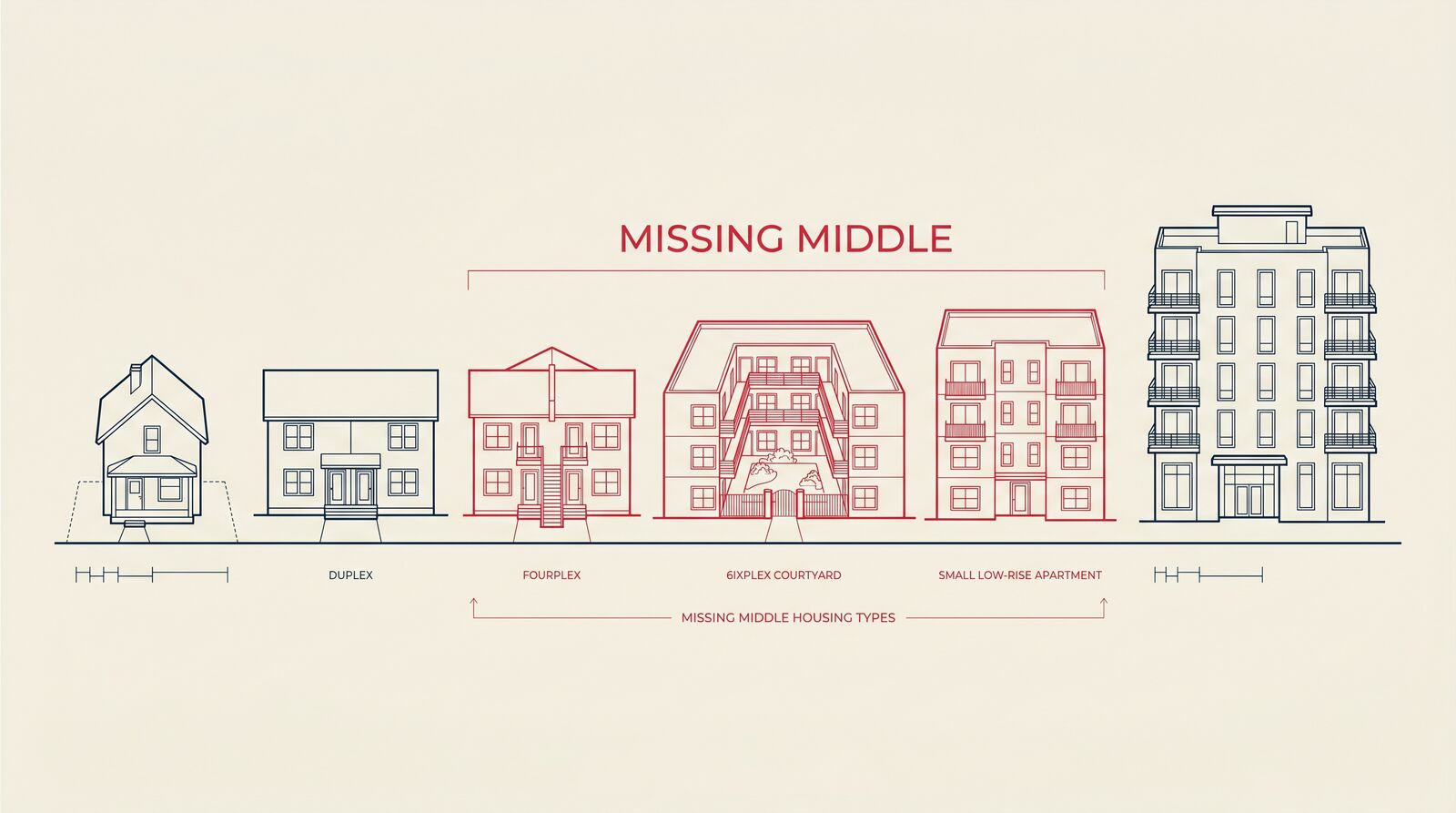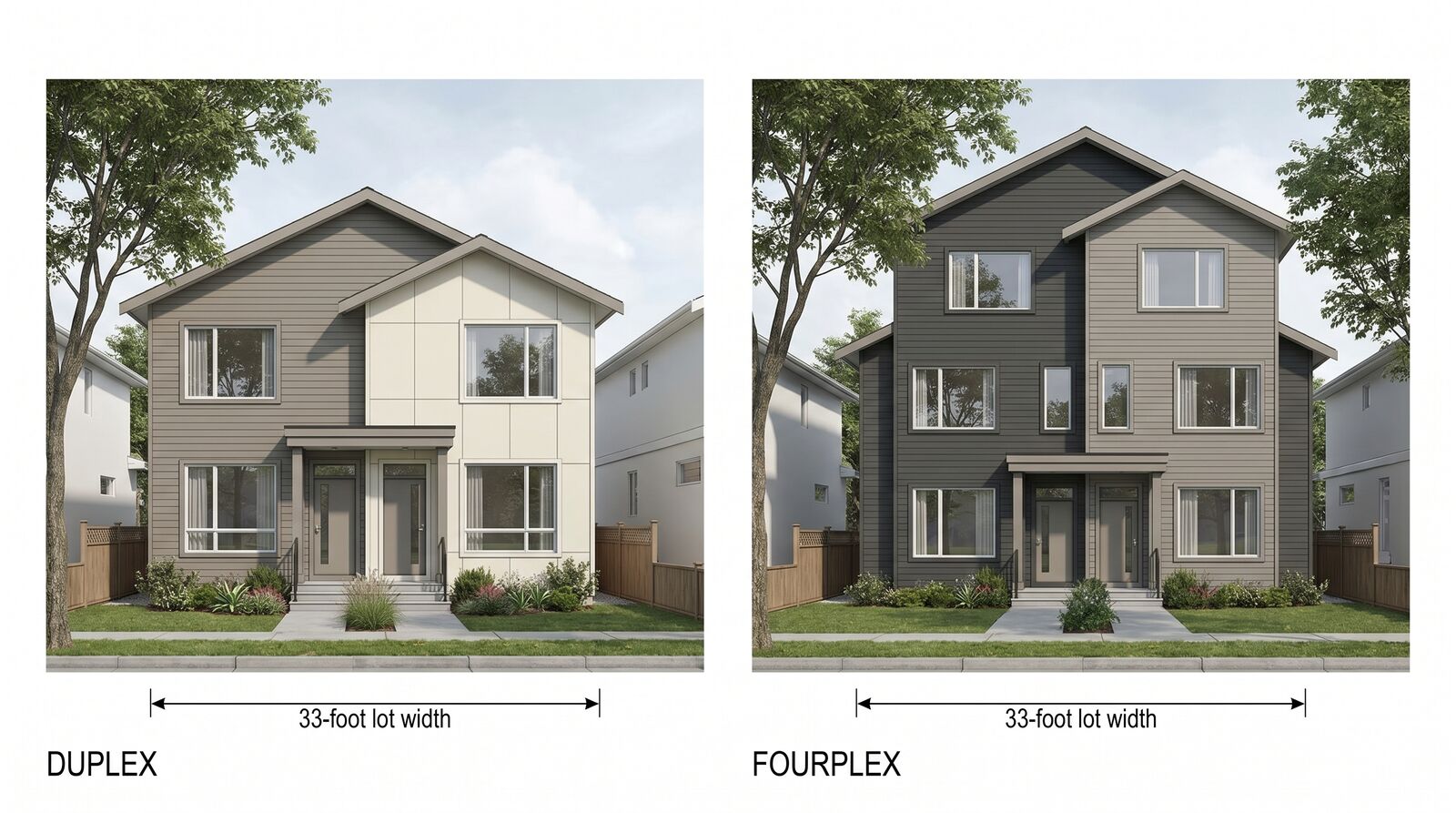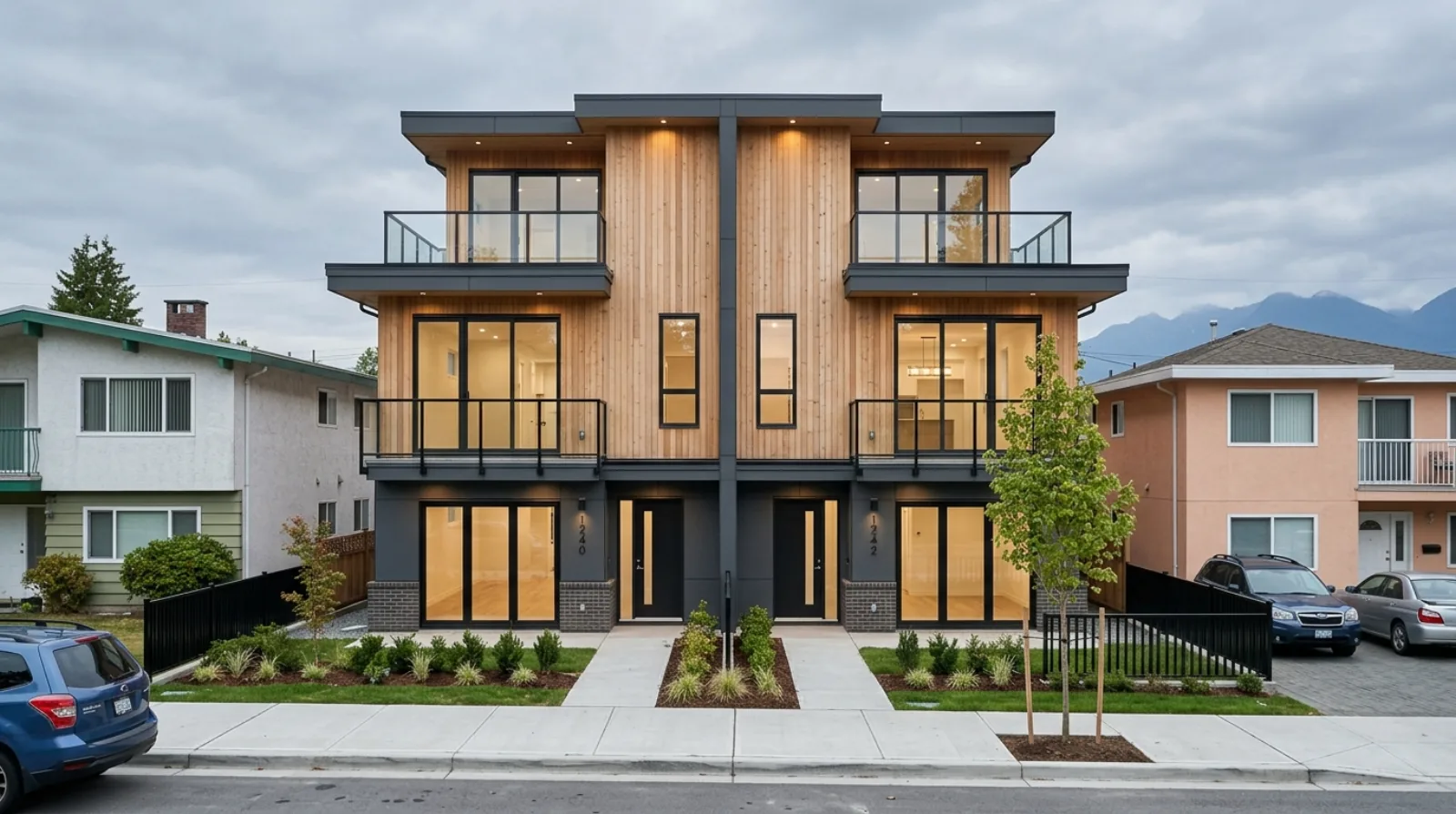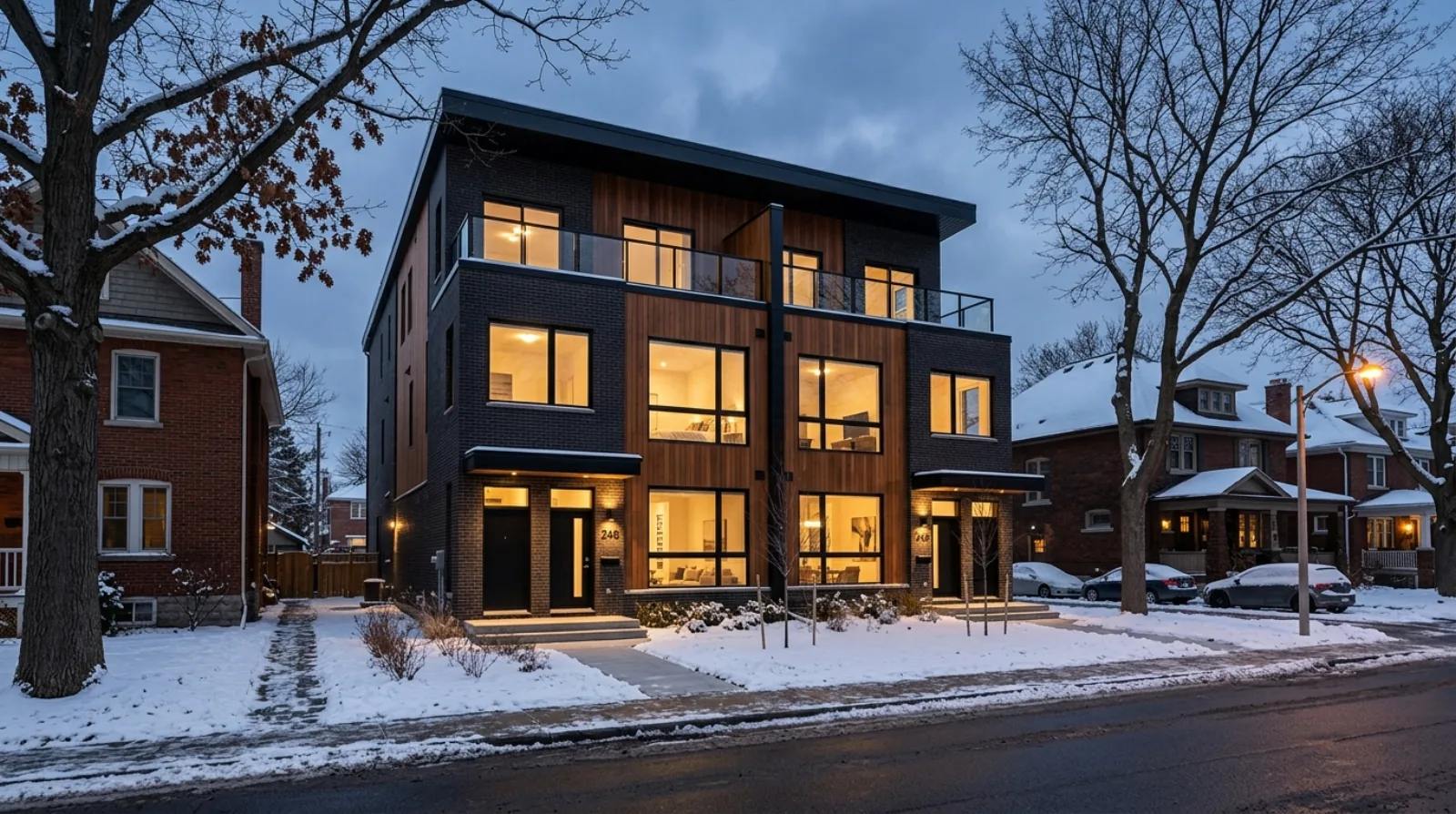

Can you build a fourplex in Ottawa? In most residential neighbourhoods, yes. As of 2026, Ottawa lets you put up to four dwelling units on a serviced residential lot without applying for a rezoning. That last part is what “as-of-right” means, and it is the difference between a project you can start planning today and one that sits in front of a committee for a year.
This is a practical explainer for an Ottawa homeowner or small investor thinking about a multiplex. What the rules actually say, what conditions you have to meet, and what to check before you assume four units fit your lot.
TL;DR
- Ottawa permits up to 4 dwelling units as-of-right on a serviced residential lot under Ottawa Zoning By-law 2026-50, approved by Council on January 28, 2026 and enacted March 11, 2026.
- “As-of-right” means no rezoning hearing. If your project fits the rules, you go straight to building permit. It does not mean no rules.
- The old building-type R-zones are gone. The city now uses size-based Neighbourhood zones N1 through N4. Per-building unit caps run roughly 4 in N1, 6 in N2, 10 in N3, and mid-rise in N4.
- Ottawa’s four-unit floor sits above Ontario’s province-wide minimum of 3 units from Bill 23.
- Parking minimums were removed city-wide. Confirm your parcel’s zone and the building envelope on geoOttawa before you assume four units fit.
What “as-of-right” actually means
As-of-right means the use is already permitted by the zoning that applies to your lot. You do not ask Council or a committee for permission to do it. You apply for a building permit, the city checks your plans against the rules, and if the plans comply, they approve.
The contrast is a rezoning or a minor variance. Those are discretionary. You apply, staff review, neighbours comment, a committee decides, and the answer can be no. That adds months and real cost, and the outcome is never guaranteed.
So when Ottawa says four units are permitted as-of-right, the value is certainty and speed. You still follow the building code, the setbacks, and the height limits. As-of-right removes the political risk, not the technical work. For the fourplex specifically, that shift is the whole story. A fourplex used to need a rezoning in most Ottawa neighbourhoods. Now it does not.
What changed in 2026
Ottawa rewrote its zoning from the ground up. Council approved the new Ottawa Zoning By-law 2026-50 on January 28, 2026, and it was enacted on March 11, 2026 (City of Ottawa). The city called it the most housing-friendly zoning by-law in its history (Council approval).
Two changes matter most for a small builder.
First, the old R-zones are gone. Ottawa used to zone by building type, which meant a lot zoned for a detached house could not hold a fourplex without a rezoning. The new by-law replaced those with size-based Neighbourhood zones, N1 through N4. The zone now describes how big a building can be, not what type it has to be. That is the mechanism behind four units as-of-right: a single rule that applies broadly across residential land instead of a patchwork of type-specific zones.
Second, parking minimums were removed city-wide. The city no longer forces you to build a set number of parking spaces per unit. You can still build parking. You are no longer required to, which on a tight infill lot can be the difference between four units fitting and not.
The Neighbourhood zones, roughly
The four units as-of-right is a baseline, not a ceiling. The N-zones scale up from there. The rough per-building unit caps look like this:
- N1 — up to about 4 units. The smallest-scale residential zone.
- N2 — up to about 6 units.
- N3 — up to about 10 units.
- N4 — mid-rise.
If your lot is N1, four units is your realistic target. If it is N2 or higher, you may have room for more, which changes the math on whether a fourplex is even the right move. This is exactly the kind of thing to confirm before you design anything, because the zone sets the outer bound on what the lot can hold.
How Ottawa compares to the rest of Ontario
Ontario set a province-wide floor in 2022. The More Homes Built Faster Act, better known as Bill 23, requires municipalities to permit at least three units as-of-right on most residential lots. Three is the provincial minimum. Every municipality in Ontario has to allow at least that.
Ottawa went past it. Four units as-of-right is one more than the province requires. The gap matters because three units and four units are different buildings. A fourth unit can change how the project pencils, and it gives you flexibility, for example a multiplex with three rentals and one owner-occupied unit, or two-and-two.
So the layered answer is: Bill 23 guarantees you three units anywhere in Ontario. Ottawa’s by-law gives you a fourth on top of that, as long as your lot meets the conditions.
The conditions you have to meet
Four units as-of-right is not automatic on every lot. Three conditions decide it.
The lot has to be serviced. The four-unit permission applies to serviced residential lots, meaning municipal water and sewer. A rural lot on a well and septic is a different situation, and you should not assume the same rule applies.
The lot has to be in a Neighbourhood zone. The four-unit baseline lives in the N-zones. If your parcel sits in a different zone category, the rules are different. Confirm the actual zone, do not guess from the neighbourhood.
The building has to fit the envelope. This is where most projects get tested. The zone permits four units, but the building still has to fit inside the lot’s setbacks, height limit, lot coverage, and floor space rules. A small lot can be zoned for four units and still not physically hold a four-unit building that meets every setback. As-of-right means the units are allowed. It does not promise they fit.
There is one more thing worth knowing. By-law 2026-50 is under appeal at the Ontario Land Tribunal. During the appeal period, both the new by-law and the older 2008 by-law can apply, with the more restrictive provision governing in some cases (City of Ottawa). For a specific parcel, this is a reason to confirm the current rules with the city rather than rely on a summary.
What to check before you assume four units fit
Before you commit money to a multiplex plan, do this:
- Look up your parcel on geoOttawa. Find your exact zone (N1, N2, etc.) on the city’s mapping tool (geoOttawa). The zone is the starting point for everything.
- Confirm servicing. Verify municipal water and sewer reach the lot.
- Read the envelope rules for your zone. Setbacks, height, lot coverage, and floor space. These decide whether four units physically fit.
- Check the appeal status. Because the by-law is under appeal, confirm with the city which provisions currently apply to your parcel.
- Run the numbers before the design. A lot can permit four units and still not support a fourplex financially once you account for land, construction, and the local rent picture.
That last point is its own piece of work. Zoning tells you what you are allowed to build. It does not tell you whether you should. Land cost, construction cost, and local rents decide that, and they vary lot by lot. Our feasibility approach is built to answer that second question once you have confirmed the zoning answers the first.
The honest version
Yes, you can build a fourplex in Ottawa as-of-right in most residential neighbourhoods, on a serviced N-zone lot, if the building fits the envelope. That is a real change and a good one for small builders. It removes the rezoning gamble that used to kill most of these projects before they started.
But “as-of-right” is not “no homework.” You still have to confirm the zone, confirm servicing, fit the envelope, watch the appeal status, and run the economics. Plenty of lots will clear the zoning bar and fail the math bar. The point is that the zoning is no longer the wall it used to be.
If you want the full picture of what the new rules unlock across the city, start with the hub: Missing Middle Housing in Ottawa.
Sources
- City of Ottawa, New Zoning By-law (Engage Ottawa): https://engage.ottawa.ca/zoning
- City of Ottawa, “Council approves landmark new Zoning By-law”: https://ottawa.ca/en/city-hall/city-news/newsroom/council-approves-landmark-new-zoning-law-enable-housing-and-economic-development
- Legislative Assembly of Ontario, Bill 23, More Homes Built Faster Act, 2022: https://www.ola.org/en/legislative-business/bills/parliament-43/session-1/bill-23
- geoOttawa parcel and zoning map: https://maps.ottawa.ca/geoottawa/