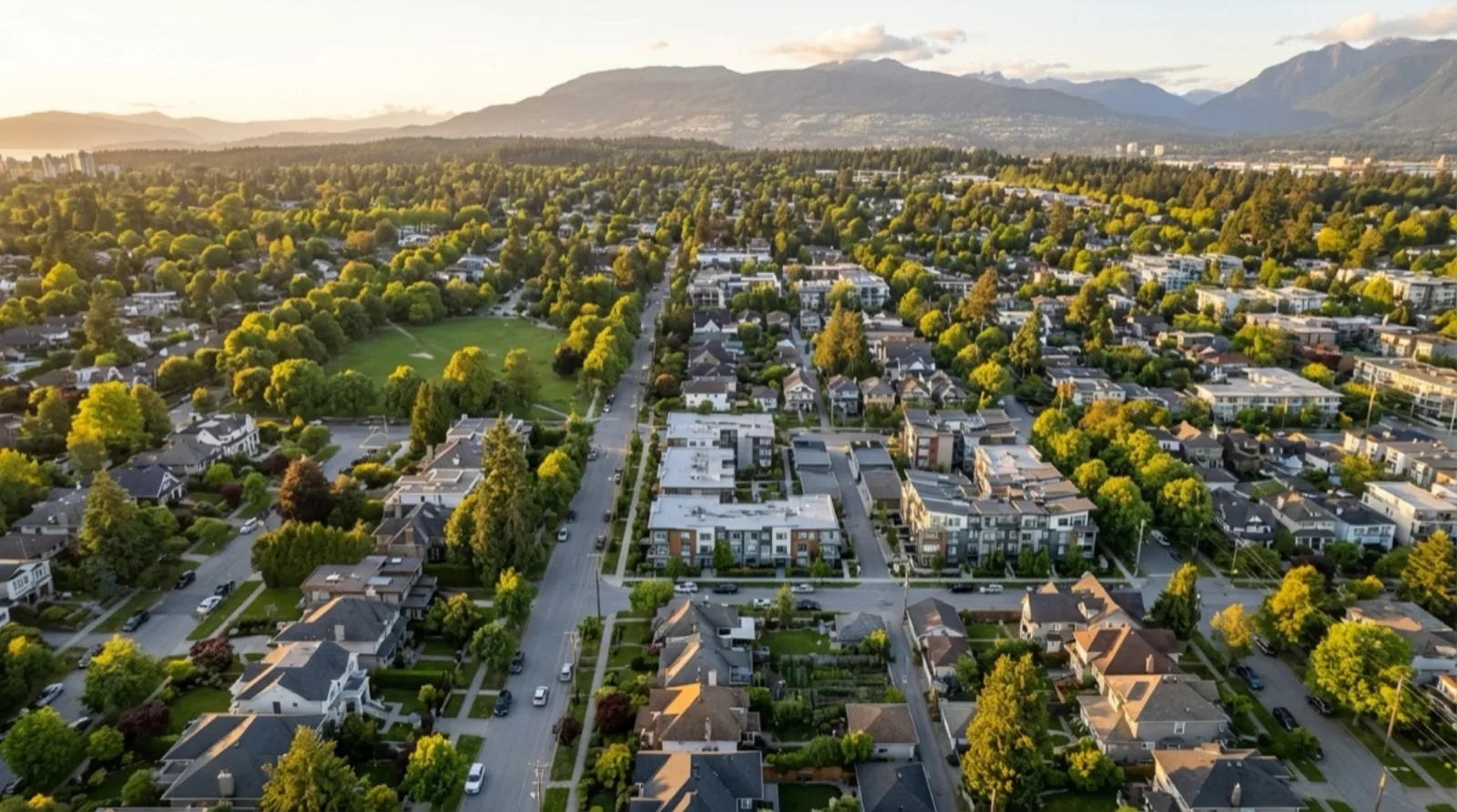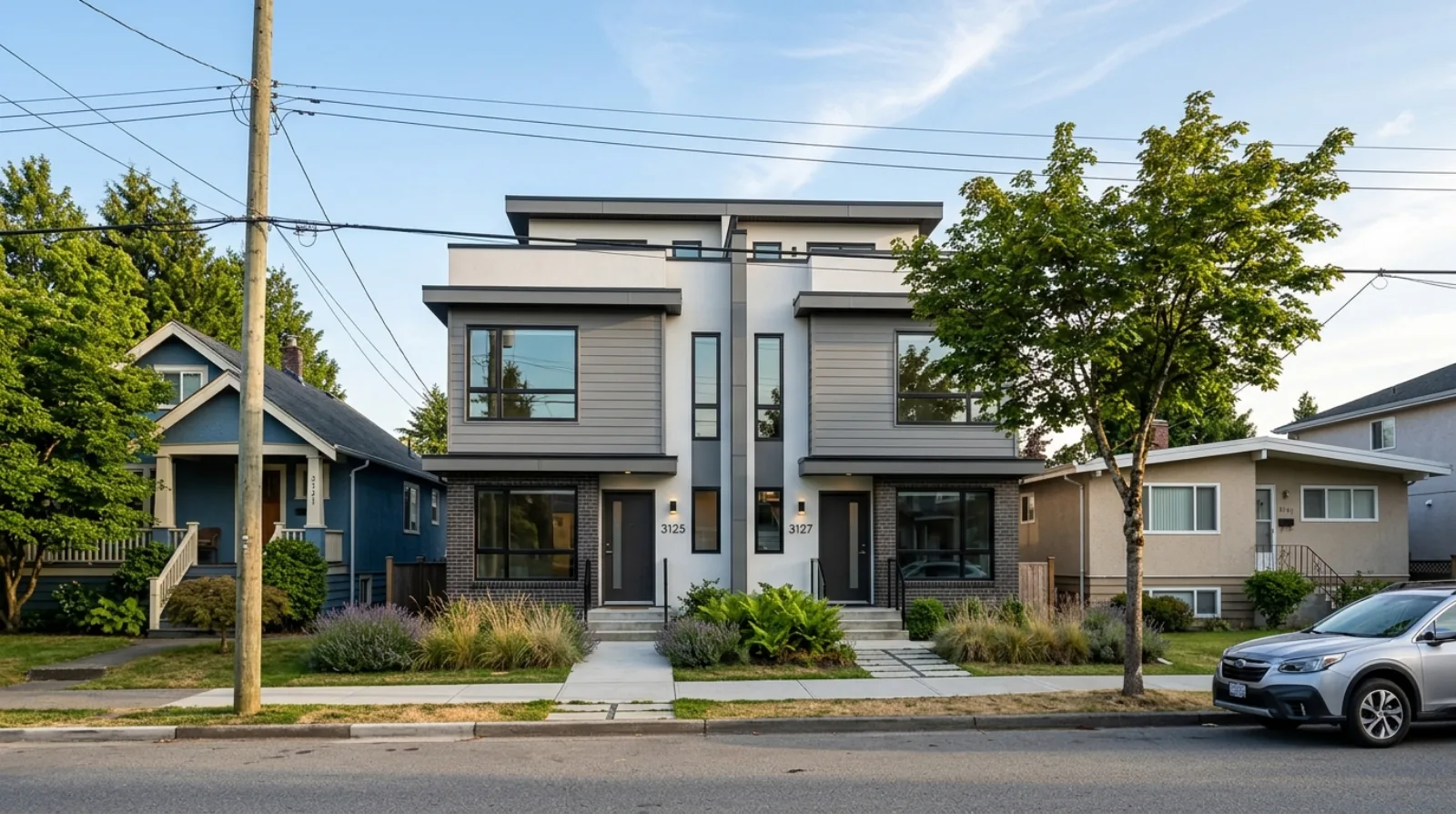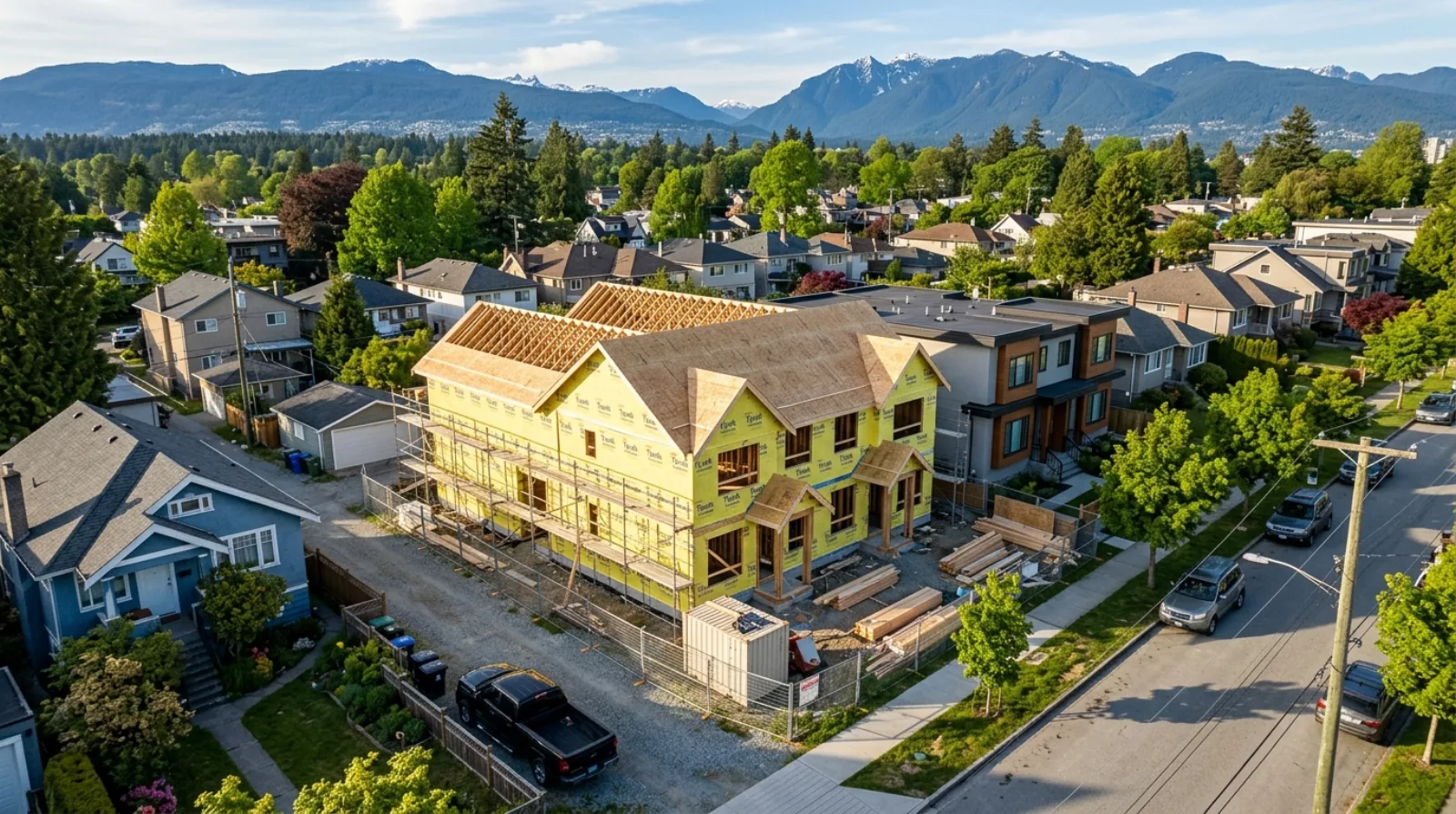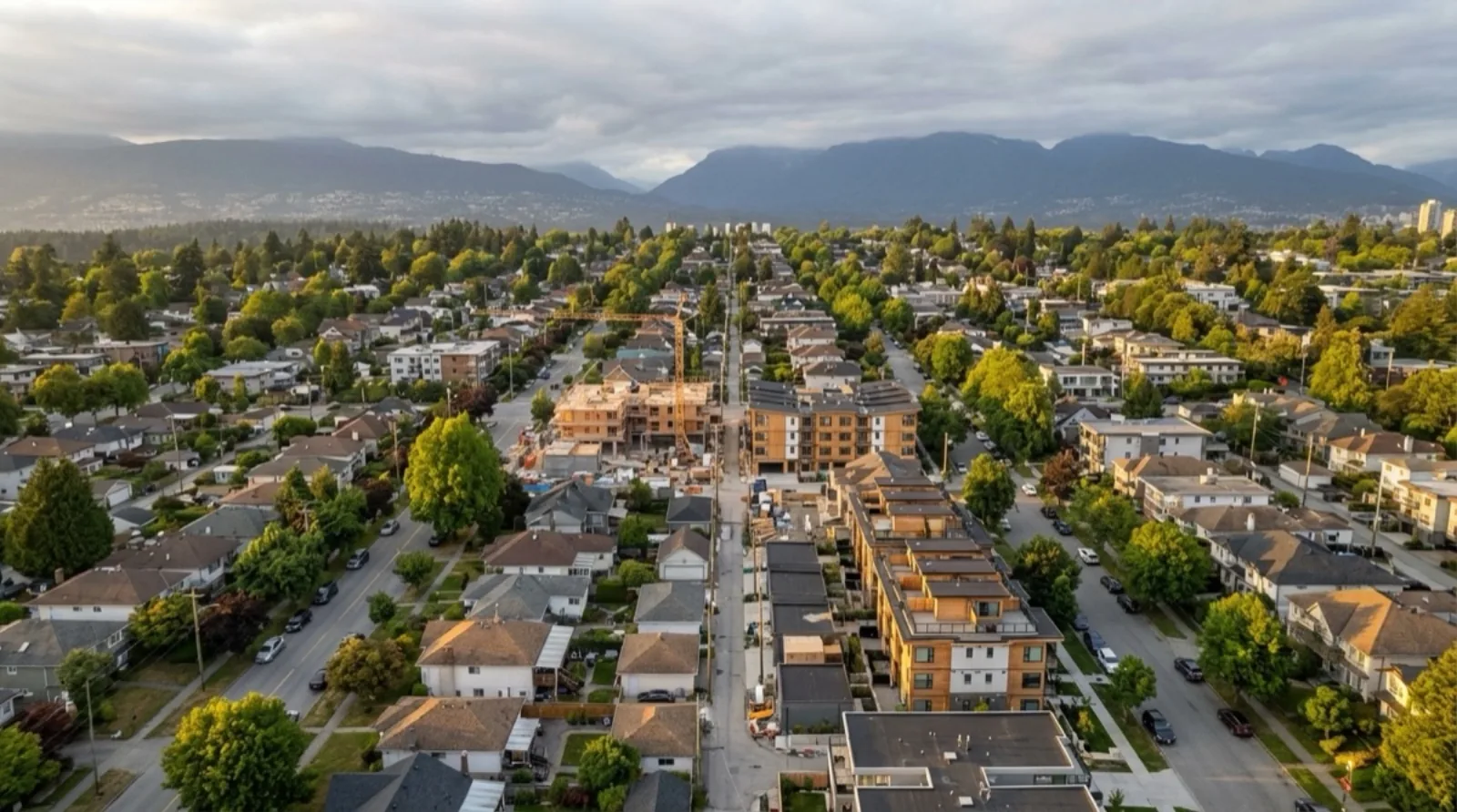

Vancouver has received roughly 518 multiplex applications as of January 2026—about 2,200 new homes, or four times what the city expected. In 2024, multiplex-focused purchases made up one-third of all residential land sales: $300 million out of $1 billion total. But here’s what the headline numbers don’t tell you: the opportunity is not equally distributed across neighbourhoods. Not even close.
Some areas have seen 66 multiplex land sales. Others have seen three. Some lots pencil at $1.5M land cost. Others need $4.4M just to get started. If you’re evaluating your property’s multiplex potential based on city-wide averages, you’re working with the wrong numbers.
Hastings-Sunrise: ground zero for multiplex activity
Sixty-six multiplex land sales by January 2026. That’s more than any other neighbourhood in the city. Average lot price sits around $1.9 million.
Why here? The math is simple. Hastings-Sunrise has 33-foot-wide parcels with lane access—the ideal geometry for four-unit buildings. Land prices are lower than the west side but still within the range where development pencils. You’re not overpaying for the dirt, and you’re not fighting character-home protections.
The neighbourhood itself helps too. Hastings Park, the PNE grounds, New Brighton Park. An emerging restaurant scene along Hastings Street. The Italian Cultural Centre. Buyers want to live here, which means your exit prices hold.
If you’re looking for the epicentre of Vancouver’s multiplex transformation, this is it.
Renfrew-Collingwood: the value play
Slightly lower land prices than Hastings-Sunrise. That margin difference matters when you’re underwriting a $2M+ construction project.
The real story here is Kingsway. Several blocks along the corridor qualify for six-unit development under the frequent transit designation. Six units on a single lot changes the math entirely—more revenue per project, better cost absorption across units.
The tradeoff: tighter margins require disciplined budgeting. You can’t absorb a 15% cost overrun as easily as you can in a higher-value neighbourhood. But for builders who run a tight operation, Renfrew-Collingwood is a sweet spot.
Renfrew Ravine Park—a forested urban wilderness most Vancouverites don’t know exists—is the kind of hidden amenity that attracts exactly the buyer demographic multiplex units target: young families who want space and nature without leaving the city.
Kensington-Cedar Cottage: watch the zoning
Here’s where it gets tricky. KCC has split zoning. R1-1 zones allow standard multiplex development. RT zones have character-home protections that restrict what you can build and how.
This is the single most important thing to check before you assess any property in KCC: verify the zoning designation before you evaluate the land price. An R1-1 lot and an RT lot on the same block can have wildly different development economics.
The fundamentals are strong. Kingsway and Knight Street provide transit access. Trout Lake (John Hendry Park) and the Saturday farmers market create genuine neighbourhood pull. But zoning complexity means you need to do your homework—or let PlexRank do it for you.
Killarney: lowest entry point in Vancouver
If you’re looking for the most accessible land prices for multiplex development in the city, Killarney is it. Standard lots run $1.5-1.8 million.
That lower entry price gives builders more margin to work with. Your construction costs are roughly the same everywhere in Vancouver ($500+/sqft in 2026), so the cheaper your dirt, the wider your spread.
The tradeoff is real: lower end-unit sale prices than closer-in neighbourhoods. You’re not going to get Kitsilano pricing in Killarney. But the gap between land cost and end value is often wider here than in premium areas, which is what actually drives ROI.
The Community Centre is well-equipped (pool, rink, fitness), Fraserview Golf Course is walkable, and the Southeast Asian cuisine along Victoria Drive is as good as anything in Metro Vancouver. Buyers know this.
Sunset: where mortgage-free homeowners hold the cards
Sunset has a demographic advantage that most people overlook. Many homeowners here have been in their homes for decades. Mortgages paid off. That means they’re sitting on $2-3M in untouched equity, and they don’t owe a dime on it.
These are exactly the homeowners who benefit most from Bill 44. No mortgage means no carrying cost on the land contribution. A joint venture or GP/LP structure starts from a position of pure equity.
The building stock is aging, which supports teardown economics—you’re not demolishing a $500K renovation someone did last year. Transit access along Fraser and Main Streets enables six-unit development under the frequent transit designation.
Lane networks and garden plots give the neighbourhood a character that attracts buyers looking for something different from a glass tower. The Punjabi Market adds cultural weight. This is a neighbourhood that sells itself.
Dunbar-Southlands: premium product, premium price
Land here is expensive. No way around that. But the end-unit prices justify the entry cost: $1,200-1,400 per square foot for completed multiplex units.
The target buyer in Dunbar is specific: families earning $200K+ seeking $1.4-1.7 million units near quality schools like Lord Byng and University Hill. These buyers expect premium finishes. They’re comparing your units to $3M+ single-family homes in the same neighbourhood. The bar is high.
Pacific Spirit Regional Park (800 hectares), Dunbar village shopping with independent bookstores and bakeries, the Arbutus Greenway—this is lifestyle-driven real estate. If you build to that standard, the margins are there.
Marpole: transit does the heavy lifting
Marine Drive Canada Line station gives Marpole something most Vancouver neighbourhoods can’t match: direct rapid transit to downtown, the airport, and Richmond. For renters and buyers commuting to multiple locations, this is a genuine selling point.
Land prices are lower than established west-side neighbourhoods. The sweet spots are quieter residential streets east of Granville, where you get the transit access without the arterial traffic.
Fraser River waterfront paths and character-driven Granville businesses round out the appeal. Marpole won’t generate Dunbar-level exit prices, but the land-to-value spread is competitive.
Kerrisdale: wider lots, bigger builds
Kerrisdale lots are often 50+ feet wide. That wider frontage supports five- to six-unit development, which fundamentally changes the per-unit economics.
The catch: land prices often exceed $3 million. You need to be confident in your exit pricing before committing capital at that level.
The market here demands thoughtful design that respects neighbourhood character. Elm Park and the Arbutus Greenway cycling corridor define the lifestyle. Kerrisdale buyers aren’t shopping for a deal—they’re shopping for a home that fits the neighbourhood.
Kitsilano: constrained but rewarding
Large portions of Kits are zoned RT-7 or RT-9—two-family with character protections. That makes multiplex development slower, more expensive, and more constrained than east-side neighbourhoods.
The counterbalance: among the highest end-unit sale prices in the entire city. Beach proximity, Burrard Bridge downtown access, and the future Broadway Subway extension create sustained buyer demand.
Hadden Park with its hidden tennis and basketball courts, the saltwater Kitsilano Pool—these are amenities you can’t replicate. Development in Kits is harder, but the premium justifies the difficulty for the right lots.
Victoria-Fraserview: the emerging play
The most accessible land prices for multiplex development in Vancouver, alongside Killarney. Aging building stock. Long-time homeowner demographic similar to Sunset.
What’s changing: younger families are discovering the tree-lined streets and manageable downtown commutes. Everett Chicken (a local institution), Fraserview Golf Course with its bluff views, David Thompson Community Centre—these are the kind of anchors that drive neighbourhood appreciation.
Victoria-Fraserview is where patient capital meets emerging demand.
First Shaughnessy: heritage meets density
Initially exempted from Bill 44, First Shaughnessy got a multiplex option approved mid-2024 with heavy design constraints. Heritage conversions, not teardowns.
The numbers tell the story: only three land transactions in 2024, averaging $4.4 million per lot. This is not a volume play. It’s a niche for builders who can execute heritage conversions and sell history alongside square footage.
The Crescent (world-class residential streetscape), VanDusen Botanical Garden, South Granville’s restaurant and gallery row—the location is exceptional. But the design constraints and entry cost limit this to experienced developers with deep capital.
90% of builders are skipping basements
One construction trend worth noting across all neighbourhoods: approximately 90% of multiplex builders are choosing basementless designs.
Why? Excavation is one of the biggest cost and timeline risks in residential construction. Basementless designs eliminate it. No shoring, no dewatering, no surprises when you hit the water table. Faster build, lower cost, fewer problems.
This single design decision has become nearly universal because it works. The lost square footage matters less than the saved cost and timeline.
The gap between buyer price and developer premium
Here’s the key insight for mortgage-free homeowners, particularly on the east side: there’s a measurable gap between what a regular buyer would pay for your home and what a multiplex developer will pay.
That gap is your profit—tax-free if it’s your principal residence.
In active east-side neighbourhoods like Hastings-Sunrise, Renfrew-Collingwood, and Sunset, this gap is widest. Developers are paying premiums for lots that pencil for fourplex or sixplex development. Regular buyers can’t match those numbers because they’re buying a house, not a development site.
The question isn’t whether your neighbourhood has multiplex activity. It’s whether your specific lot has the right geometry, zoning, and economics to capture that premium.
Your lot, not your neighbourhood
City-wide averages are meaningless for individual decisions. A 33-foot lot on a lane in Hastings-Sunrise has completely different economics than a 50-foot lot in Kerrisdale. Both might be profitable. But the structure, the timeline, and the partnership model are different.
VanPlex’s PlexRank system scores every lot individually—factoring in zoning, frontage, lane access, land value, construction costs, and projected end values for the specific neighbourhood.
Visit VanPlex.ca to:
- Check your specific lot’s PlexRank score and multiplex eligibility
- See neighbourhood-specific pro forma projections based on actual land sales
- Compare your property against the 86,000+ lots VanPlex has analyzed
- Connect with builders and developers active in your specific neighbourhood
Your neighbourhood might surprise you. But only if you run the numbers on your actual lot.
David Babakaiff CEO & Co-Founder, VanPlex
PlexRank™ | Profit with Multiplex