
The plan to convert 2,200 unsold B.C. condos into affordable homes may help people quickly. It also exposes a deeper weakness in how Canada produces housing.
Peter Diamandis often contrasts scarcity thinking with abundance thinking. In a scarcity model, we compete over the existing pie and argue about how to divide it. In an abundance model, we find ways to bake more pies. That is the lens Canada’s housing debate needs right now.
On June 18, 2026, Prime Minister Mark Carney and B.C. Premier David Eby announced a federal-provincial housing partnership. Part of it converts more than 2,200 vacant condo units into affordable homes through Build Canada Homes and BC Housing. Another part puts up to $3.2 billion over 10 years toward cutting development charges on multi-unit housing by as much as 50% in priority communities, and toward the water, sewer and roads that new housing needs.
Both measures could help people. But they raise a larger question: are we creating housing abundance, or using public money to move the cost of housing scarcity from one balance sheet to another?
Smart public investment, or a bailout?
There’s a real case for putting completed but empty homes to use. As of last month, Canada Mortgage and Housing Corporation data showed 4,376 finished condos sitting vacant in Metro Vancouver, a 76% jump from a year earlier. If governments can buy these units at a genuine discount, hold them as affordable housing, and get people into them fast, the program could be a sound public investment. Government has a legitimate role delivering housing the market won’t deliver on its own.
But the economics decide which story this becomes. We still need to know:
- What will government pay, and how does that compare to current market value?
- Will the homes be rented, resold, or kept as public assets?
- How long is affordability protected?
- Who collects any future appreciation, and who absorbs the loss if values fall further?
The same program could be excellent public policy or a developer bailout. Conservative Leader Pierre Poilievre has already called it a bailout. Some housing economists call it a potential win-win. The final terms tell us which one it is. Pay a real discount and the public builds an affordable asset. Pay a price designed mainly to shield developers from losses the market was already imposing, and it’s something else.
Moving a cost is not the same as removing it
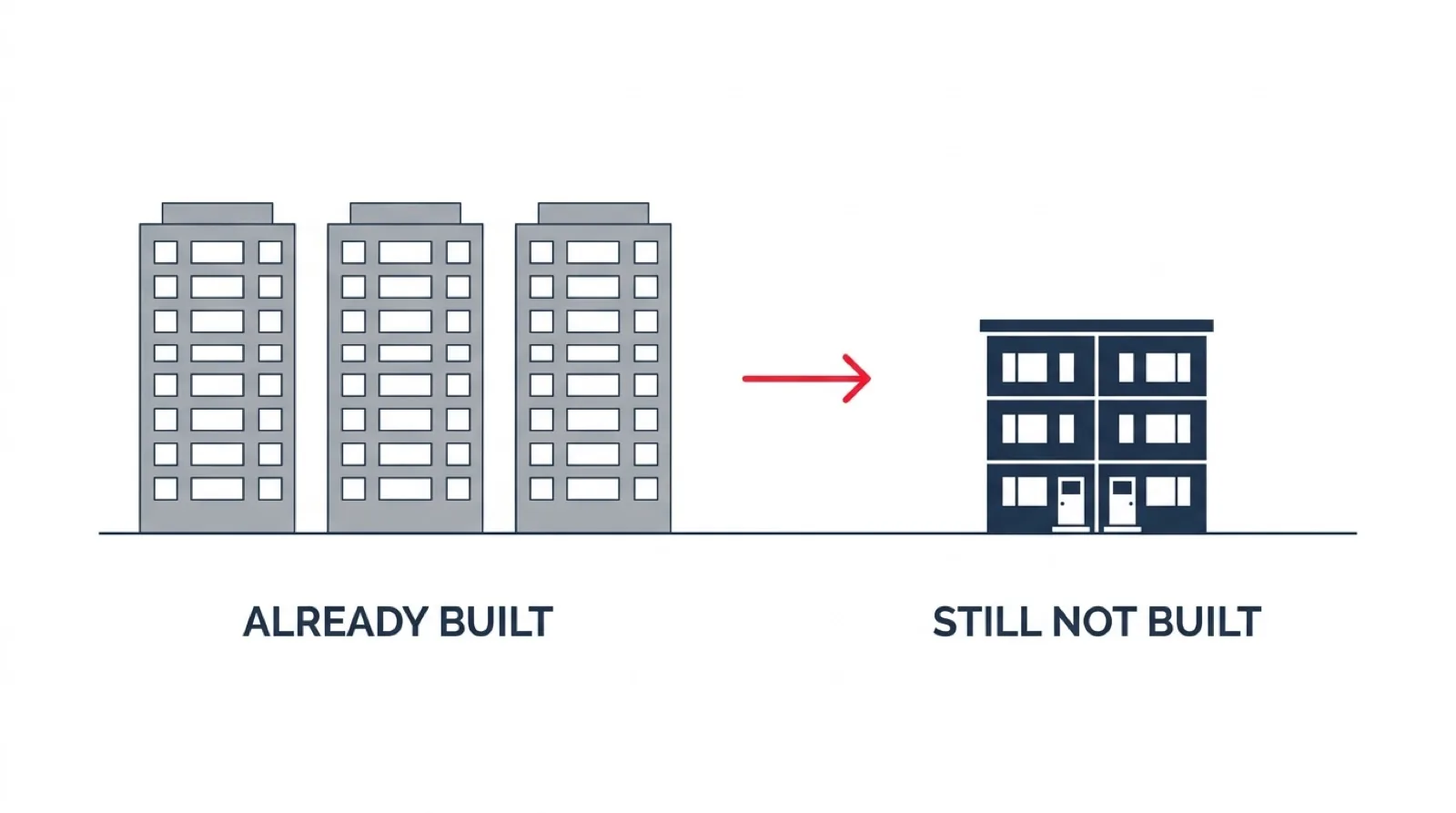
The condo conversion doesn’t create 2,200 new homes. The homes already exist. The program changes who owns them, how they’re financed, and who gets to live in them. That can produce real social value. But in Diamandis’s framing, it mostly changes how the existing pie is divided.
Development charges create the same tension. Cutting them improves a project’s math and can let stalled housing proceed. But the cost of roads, water, transit and public facilities doesn’t disappear. It moves to another balance sheet.
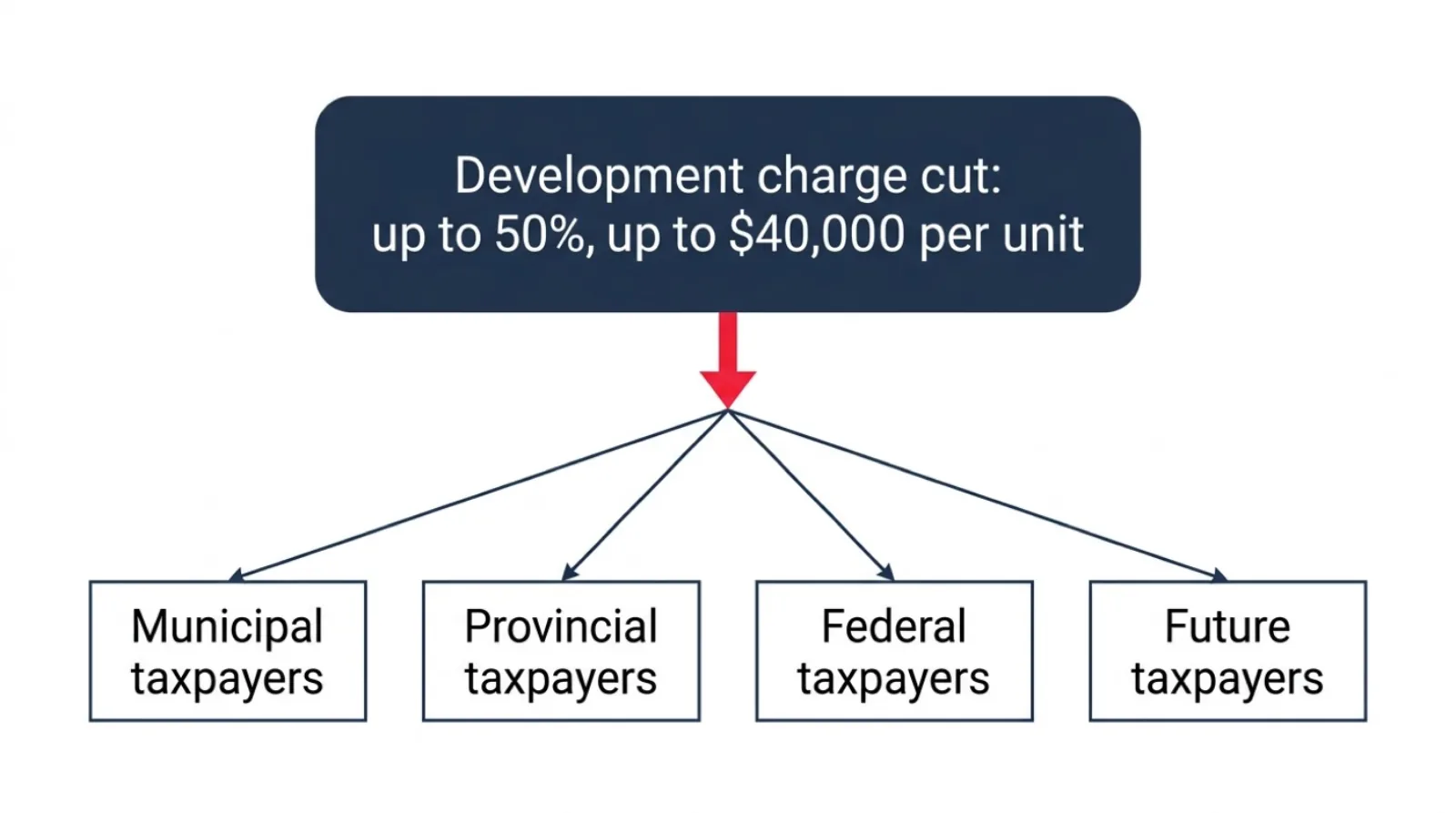
| The cost goes in here | The cost comes out here |
|---|---|
| Development charges on new homebuyers | Municipal taxpayers |
| Up to 50% fee reduction, up to $40,000/unit | Provincial taxpayers |
| Stalled project now pencils | Federal taxpayers |
| Empty condo gets an occupant | Future taxpayers servicing debt |
Moving the cost to taxpayers may be fairer than loading it all onto first-time buyers. But it’s still a transfer. By itself it doesn’t make the system that produces housing any more productive.
The loop we need to break
Canada’s housing system keeps running the same loop. We pile on land cost, municipal charges, financing cost, approval delays, fragmented design, construction inefficiency and layers of risk. Those costs settle inside the finished home. Buyers can’t afford the result. Projects stall. Then government steps in: cut the fees, guarantee the financing, buy the finished units, or subsidize whoever ends up living there.
Each step can be defensible on its own. Together they describe a system that isn’t creating enough value. We make housing expensive through how we plan, approve, finance and build it, then spend public money to bridge the gap between what it costs and what households can pay. The cost moves around the system. It doesn’t leave.
A fourplex right is not a fourplex
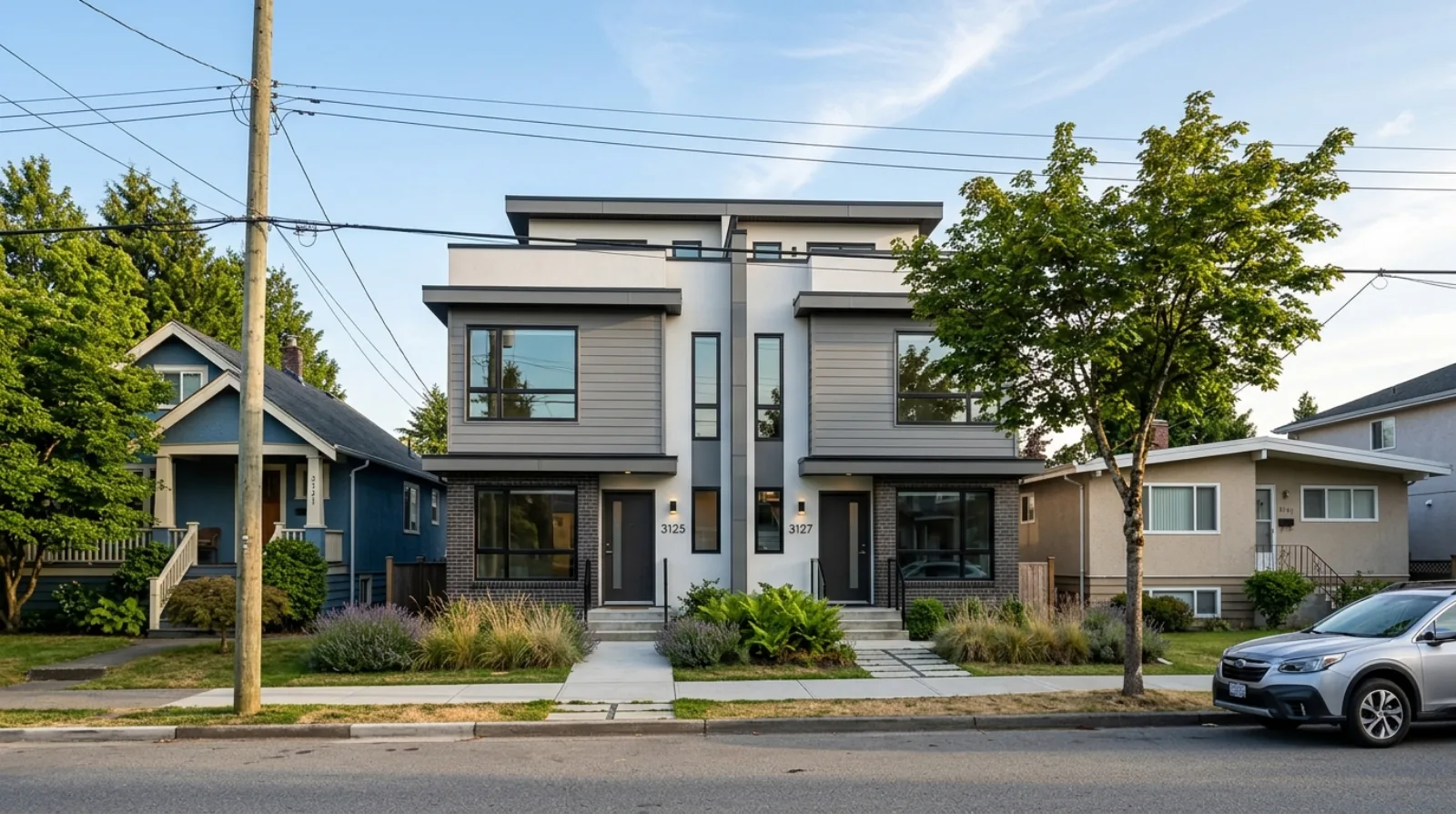
This is where it gets concrete for multiplex housing. B.C.’s Bill 44 created the legal potential for three, four, five or six homes on many lots that used to allow one detached house. That’s real progress. But zoning permission isn’t housing supply.
A property can legally permit four homes and still be impossible to build, because the buildable floor area is too small, the land or existing house is too valuable, construction costs too much, parking and site constraints eat the opportunity, fees are too high, financing isn’t there, or the prices you’d need to charge are above what local buyers will pay.
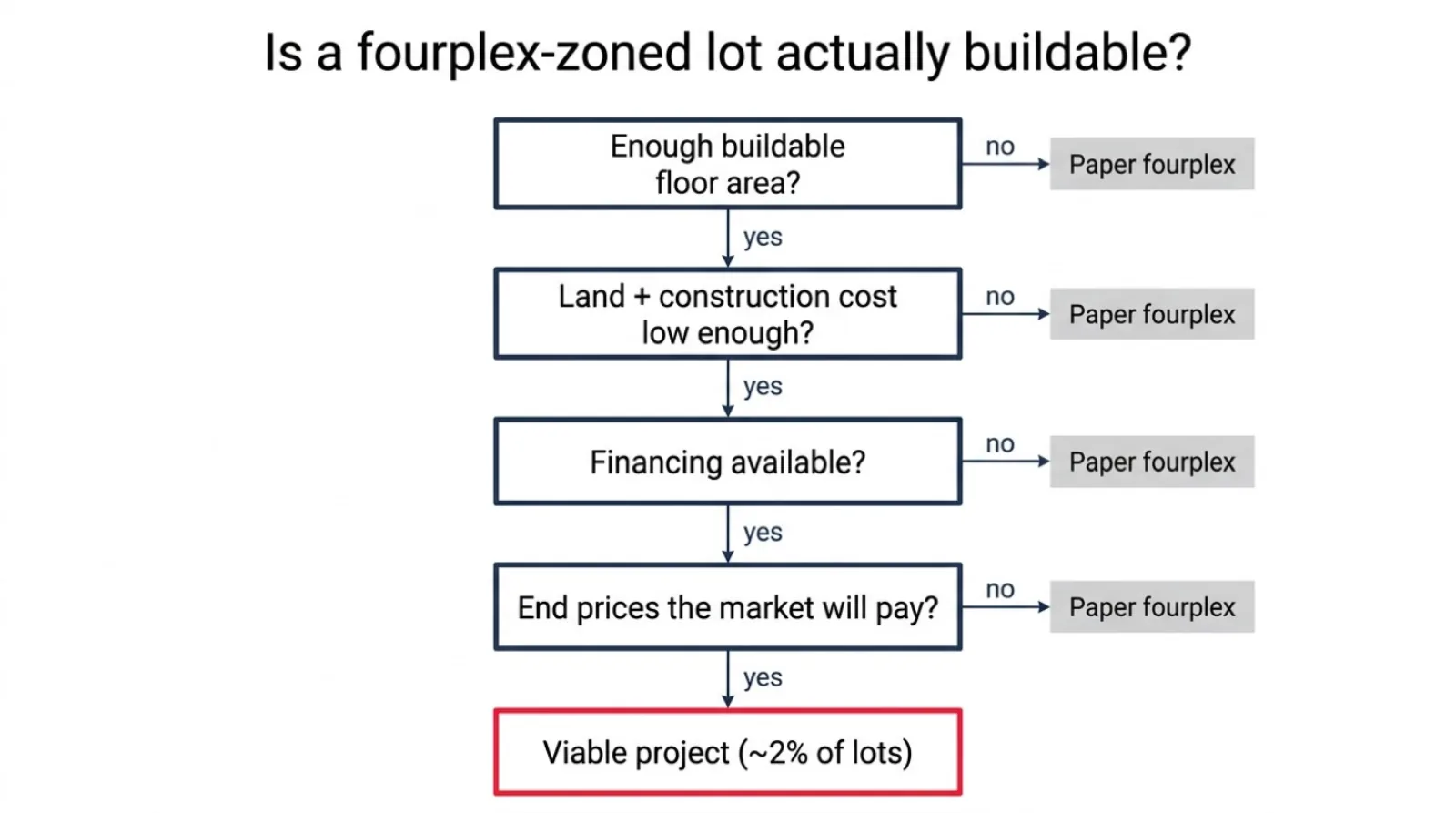
Zoning can quadruple the homes allowed on a parcel on paper. But if the project needs sale prices above the local market just to cover land, construction, financing, fees and a fair return, nothing gets built. The legal capacity exists. The economic capacity doesn’t.
We’ve seen this in the data. When PlexRank first scored more than 100,000 Greater Vancouver lots, only about 2,419 — roughly 2% — cleared a 100%-plus return-on-equity bar. PlexRank now scores more than 205,000 residential lots across six B.C. cities, and the pattern holds in each one. The new rights are spread across the whole map. The viable deals are not.
| What Bill 44 grants | What feasibility returns |
|---|---|
| The right to build 3-6 homes on tens of thousands of lots | A strong, risk-adjusted return on roughly 2% of them |
| Optionality, everywhere | Value, in a few places |
| A theoretical unit count | A buildable, financeable, sellable project |
Zoning creates optionality. Feasibility creates value. For a city, that means theoretical unit counts aren’t supply. For a homeowner, it means new density rights don’t automatically make your lot worth more. For an investor, it means broad zoning doesn’t make every parcel a good buy. Finding the few that work takes parcel-level intelligence, not a zoning map.
What housing abundance would actually look like
Abundance doesn’t mean unlimited luxury housing. It means raising our ability to produce the right homes at prices more people can carry. That takes a more productive system: allow more homes on existing residential land, identify which parcels are viable before writing the policy, cut approval times from years to months, standardize common building forms, stop repeating the same analysis on every project, expand off-site construction, build financing suited to small projects, and direct infrastructure money to the places where it actually unlocks supply.
That’s not just deregulation. It’s better system design. The goal is more housing value from every parcel, every dollar, every approval and every hour of work.
Multiplex housing is part of that answer, though not all of it. It isn’t a replacement for deeply affordable or supportive housing. It serves a different group: families priced out of detached homes, downsizers who want to stay in their neighbourhood, multigenerational households, middle-income earners, and first-time buyers looking for a way into ownership. Many earn too much to qualify for subsidized housing but can’t afford much of what the market currently builds. That’s the missing middle, in both housing form and household income. Government should keep helping people who need deeper support. But unless we also fix the market-housing system, the number of people who need a subsidy keeps growing.
The Housing Abundance Test
Here are four questions worth asking of any major housing policy:
- Does it merely transfer an existing cost, or permanently reduce the cost and difficulty of producing housing?
- Does it divide existing supply differently, or expand our capacity to create more homes?
- Does the public get lasting value equal to the money and risk it puts in?
- Does it make the next project easier and cheaper, or only rescue the last one?
The B.C. condo plan may pass parts of this test. Buying finished homes at a meaningful discount could be a smart way to create affordable public assets fast. Paying prices set mainly to protect developers from market losses would be the opposite. The terms decide it.
This shouldn’t become a false choice between looking after people and respecting economic reality. We need both. Help the people who can’t house themselves. Insist that public spending creates durable public value. And most of all, improve the system that keeps making intervention necessary. A housing strategy can’t lean forever on shifting costs from one group to another while the cost of producing a home keeps rising. That’s scarcity management. Abundance comes from creation: more productive land, better information, more efficient capital, faster decisions, lower risk, better construction, and more homes that fit the people they’re meant for.
The 2,200 vacant condos may meet an immediate need. The larger job isn’t to redistribute the existing housing pie. It’s to build a system that can bake many more.
Find out which side your lot is on
If you own property in Metro Vancouver, Bill 44 either gave your lot real value or just gave it a number on a zoning map. Most lots are the second kind. You should know which before you spend $20K on architectural drawings.
Visit VanPlex.ca and enter your address. You’ll see your property’s PlexRank score and where it lands in the distribution. Two minutes. No cost. Just the data. And if you want to see the bigger picture first, read where the gold actually is in multiplex zoning.
David Babakaiff
Co-Founder, VanPlex
PlexRank™ | Profit with Multiplex