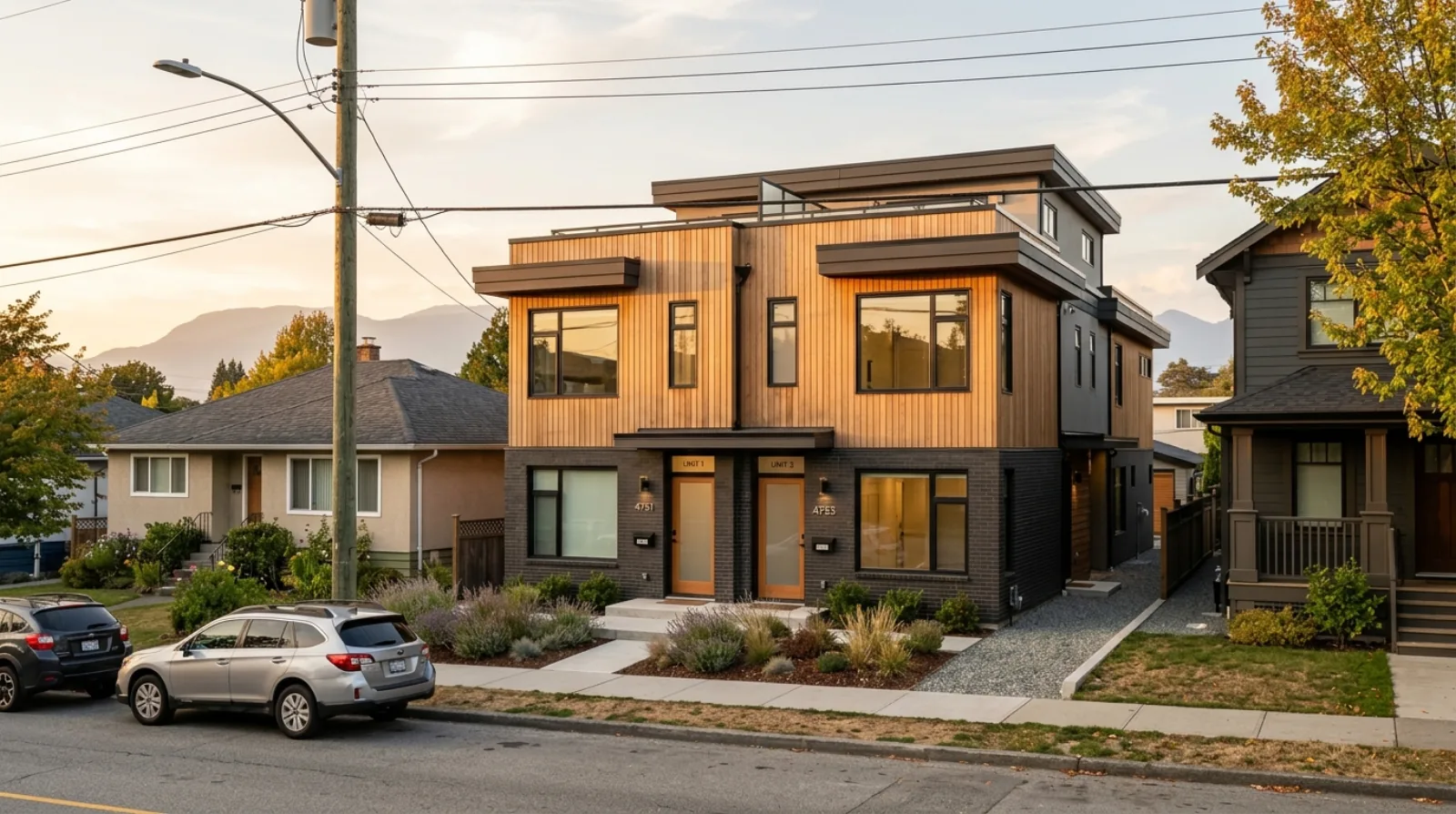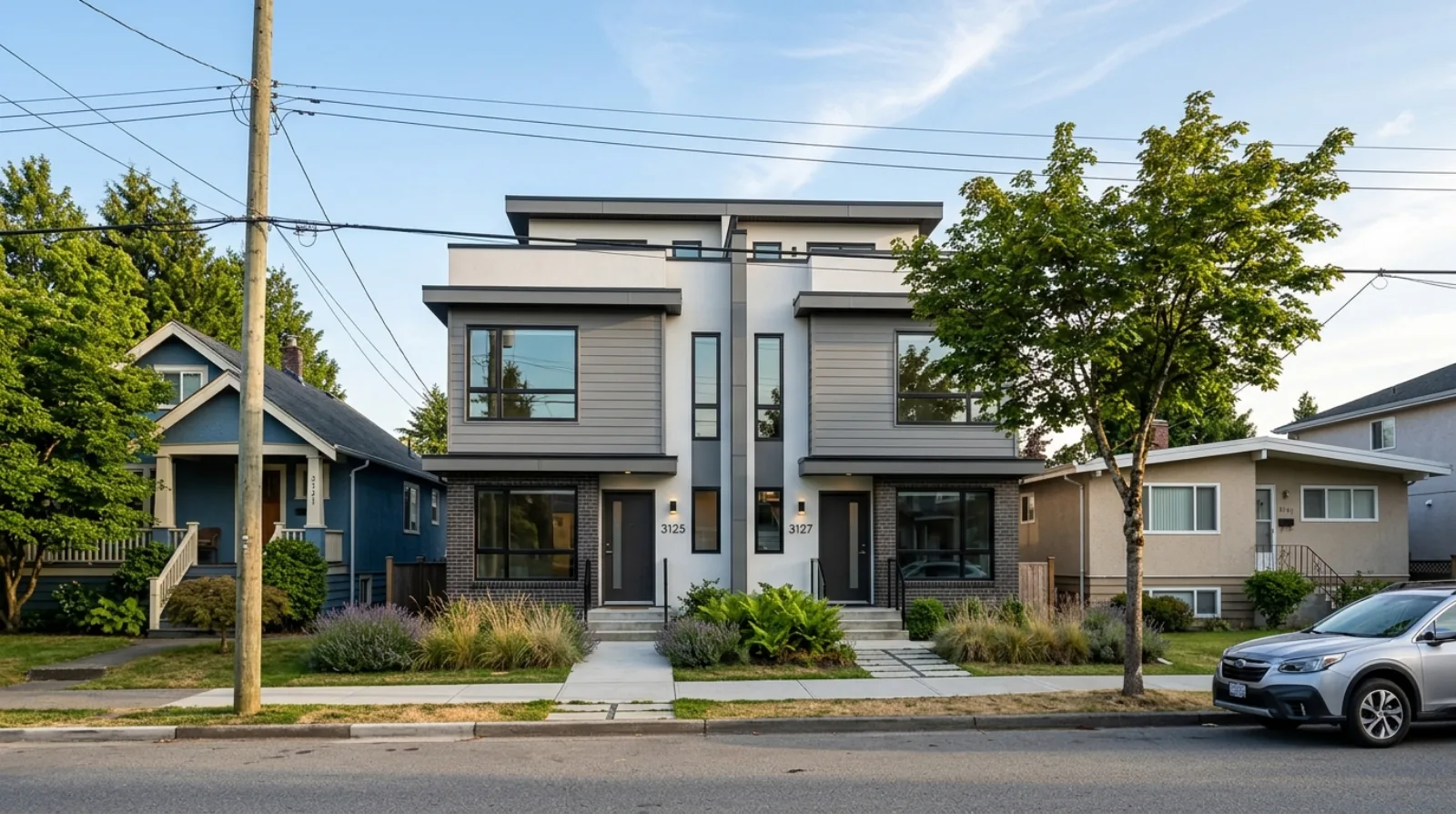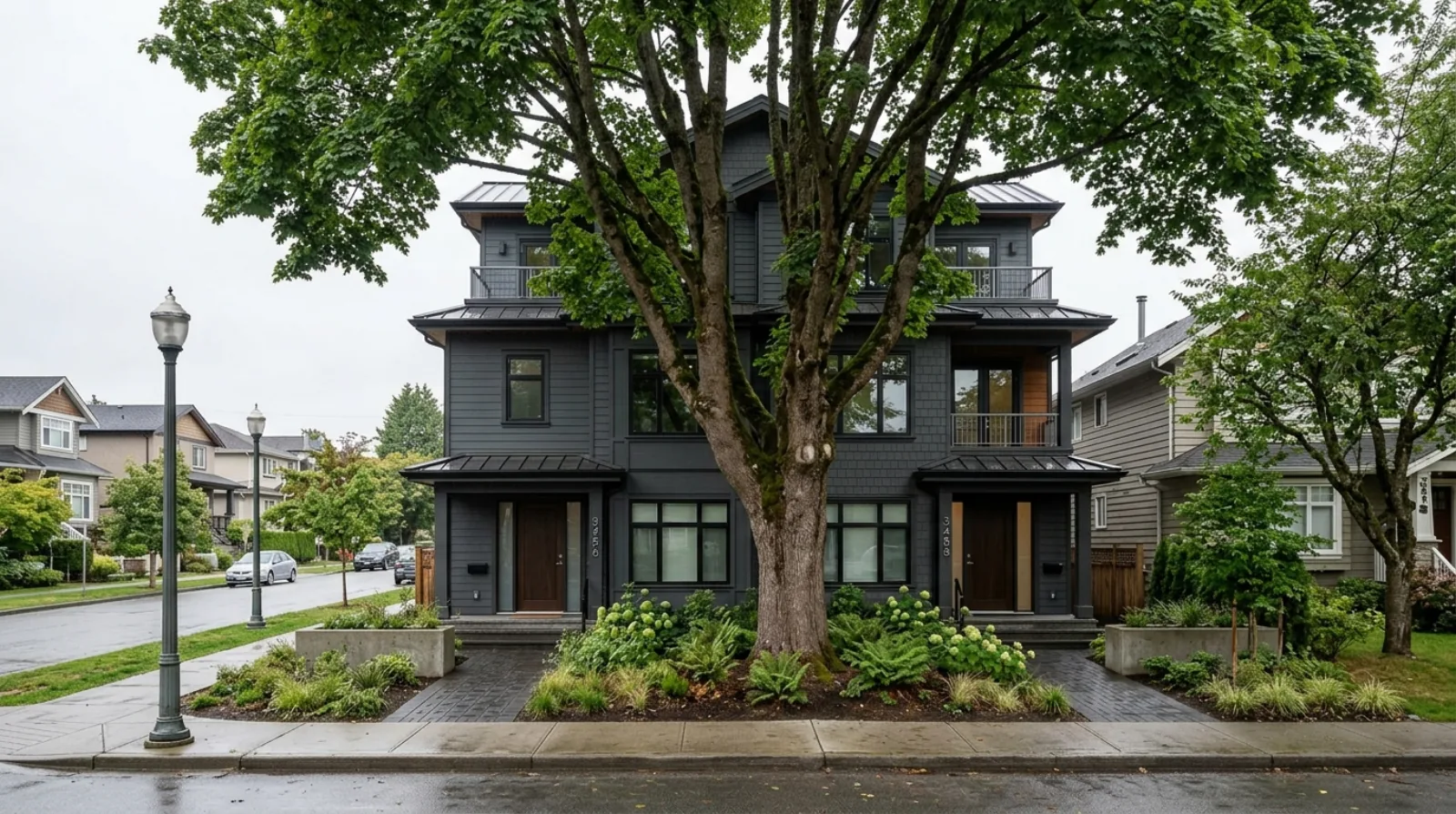
Yesterday was Canada Day. We spent it looking at the country as a whole — its land, its people, what we’ve built and what’s still ahead. Today the question gets smaller and more practical: what do we build next? Big answers usually involve railways, ports, and power grids. But nation-building also happens one address at a time — the moment a family finds a home it can afford, or an aging owner makes room for the next generation without leaving the block.
The short version
- Big nation-building is railways and ports. The quieter kind is one property at a time: more homes on land that used to hold one.
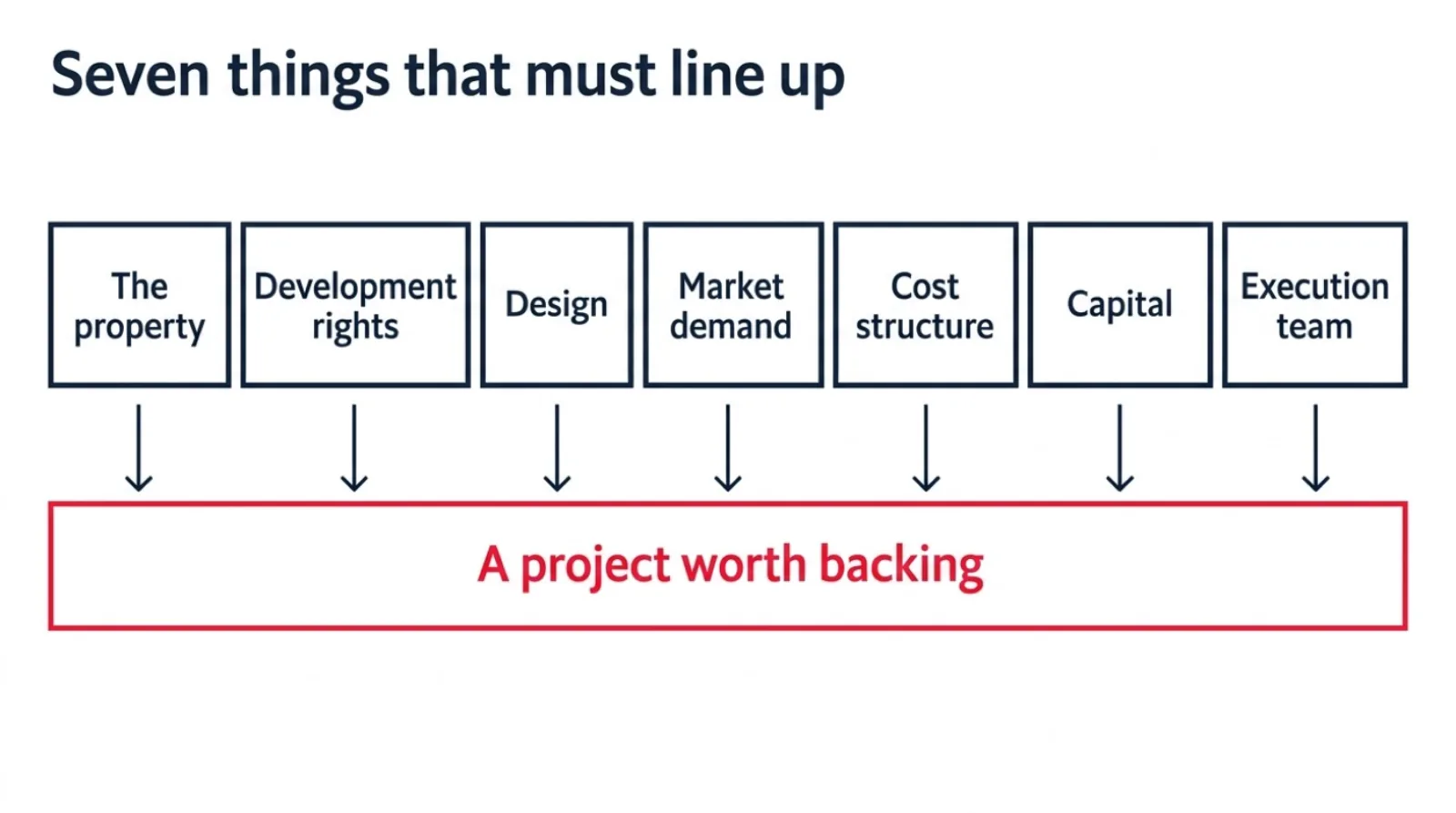
- A multiplex only works when several things line up at once — the property, the development rights, the design, the market, the cost to build, the capital, and the team. That alignment is rare.
- Across BC, new density has been added to tens of thousands of ordinary lots. The field of what’s possible is huge. Inside that field, each lot has its own economics.
- The opportunity isn’t “any lot with new zoning.” It’s the small number of addresses where rights, land basis, product, and execution actually converge.
- Later this month we plan to bring one specific multiplex investment opportunity to a small group of qualified investors. This piece is the lens we’ll use to judge it.
Nation-building, one address at a time
We tend to picture nation-building as something enormous. Railways stitched across a continent. Ports, dams, highways, whole new cities. That story is real, and it matters.
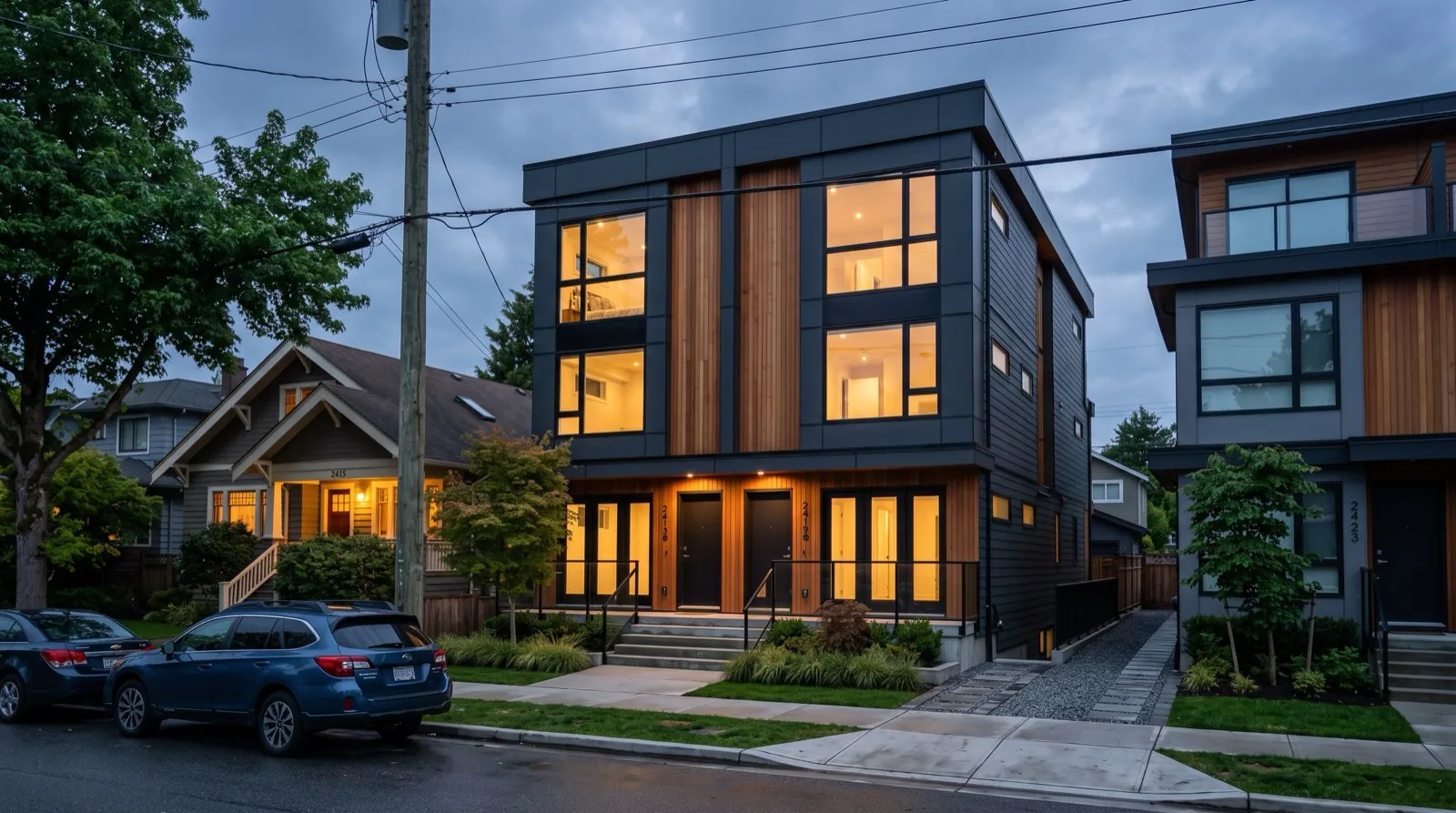
But there’s a quieter version that adds up to just as much. It happens when a family finally finds a home they can afford. When an aging homeowner builds a suite so a parent — or an adult kid — can stay close instead of moving away. When a single lot that held one household starts holding four or six. When investors put money behind projects that pay a return and leave a real place for people to live.
That’s the promise of multiplex housing. Not abstract. One address, then another.
Why the good ones are rare
Here’s the part people underestimate. A multiplex isn’t one decision — it’s several, and they all have to line up.
You need the right property. Development rights that permit a housing form worth building. A design that works on the lot. Real market demand for the homes you’d deliver. A cost structure that pencils at today’s construction prices. Capital matched to the risk. And a team that has actually built before, not just modeled it in a spreadsheet.
Each of those strengthens the others. A great lot with the wrong zoning goes nowhere. Perfect zoning on land you overpaid for goes nowhere either. The value shows up only when the pieces converge — and that convergence is uncommon. Which is exactly where the opportunity hides.
The field is enormous. The winners are few.
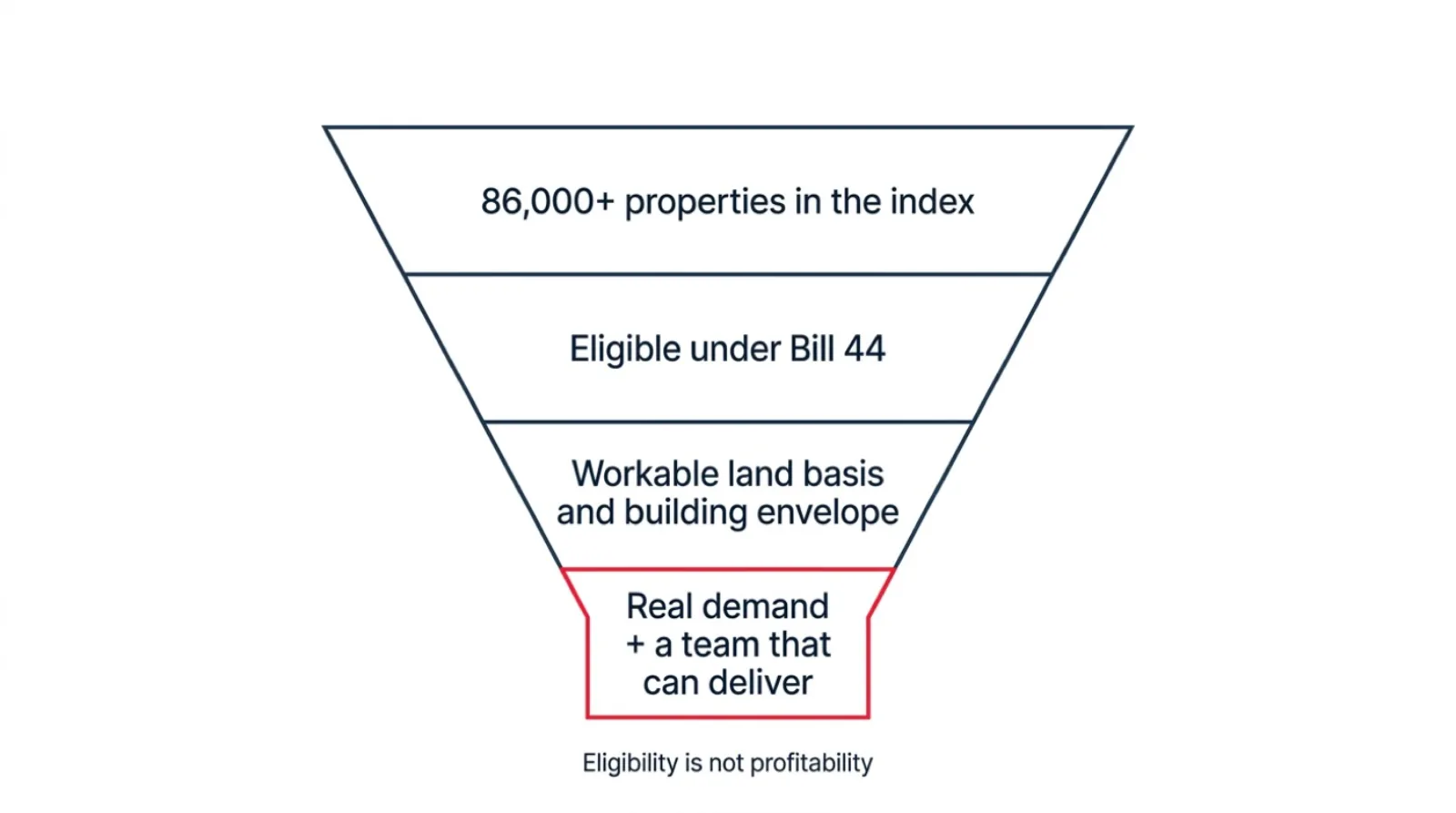
Across British Columbia, Bill 44 added new development rights to a huge number of ordinary residential lots. Most single-family lots can now hold three or four homes, and up to six near frequent transit. Overnight, the field of what’s possible got much bigger.
But “possible” and “profitable” are different words. Inside that field, every lot carries its own math. Some have an efficient building shape and strong demand nearby. Some have an advantageous land basis — the owner bought long ago, or the price simply works. Some sit in a location, or carry rights, that support a particularly valuable kind of housing.
The investment case appears where those advantages stack on the same address. That’s the whole game at VanPlex: out of an index of more than 86,000 properties, find the handful where the pieces already point the same direction.
What we’re actually looking for
When we screen a property, we’re looking for several kinds of value that can be created together on one lot:
- More homes on land that used to hold one.
- A housing product people genuinely want to live in.
- A return that fairly pays the capital taking the development risk.
- A clear path from analysis all the way through to keys-in-hand execution.
Miss any one of those and the project gets shaky. Hit all four and you have something worth backing.
| The variable | What makes it strong |
|---|---|
| The property | Efficient building envelope, few site surprises |
| Development rights | Zoning that permits a genuinely valuable housing form |
| Land basis | Held or bought at a price the project can carry |
| Market | Real, present demand for the homes you’d build |
| Cost structure | Construction that pencils at today’s prices |
| Capital | Financing matched to the development risk |
| Execution team | People who’ve delivered multiplexes before |
None of these is exotic. Getting all seven on one address is the hard part.
An opportunity, coming later this month
Later in July, we expect to bring forward one specific multiplex investment opportunity to a limited group of qualified investors. We’re not releasing the address today. Right now we’re doing the unglamorous work — testing the assumptions, the structure, the risks, the execution plan, and the underlying property economics.
We think this one may be exceptional, because several variables that rarely line up appear to line up here. But “appear to” is doing real work in that sentence, and we’d rather confirm than sell. When we release it, investors will be able to see for themselves why this particular property rose above a much larger field — grounded in the project itself: the land, the rights, the housing product, the market, the financial structure, and the team responsible for delivery.
If you want to be on the list to receive that offer, reach out through VanPlex and tell us you’d like to see it.
Common questions
What is a multiplex under BC’s zoning changes?
It’s a small residential building with three to six homes on what used to be a single-family lot. Bill 44 made most of these lots eligible across BC — three or four units on a standard lot, and up to six near frequent transit. You can read the details here.
Does new zoning mean a lot is a good investment?
No. Zoning creates the option to build, not the guarantee of a return. A lot’s economics depend on its building shape, land basis, local demand, construction cost, financing, and the team building it. Most eligible lots don’t clear that bar. A small number do.
How does VanPlex pick which properties to pursue?
We start with an index of more than 86,000 properties and screen for the addresses where several forms of value line up at once — the right rights, an efficient envelope, real demand, a workable cost structure, and a deliverable plan. The goal is to find convergence, not just eligibility.
How do I get access to the investment opportunity?
The offer goes to a limited group of qualified investors later in July. If you’d like to be included, get in touch through VanPlex and ask to be added to the list.
My take
Yesterday we celebrated the country we inherited. Today we go back to building the one that comes next — and a surprising amount of that happens through thousands of small, individual decisions about single lots.
The strongest multiplex projects aren’t found by casting a wide net. They’re found by looking closely at one address at a time, and recognizing the rare few where rights, economics, and the ability to execute all point the same way. Later this month, we plan to show you one.
— David Babakaiff, Co-Founder, VanPlex. PlexRank™ | Profit with Multiplex.