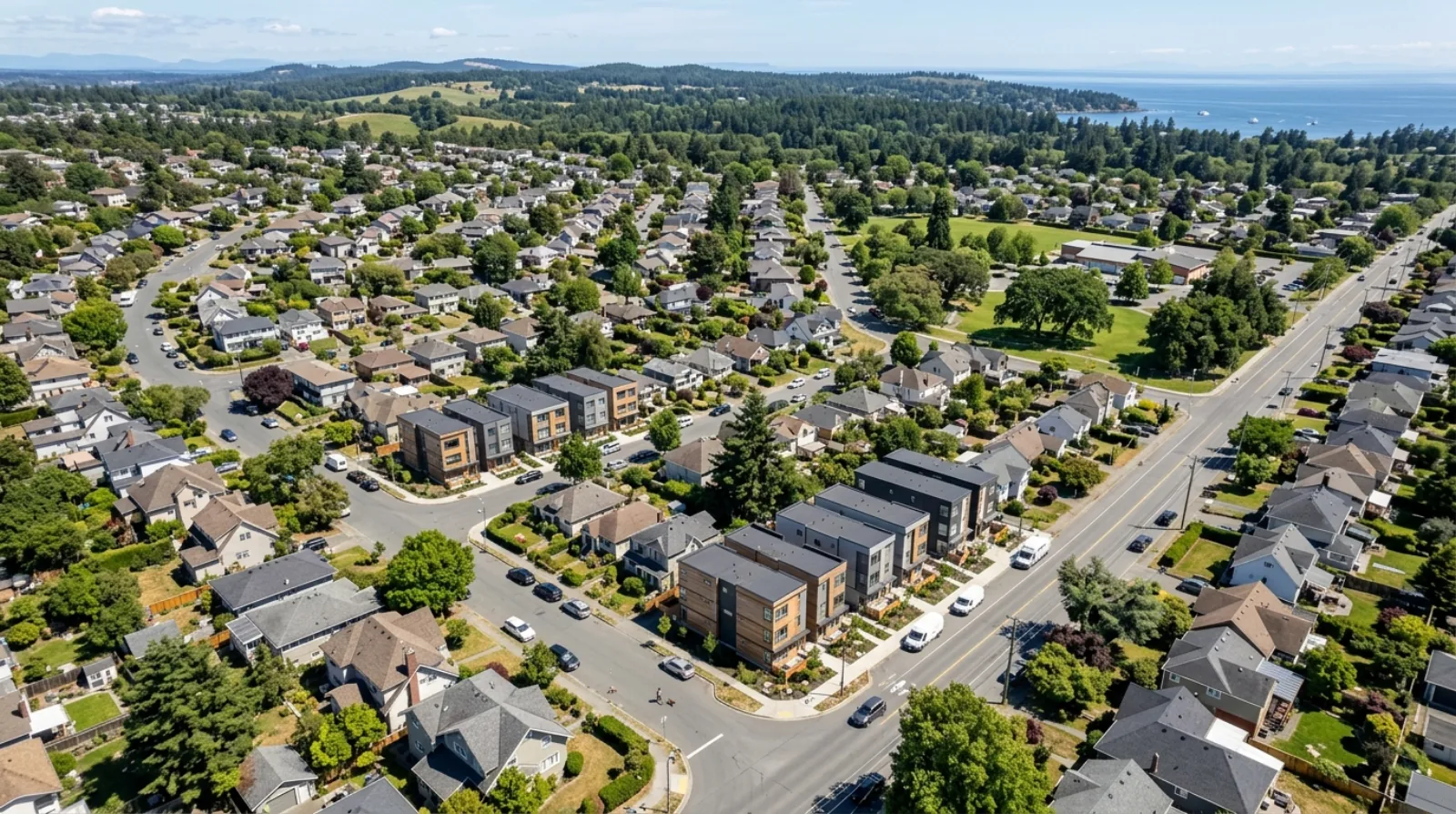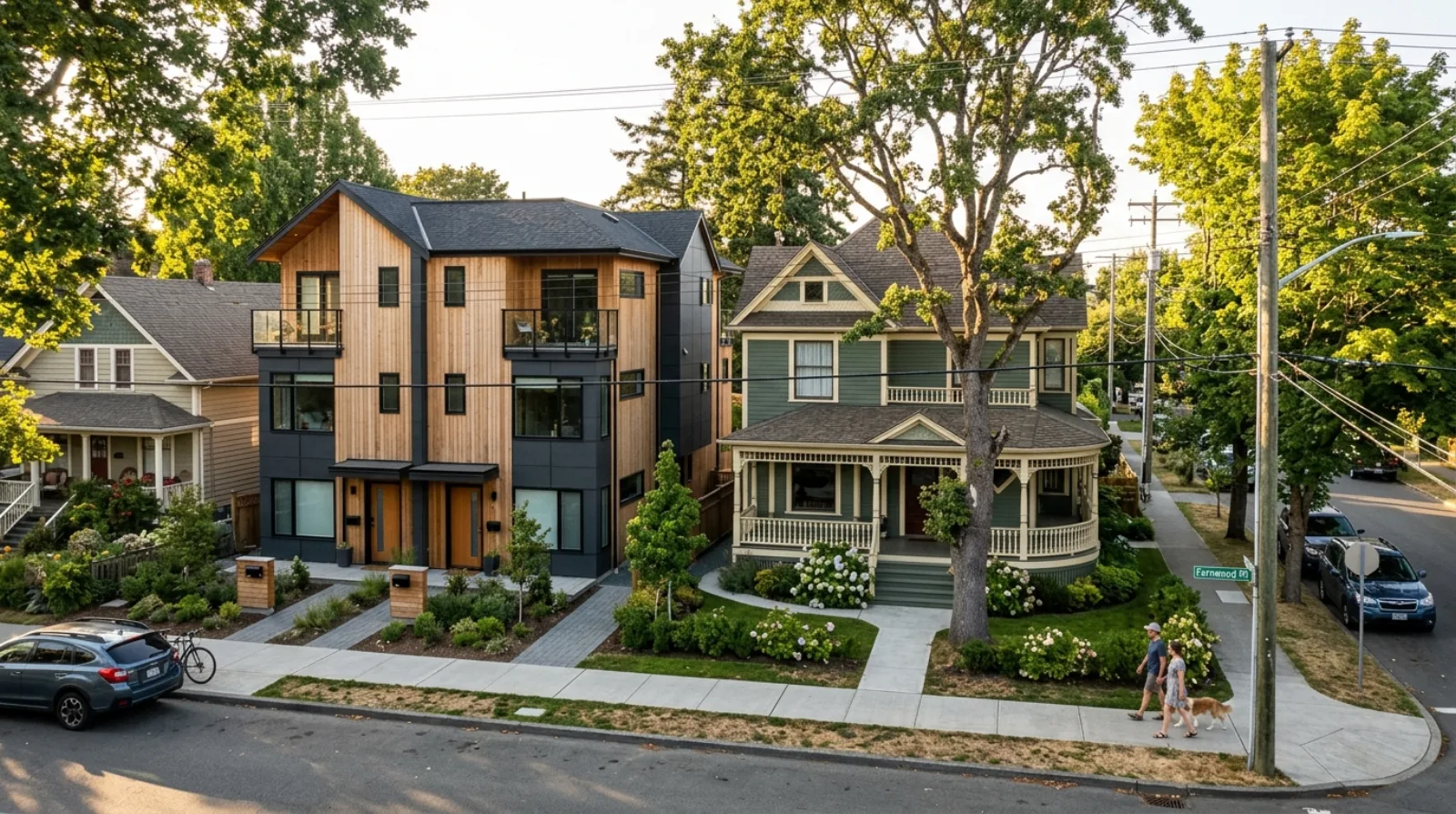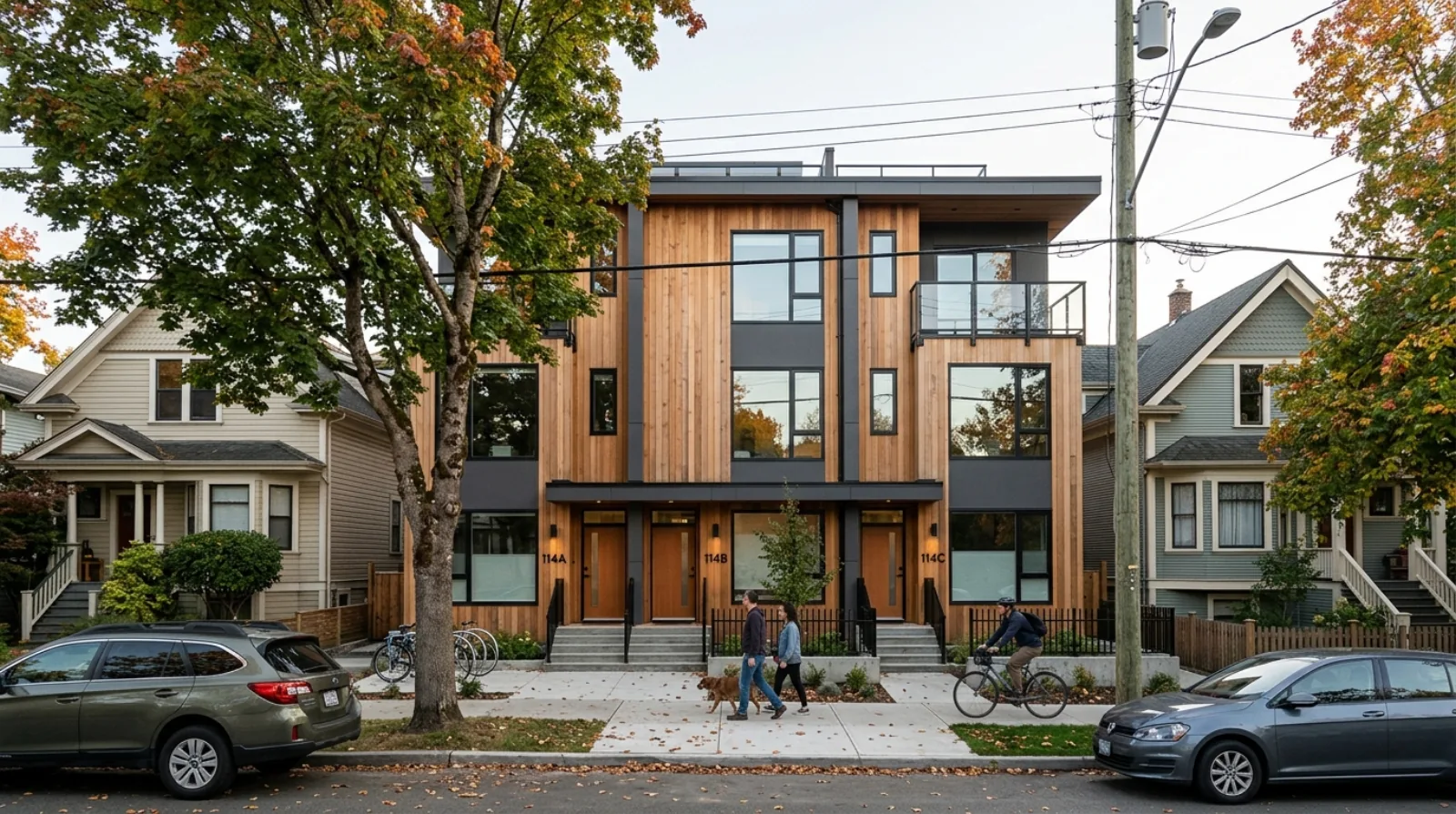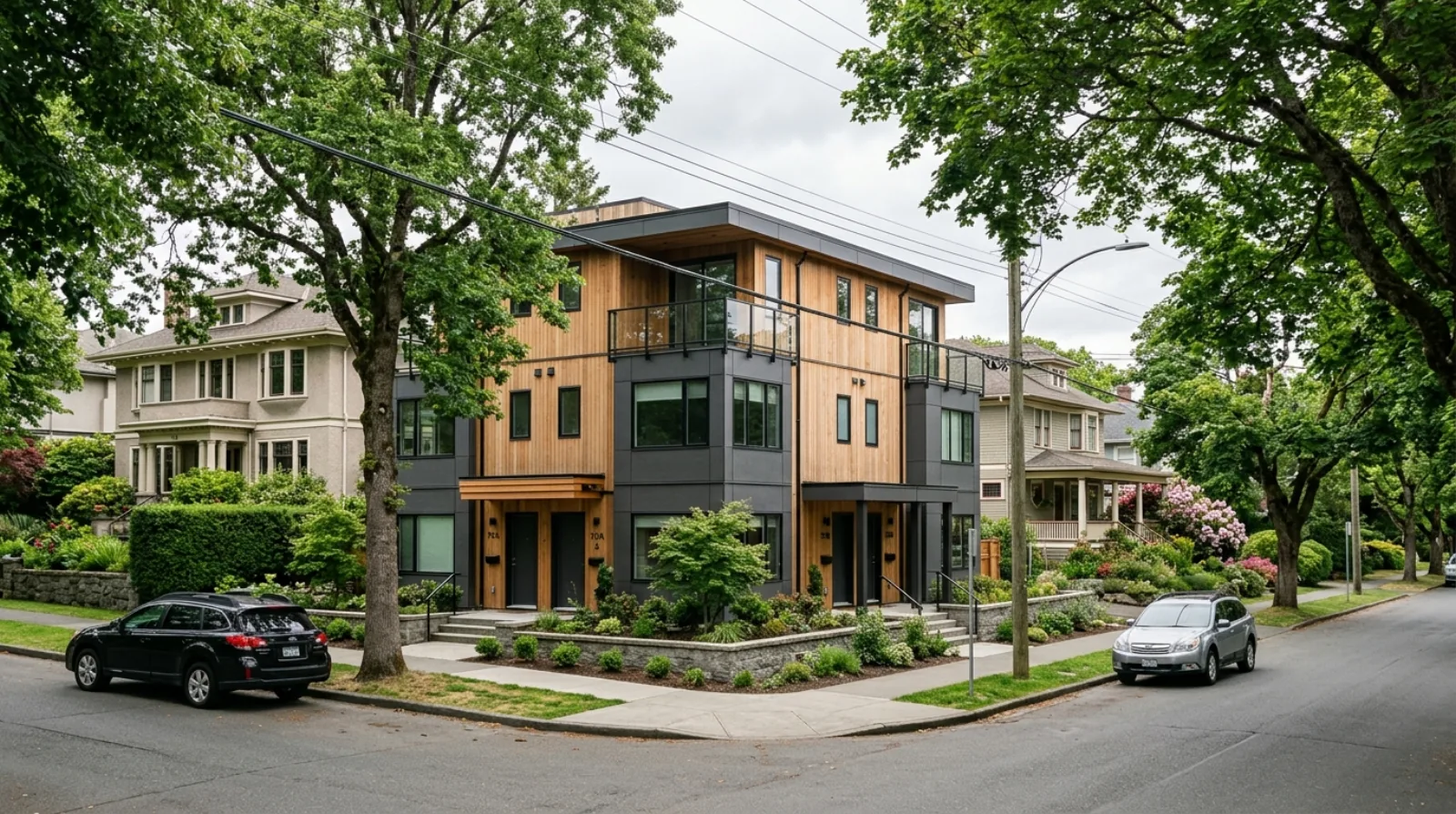

Two neighbouring municipalities in Greater Victoria got the same provincial housing law in 2023. One implemented it cleanly and added its own streamlining. The other adopted it, then drew a provincial advisor and ministerial directives. Saanich and Oak Bay are the clearest case study in how much the local response matters.
TL;DR
- Both Saanich and Oak Bay had to comply with the provincial Bill 44 / SSMUH law by June 30, 2024.
- Saanich went beyond the floor: up to 3, 4, or 6 units, plus a Form and Character DP exemption for four units or fewer.
- Oak Bay adopted a four-unit base — but became the only Capital Region municipality placed under a Housing Supply Act advisor, with ministerial directives signalled in 2025.
- Same law, very different builder experience. Where your lot sits changes the process, not just the unit count.
The shared starting point
The province’s Small-Scale Multi-Unit Housing rules required municipalities over 5,000 people to permit 3, 4, or 6 units on most residential lots, by lot size and transit proximity, with bylaws updated by June 30, 2024. Saanich and Oak Bay both had to act. They responded very differently.
Saanich: clean, plus a bonus
Saanich implemented SSMUH on time and added local streamlining that genuinely helps builders. It permits up to 3, 4, or 6 units without rezoning inside its Urban Containment Boundary. And it exempted projects of four units or fewer from requiring a Form and Character Development Permit — removing a discretionary review step that elsewhere adds time and uncertainty. It also eased suite rules, allowing a secondary suite and a garden suite on the same property and dropping the owner-occupancy requirement.
The effect: in Saanich, a small multiplex of four or fewer units has an unusually clean path.
Oak Bay: adopted, then directed
Oak Bay also adopted small-scale multi-unit zoning — an Infill Housing Program allowing up to four units on most lots, with coach houses, triplexes, and fourplexes permitted, development permit review waived in favour of a building permit, and parking minimums reduced.
But Oak Bay is also the only Capital Region municipality the Province placed under a Housing Supply Act advisor, appointed January 28, 2025. After a review, the Minister wrote on May 21, 2025 that directives would be issued — to delegate minor variances to staff and to set a minimum of one parking stall per unit, both by January 31, 2026. This is documented in the Province’s own public notice letter, not rumour.
What the contrast teaches
The lesson for a builder is simple: the provincial law is a floor, but the local implementation is what you actually build under. Saanich turned the floor into a streamlined, six-unit-capable system with a development-permit exemption. Oak Bay adopted a four-unit base and then became the test case for what happens when the Province judges a municipality’s implementation insufficient.
Neither story tells you which is the better place to build — that depends on your lot, the rents, and your goals. But it tells you to read each municipality on its own terms. A regional pro forma that treats “Greater Victoria” as one set of rules will be wrong.
How the City of Victoria fits
Worth remembering: the City of Victoria itself runs neither of these. It has its own Missing Middle Housing Initiative — houseplexes up to six units, corner townhouses up to twelve — adopted ahead of the provincial deadline. Three jurisdictions, three systems, one region.
The bottom line
Same law, June 2024 deadline, neighbouring municipalities — and a completely different builder experience. Saanich made it clean. Oak Bay drew provincial directives. Before you buy in either, read the municipality you are actually buying in.
Compare them on the Victoria Multiplex hub, or read Saanich and Oak Bay in full.