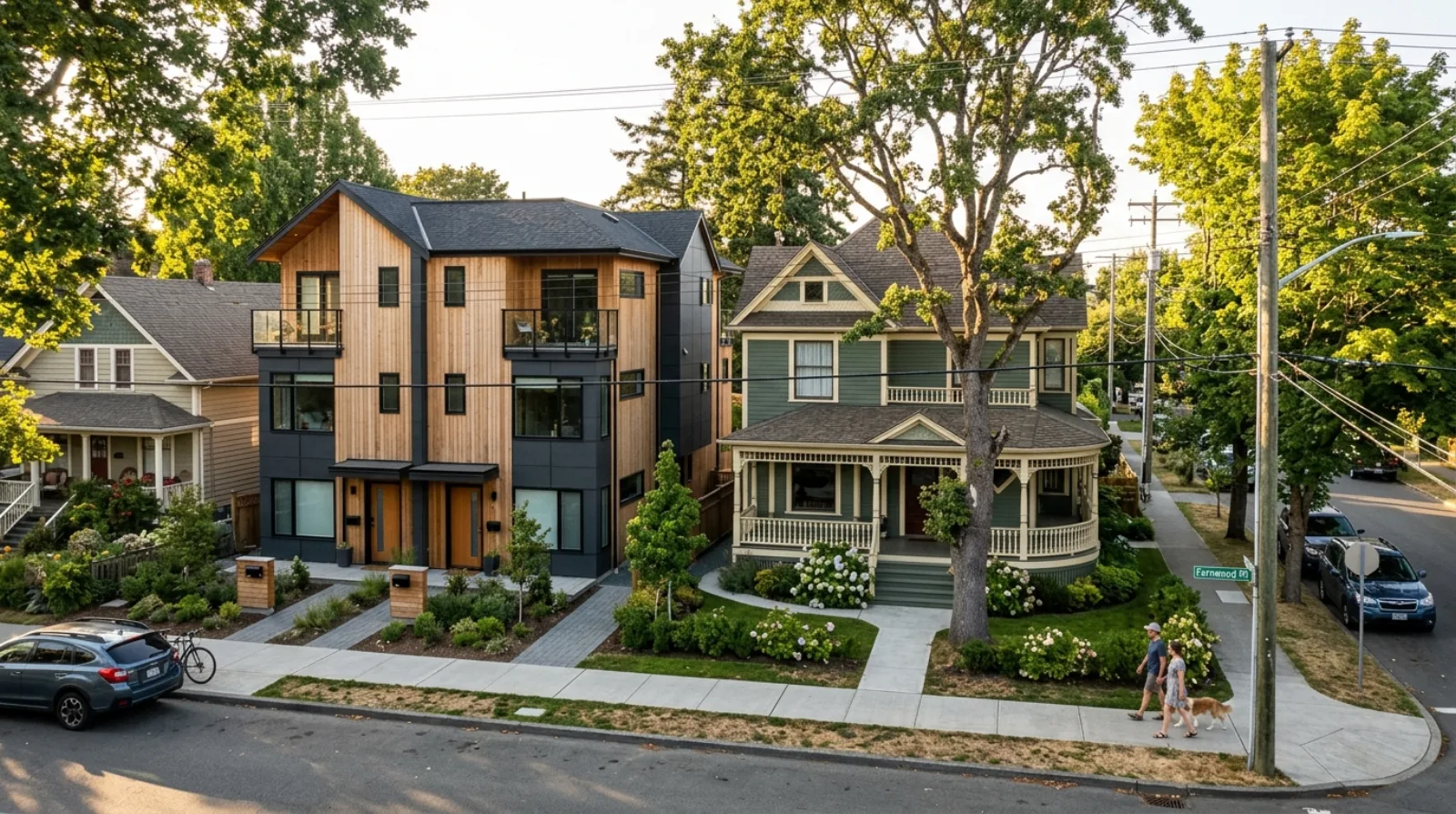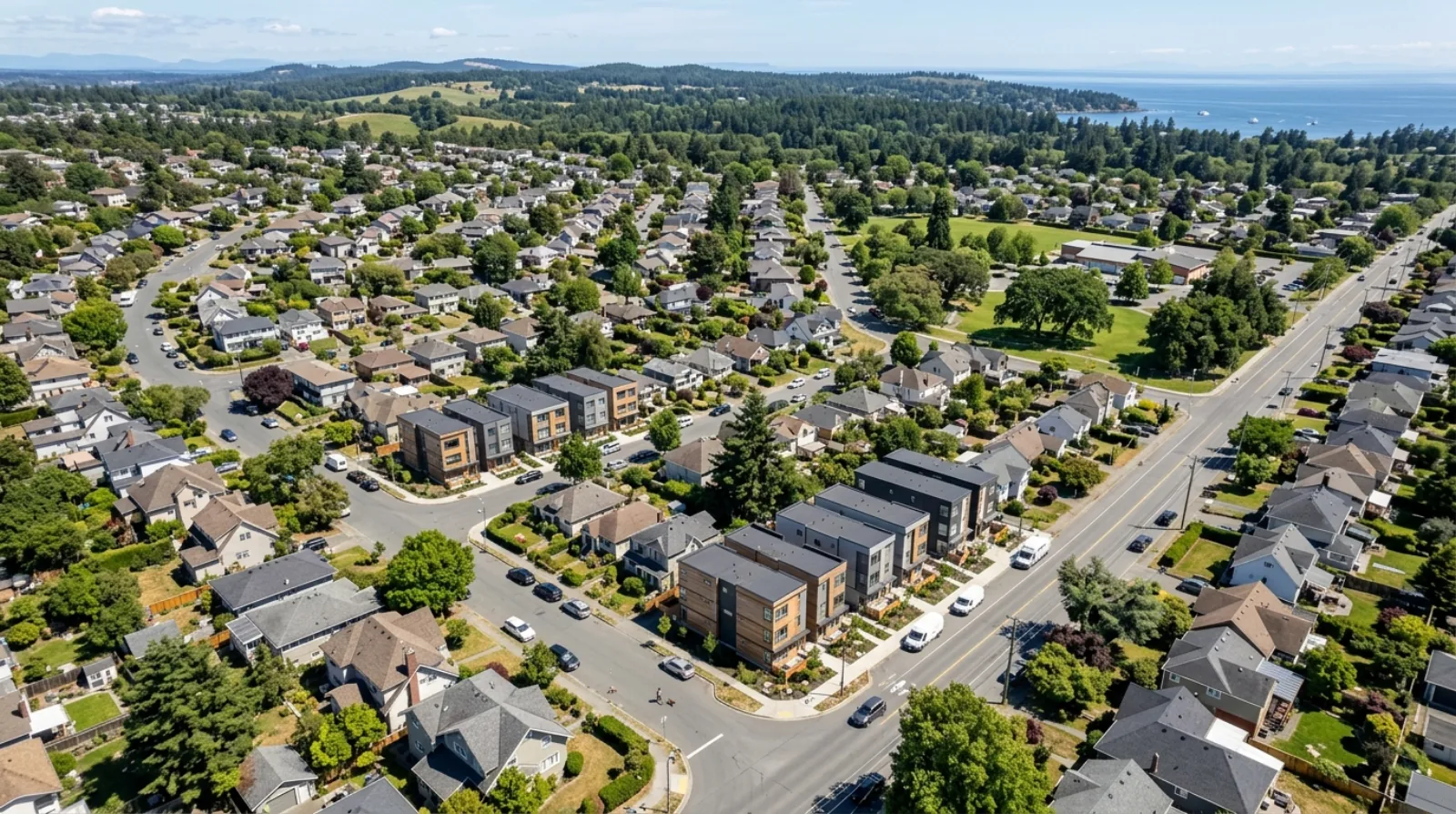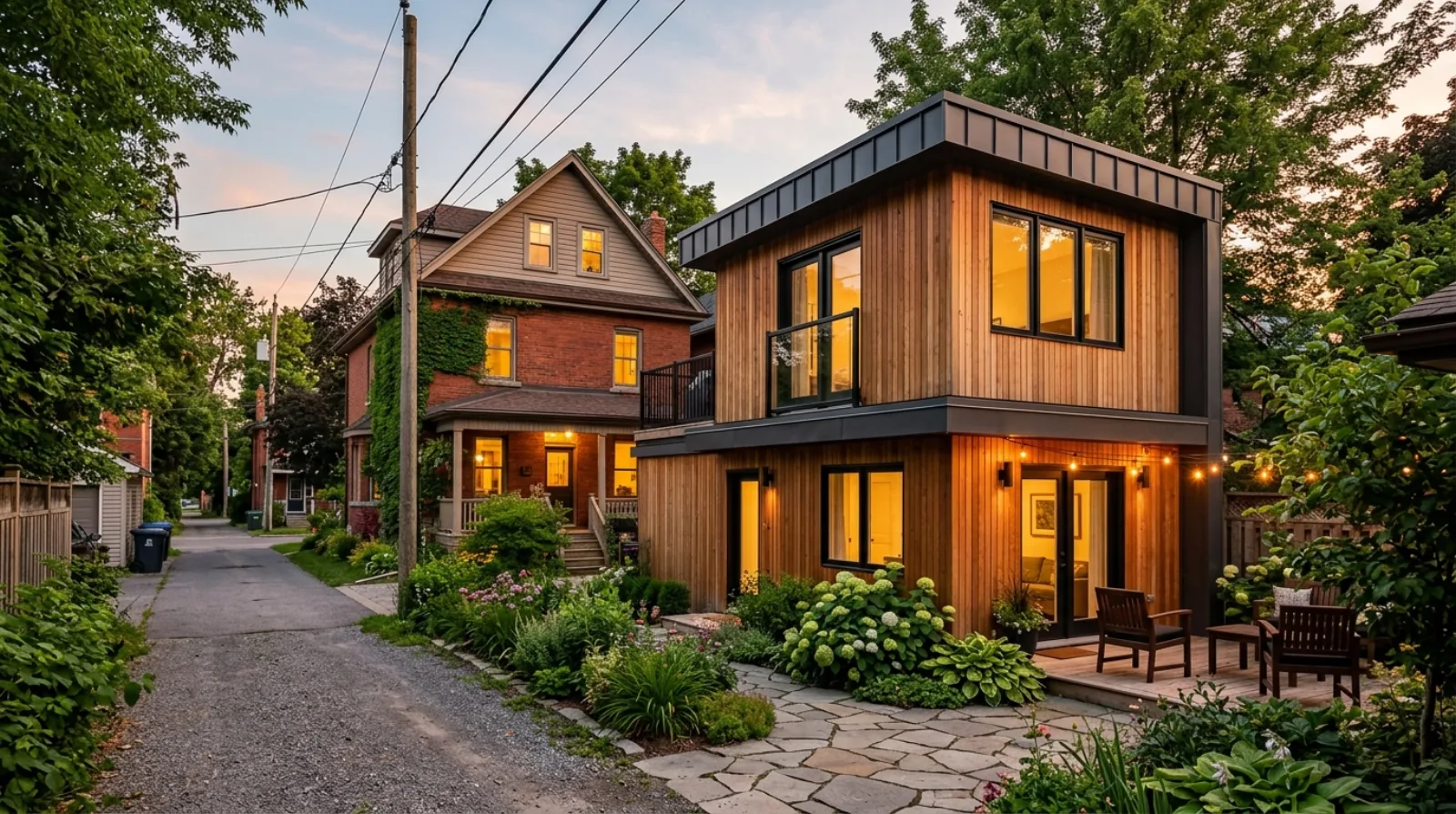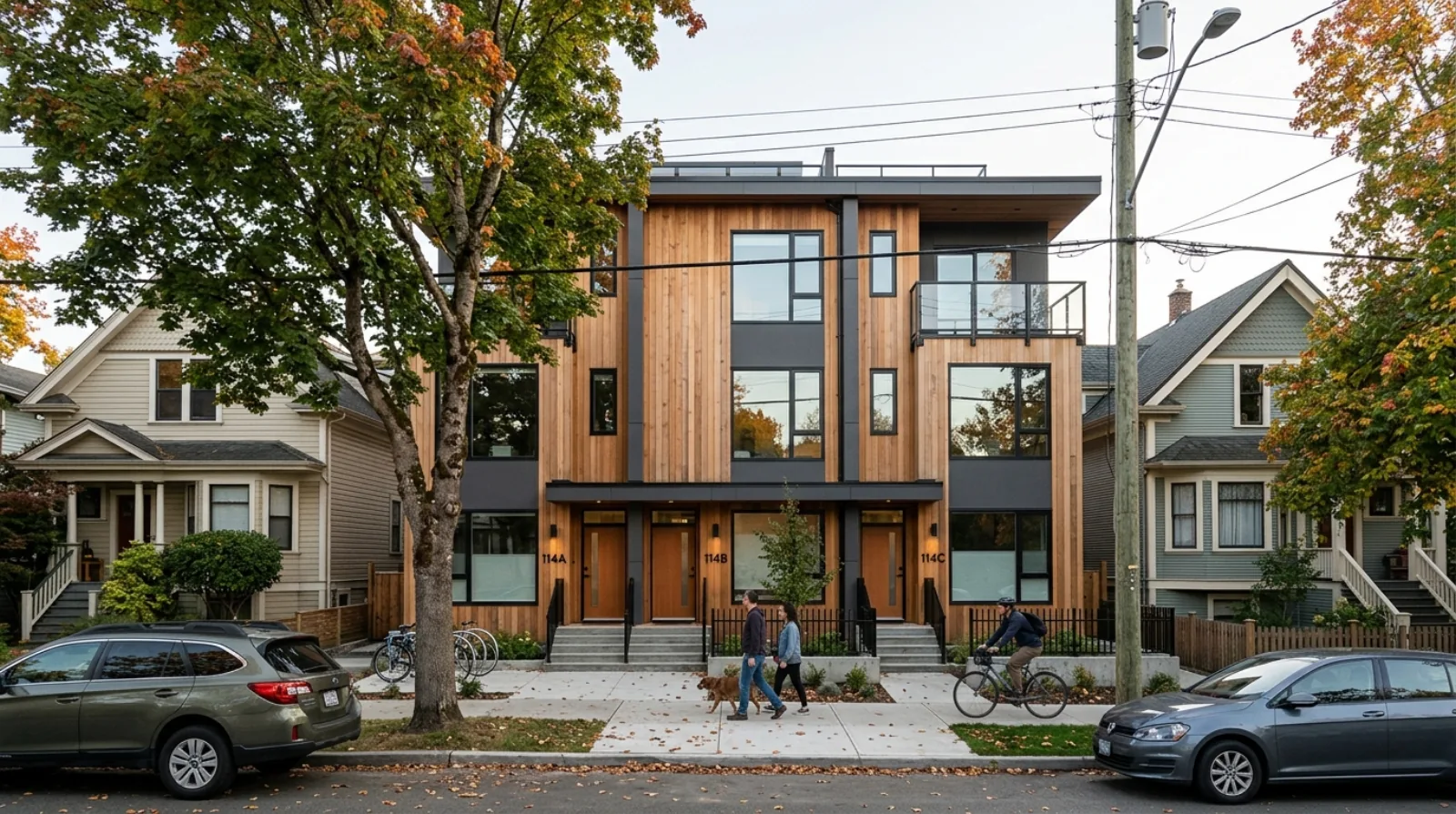

Say you own a single-family home on a standard lot in Fairfield, and you have heard that Victoria now lets you build six homes where one stands today. Is that real, and what would it take? This is the walkthrough — from the two-gate eligibility test to the rules that decide how big the building can be.
TL;DR
- Victoria’s Missing Middle Housing Initiative lets a houseplex of up to six units replace a single-family home in Traditional Residential areas — with no rezoning and no public hearing for a compliant project.
- Two gates must both be open: the lot must be designated Traditional Residential in the Official Community Plan, and zoned R1-B, R1-G, R1-A, or R-2. See is your lot eligible.
- The Schedule P rules cap a houseplex at 1.0 floor space ratio, 40% site coverage, 11–12 m height, with a 12 m minimum lot width and a rear yard of the greater of 10 m or 25% of lot depth.
- A houseplex with more than three units needs a development permit and, at four-plus units, triggers Development Cost Charges.
- At least the greater of two units or 30% of units must be three-bedroom homes.
Start with the two gates
Before anything else, confirm two things about your Fairfield lot. First, the Official Community Plan has to designate it Traditional Residential. Second, the zone has to be one of R1-B, R1-G, R1-A, or R-2. Both must be true. A lot in the right zone but a different designation is not eligible, and neither is the reverse.
This is the step most owners skip. It is also the cheapest one to get right — you can check both before you spend a dollar on a survey. Our eligibility page walks through where to look.
What “six units” actually means
Victoria’s bylaw defines a houseplex as a building of three to six self-contained units, where at least half of the units have direct access to the outside. Six is the ceiling, not a guarantee. Whether your lot reaches it depends on its dimensions and how the rules stack up.
If your Fairfield lot happens to be a corner lot at least 18 m wide near two streets, a different form — the corner townhouse — opens up, with a cap of twelve units. Most Fairfield lots are interior lots, so the houseplex is the form to plan around.
The rules that size the building
The Schedule P Missing Middle Regulations set the envelope. For a houseplex:
- Floor space ratio: 1.0
- Site coverage: up to 40%, with at least 45% open site space
- Height: 11 m flat roof, 12 m other roof
- Front yard: 4 m; side yard: 1.5 m
- Rear yard: the greater of 10 m or 25% of lot depth
- Lot width: 12 m minimum (14 m if more than one parking space is required)
On a typical Fairfield lot, the rear-yard rule and the 40% coverage cap usually decide how much building you get before the height limit ever comes into play. Our lots and setbacks page shows how lot shape changes the answer.
The three-bedroom requirement
Victoria did not just allow more units — it steered them toward families. A houseplex is permitted only if the greater of two units, or 30% of the units, are three-bedroom homes. A useful 2023 amendment lets bedrooms in a secondary suite count toward a principal unit’s bedroom total, which makes the requirement easier to satisfy.
This matters more than it looks. Three-bedroom-plus units command the highest rents in the CMHC data, so the product the bylaw mandates is also the product the market pays most for.
Where the cost and process step up
A houseplex of three or fewer units can skip both the development permit and municipal Development Cost Charges. Cross to four units and two things switch on: a development permit reviewed against the General Urban Design Guidelines, and per-unit DCCs plus Amenity Cost Charges. That makes the three-to-four-unit decision a financial one, not just a design one — covered on our cost charges page.
One more thing specific to a lot like Fairfield’s: if your existing house has a tenant, tenant protection obligations switch on — compensation, moving help, and a right of first refusal — regardless of how many units you build.
The honest version
Six units on a Fairfield lot is real, and the no-public-hearing path removes the biggest source of delay. But “permitted” and “buildable” are not the same thing. Your lot’s width, depth, grade, and any heritage status will decide what actually fits. Start with the two gates, confirm the Schedule P envelope against your dimensions, and price the jump to four units before you commit.
Start with the Victoria Multiplex hub, or check your specific address against the rules.