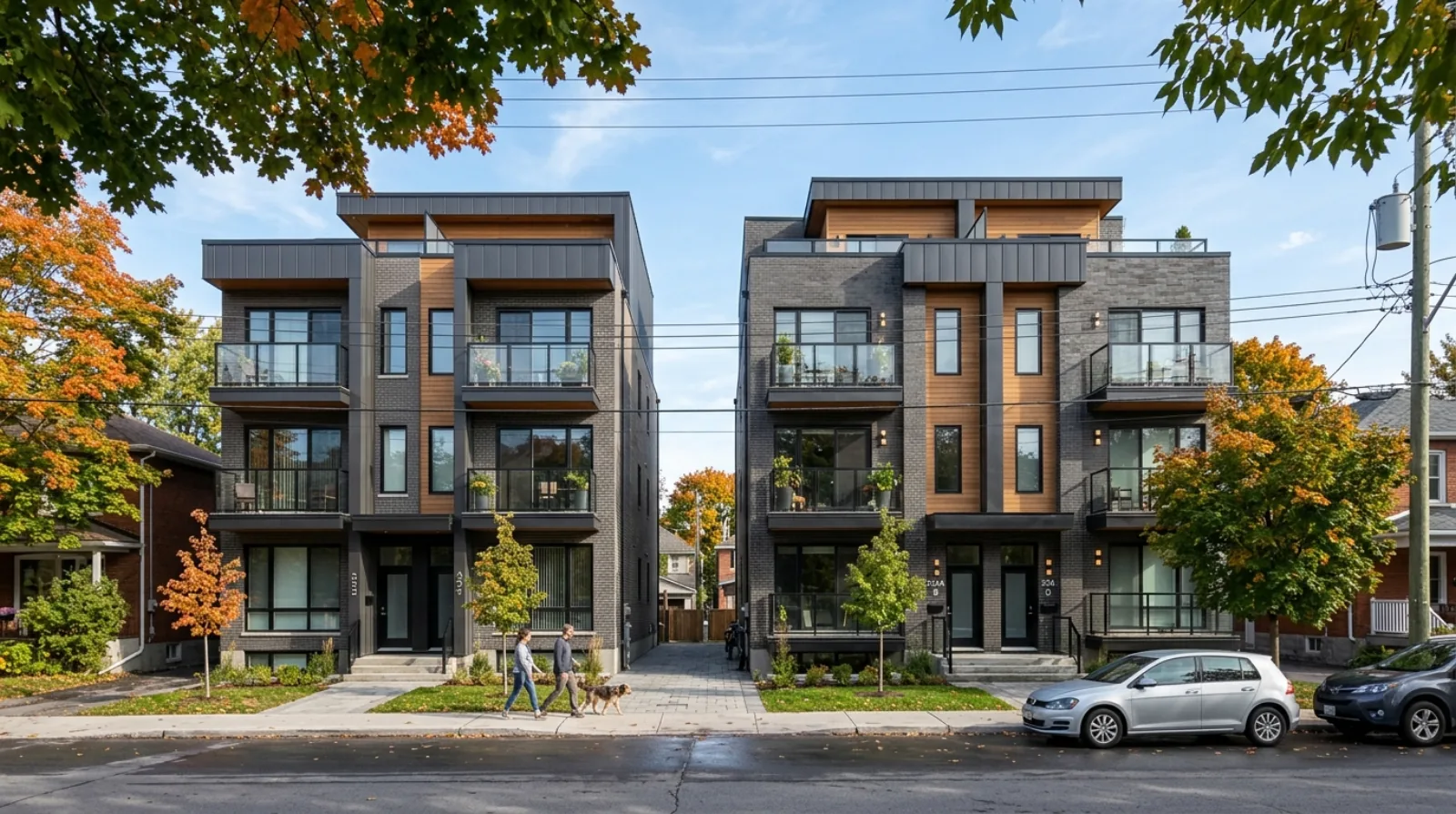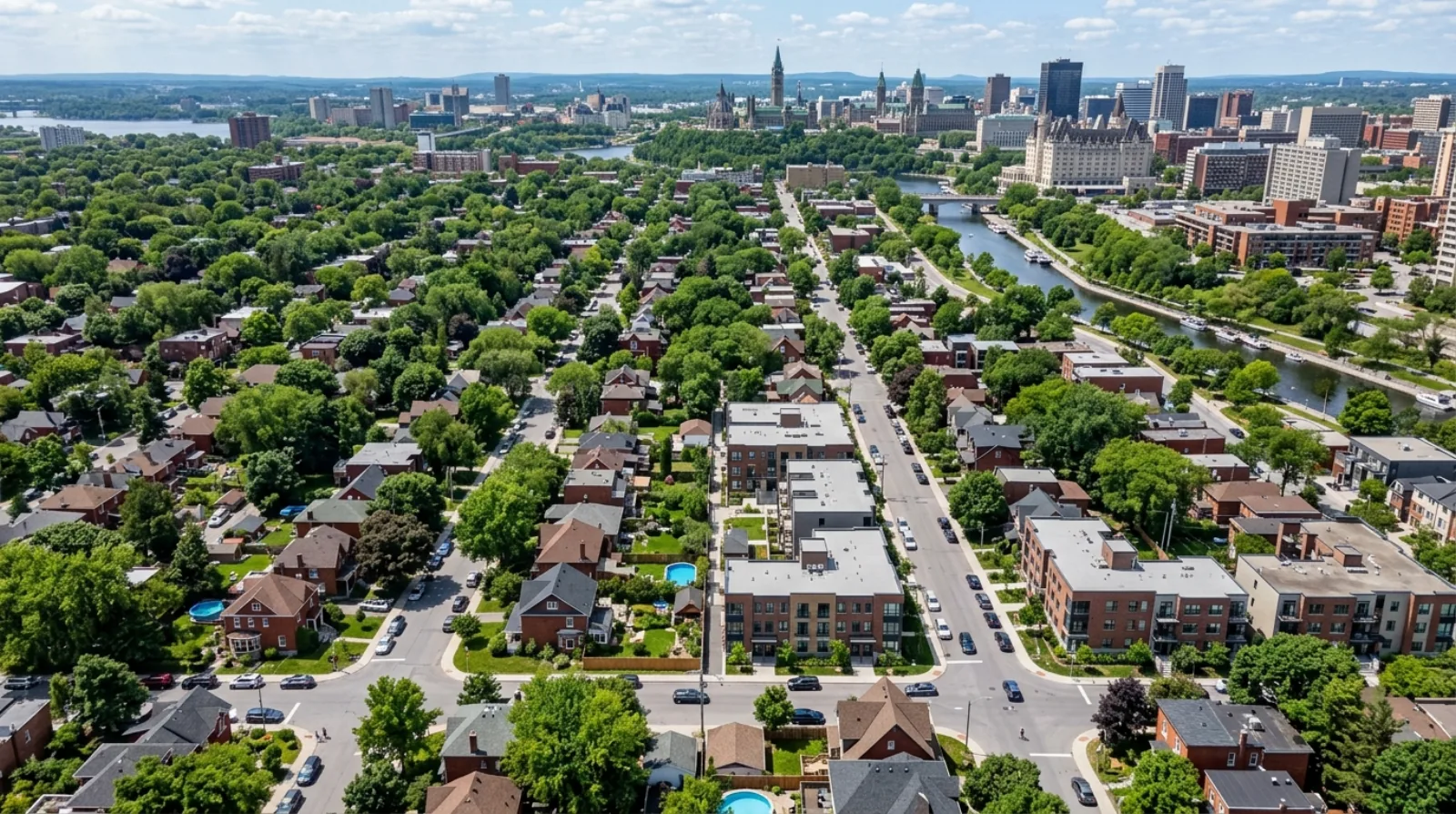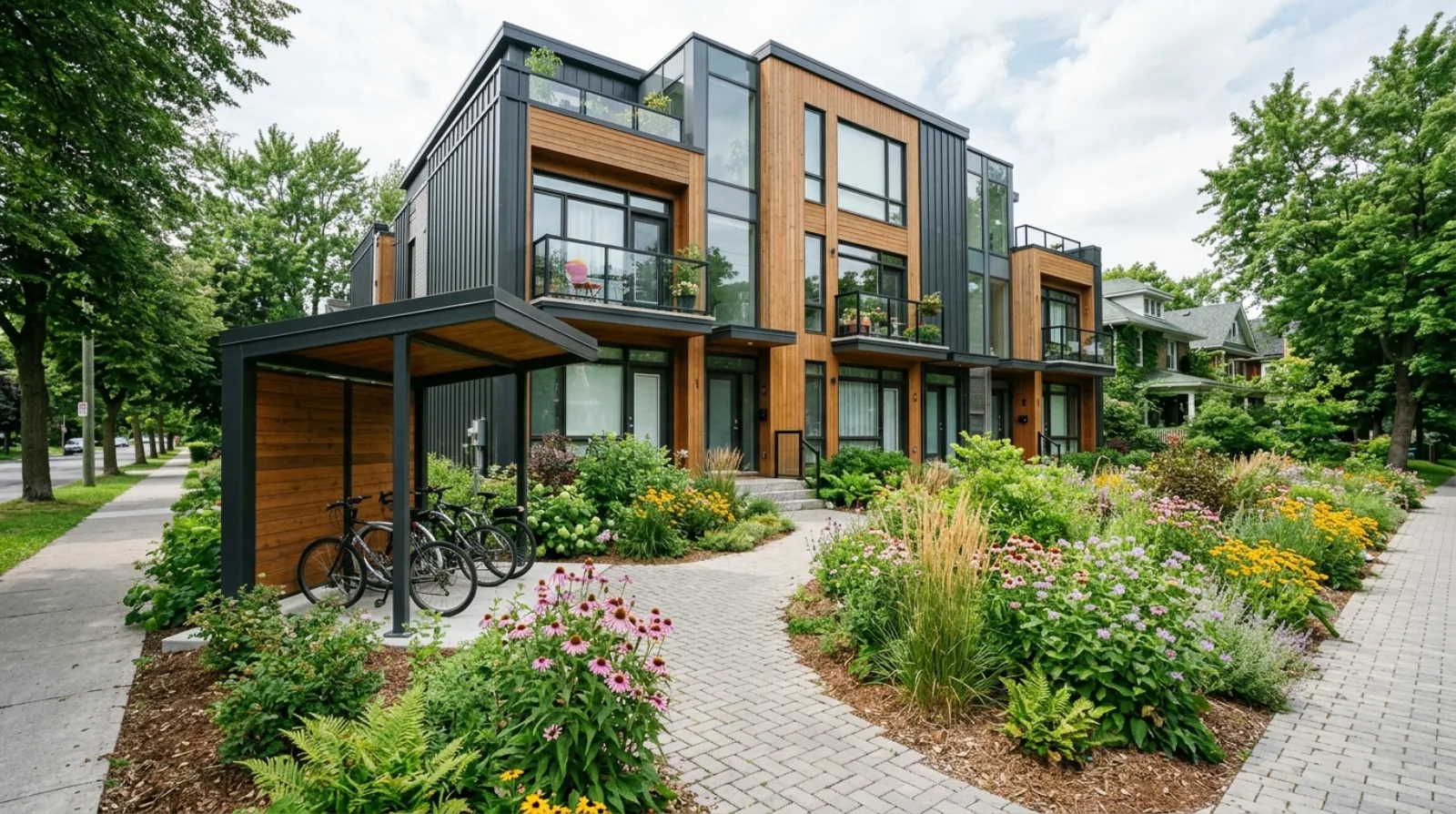

Most zoning changes get headlines for the obvious thing they do. Ottawa’s new Zoning By-law 2026-50 got them for allowing up to four units as-of-right on a serviced residential lot. That’s the part that travels well in a news clip. But there’s a quieter change buried in the same by-law that may matter more for whether a small multiplex actually gets built: the city removed minimum parking requirements city-wide.
No more mandatory stalls. For any residential development, anywhere in Ottawa.
TL;DR
- Ottawa’s Zoning By-law 2026-50 (approved January 28, 2026, enacted March 11, 2026) removed minimum parking requirements across the entire city for residential development.
- The same by-law allows up to four units as-of-right on a serviced lot, organized under size-based N1–N4 zones.
- Ontario’s Bill 23 (2022) only removed parking minimums near major transit stations. Ottawa went city-wide.
- “No minimum” does not mean “no parking.” The builder decides how much to provide, based on the site and the tenants — not on a formula.
- For a fourplex on a standard lot, freed-up yard space is often the difference between a project that fits and one that doesn’t.
What a parking minimum actually costs a multiplex
A parking minimum is a rule that says: for every X units, you must provide Y parking stalls. Sounds harmless. On a small lot, it isn’t.
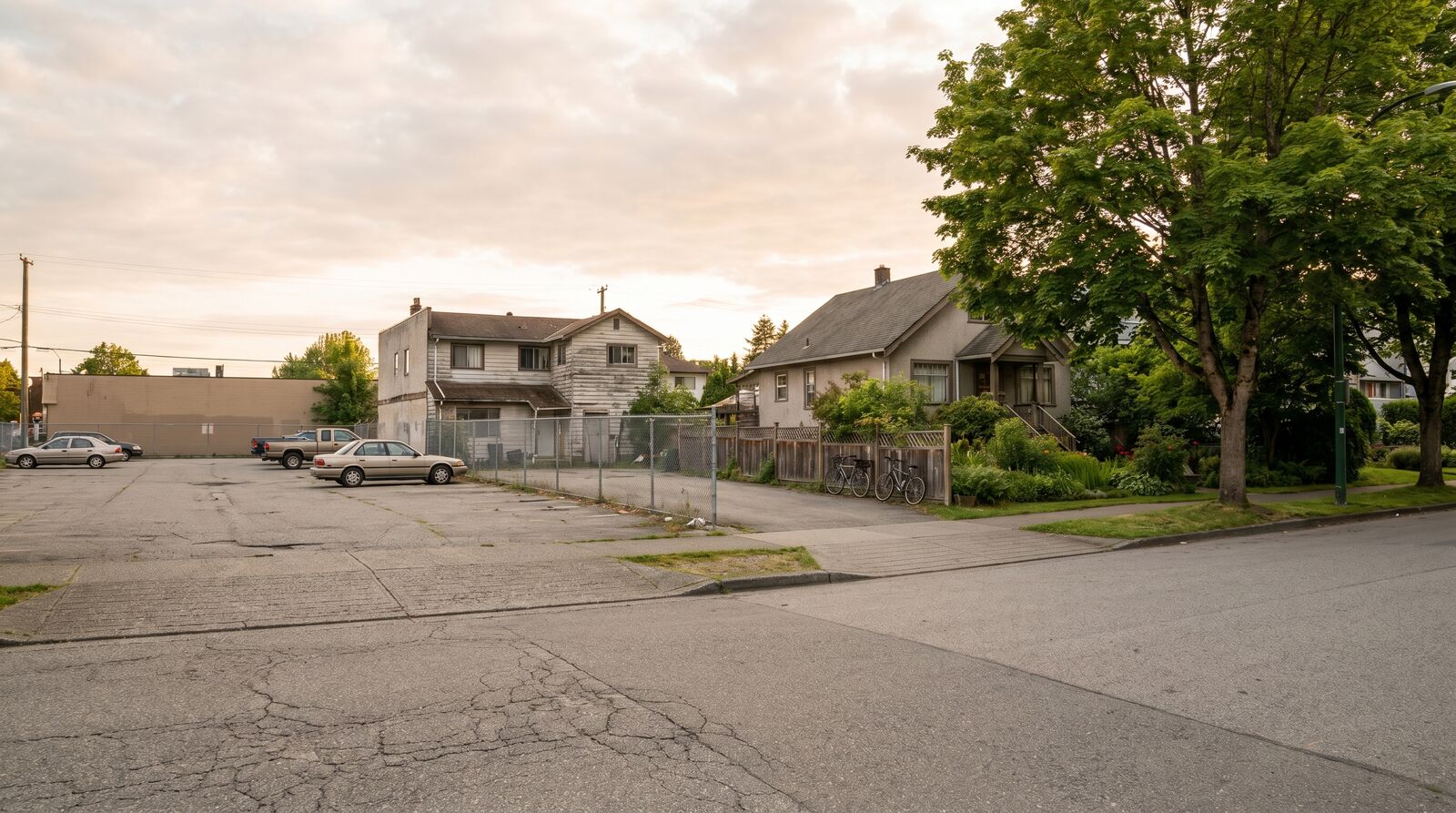
Each required stall needs a physical footprint — the stall itself plus the drive aisle to reach it. On a standard urban lot, two or three required stalls can eat the entire rear yard. That space is then unavailable for the building. So the choice becomes: shrink the units, drop a unit, or pour more concrete than the site can really carry.
For a single-family home, one or two stalls is no problem. For a fourplex on the same lot, a per-unit parking minimum can quietly make the fourth unit impossible. The zoning says four units are allowed. The parking rule says the lot can’t hold them. The second rule wins.
That’s the trap parking reform removes. When the minimum is gone, the lot’s buildable area is governed by setbacks, height, and lot coverage — the things that actually shape a building — not by a stall count.
Why this pairs with four units as-of-right
Ottawa didn’t remove parking minimums in isolation. It did it in the same by-law that permits four units as-of-right on a serviced lot, under the new size-based N1–N4 zones.
The two changes work on each other. As-of-right permission for four units tells you what you’re allowed to build. Removing the parking minimum tells you whether four units physically fit. One without the other is half a reform.
Consider the math on a typical lot. You’re allowed four units. Before, you might have needed several stalls to satisfy the minimum — and those stalls, plus their drive aisle, claimed the back third of the property. After the change, that land is back in play. You can use it for the building, for a private yard, for amenity space, or for the parking you choose to provide. The point is that it’s a design decision now, not a code obligation.
This is what makes the fourplex realistic on lots where it wasn’t before. The form was always permitted in theory once the unit count allowed it. The parking minimum was the thing keeping it on paper.
”No minimum” is not “no parking”
This is the part that gets misread, so it’s worth being plain about it.
Removing the parking minimum does not ban parking. It does not require builders to provide zero stalls. It removes the floor, not the ceiling. A builder can still provide one stall per unit, or two, or none — whatever the site and the renters actually need.
That distinction matters. A fourplex marketed to families in a car-dependent part of Ottawa will probably include parking, because tenants will want it and it supports the rents. A fourplex steps from a transit line might skip most of it and put that land toward the building instead. Under the old rules, both projects were forced toward the same stall count regardless of context. Now each one is sized to its own situation.
The builder decides. That’s the whole change. The market sets the parking, not a table in a by-law.
How this differs from Bill 23
Ontario already touched this at the provincial level. Bill 23, the More Homes Built Faster Act, removed minimum parking requirements for residential development near major transit station areas back in 2022.
Near major transit stations. That’s the limit. Bill 23’s parking change was geographic — it applied where the province judged transit could carry the load, and nowhere else.
Ottawa went further. By-law 2026-50 removed the minimums city-wide, not just in transit zones. A lot in a quieter residential pocket with no rapid transit nearby gets the same relief as one next to an O-Train station.
That breadth is the significant part. Transit-area parking reform helps the handful of lots near stations. City-wide reform reaches the ordinary residential lot — the kind most small multiplex projects actually sit on. Ottawa’s council approved the new zoning law as part of a broader push to enable housing, and the city-wide scope is what separates it from the narrower provincial baseline.
What it means for feasibility
Parking reform shows up in two places on a project’s math.
The first is land use. Freed-up yard space is buildable area that used to be paved. On a small lot, that can be the margin between three units and four — and the fourth unit is often where a project starts to pencil. More units across the same land cost spreads the fixed expenses further.
The second is cost. Structured or surface parking is not free to build. When the minimum forced stalls onto a lot that didn’t want them, that was cost added to satisfy a rule rather than a tenant. Removing the requirement lets the builder spend that money where it earns a return — or not spend it at all.
We won’t put a dollar figure on any of this, because the right number depends entirely on the lot, the design, and what renters in that pocket of Ottawa actually want. The honest version is: removing the parking minimum widens the set of lots where a small multiplex works, and on the lots where it already worked, it improves the design freedom. How much depends on the parcel. That’s exactly the kind of question feasibility analysis exists to answer, lot by lot.
The quiet enabler
City-wide parking reform doesn’t make for a dramatic headline. Allowing four units as-of-right does. But the four-unit permission only matters if four units fit, and on a lot full of mandatory stalls, they often didn’t.
Removing the minimum is the change that lets the unit-count change do its job. It’s less visible and, on a lot-by-lot basis, frequently more decisive.
If you want the full picture of how these pieces fit together — the unit-count rules, the zone system, the financing, and how a specific lot actually pencils — start with our hub on Missing Middle Housing in Ottawa.
Sources
- City of Ottawa, new Zoning By-law 2026-50 — engage.ottawa.ca/zoning
- City of Ottawa, “Council approves landmark new zoning law to enable housing and economic development” — ottawa.ca newsroom
- Legislative Assembly of Ontario, Bill 23, More Homes Built Faster Act, 2022 — ola.org
David Babakaiff is Co-Founder of VanPlex and a 2024 HAVAN Award winner. PlexRank™ | Profit with Multiplex.