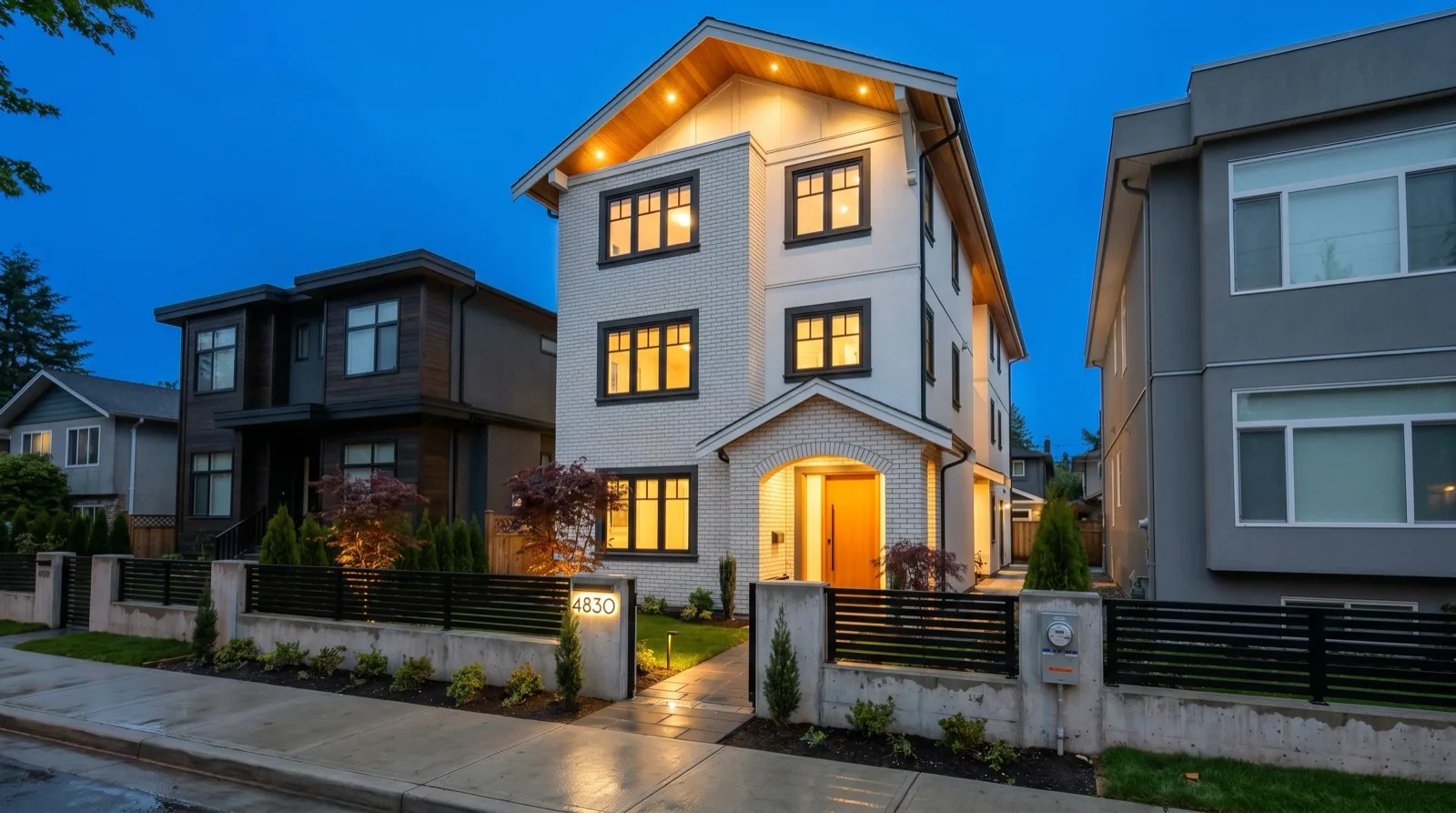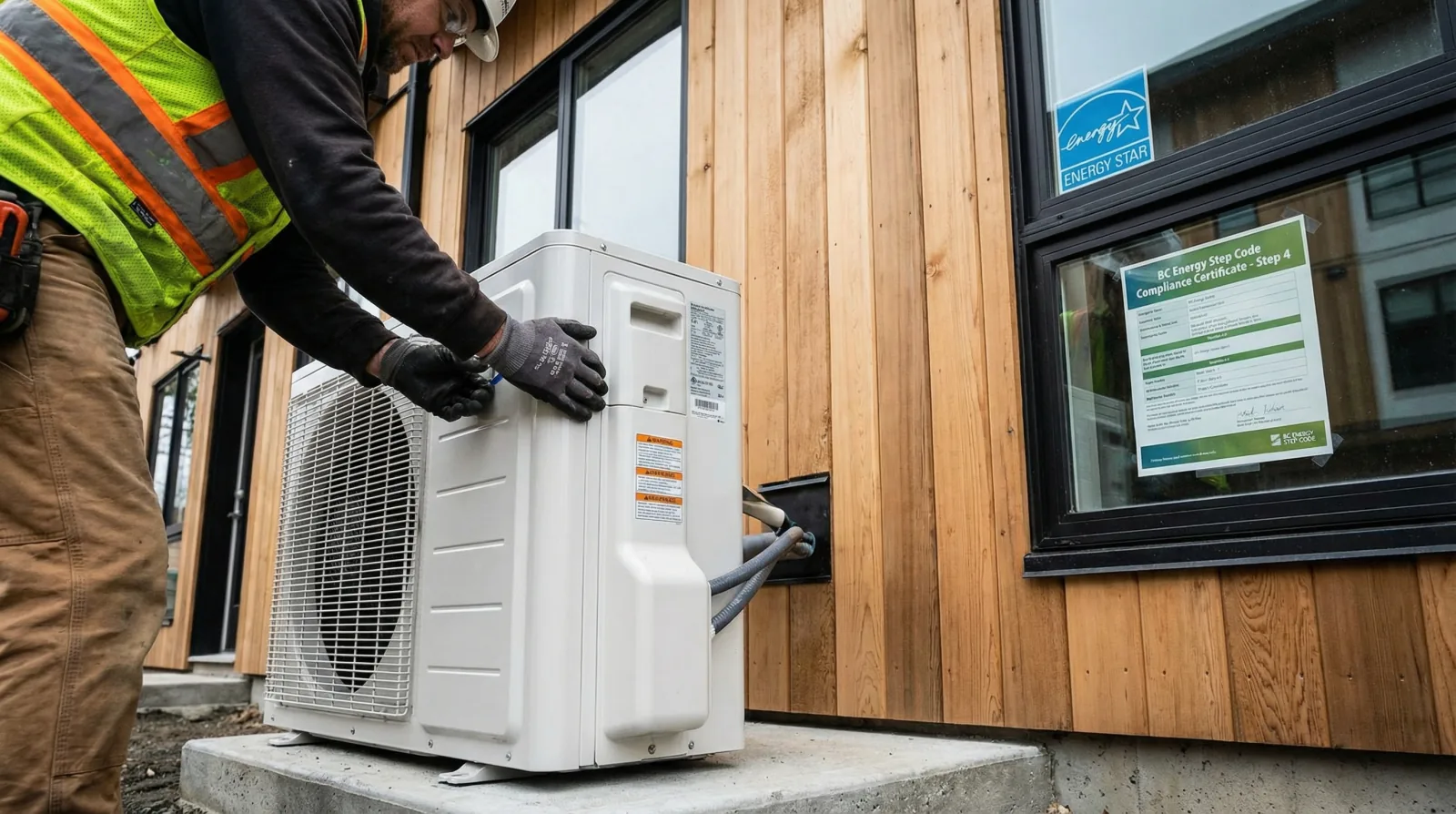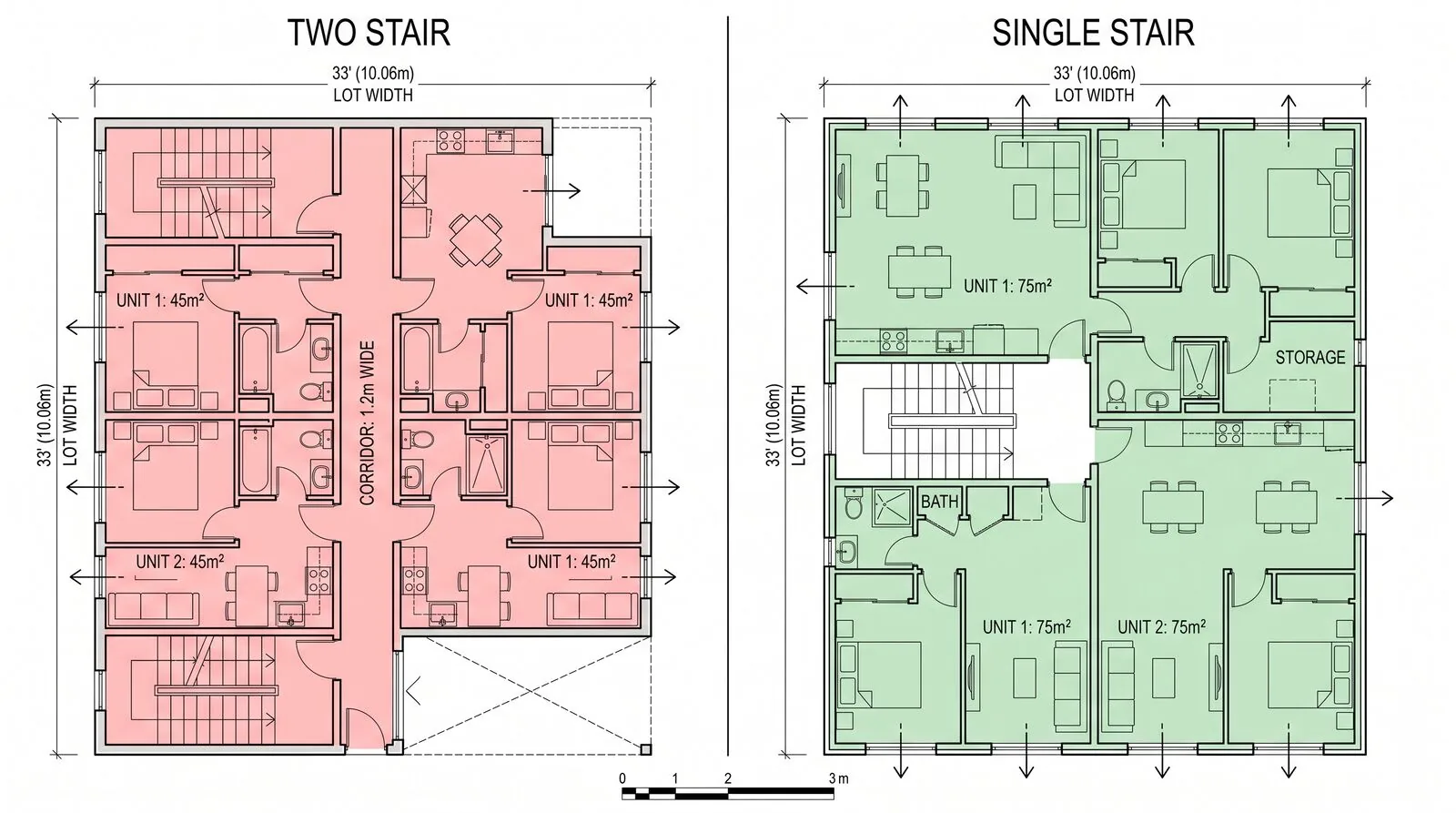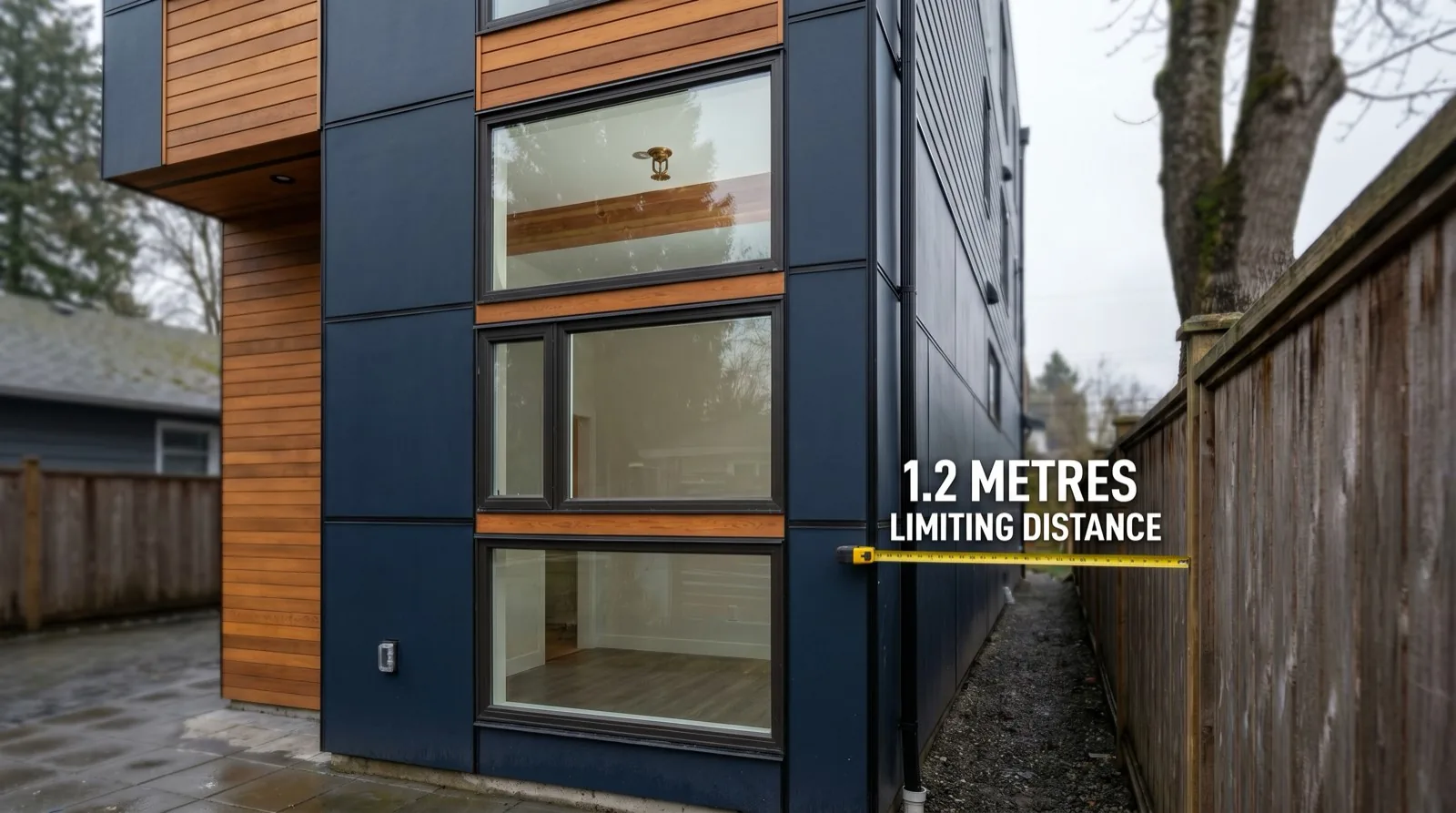

A builder asked the question every multiplex designer eventually runs into: can a residential sprinkler system replace the fire-rated windows, fire shutters, and rated wall assemblies the code wants on a tight-lot multiplex? Cost on the table: $50,000–$75,000 for an NFPA 13D sprinkler + pump versus the stack of fire-rated glazing, shutters, and Type X assemblies on a multiplex squeezed against a 1.2 m side yard. Insurance discount on the other side of the trade.
Short answer: the trade is real under the BC Building Code Part 9, but it’s a reduction, not an elimination — and your limiting distance to the property line is what actually decides how much you get back.
TL;DR
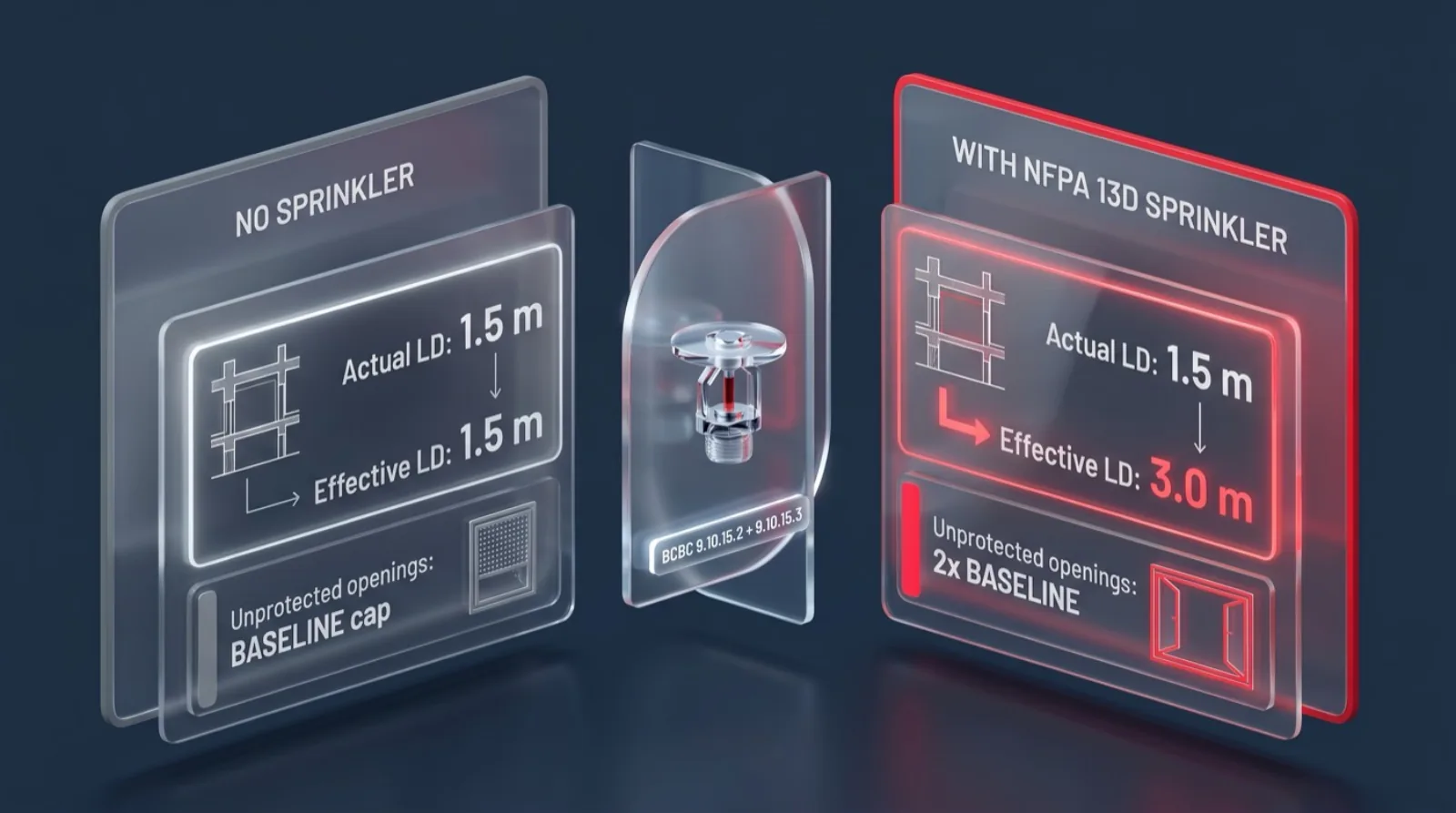
- What the code does: BCBC Sentence 9.10.15.2 and 9.10.15.3 let a sprinklered building either double the allowable area of unprotected openings or treat the limiting distance as if it were twice the actual distance to the property line. Sprinkler must be NFPA 13D compliant.
- What you don’t get: Outright elimination of fire-rated assemblies. At very tight LDs (under 1.2 m), you still need tempered/wired/laminated glass and a rated exposing face per BCBC 9.10.15 — sprinklers just raise the opening cap to 10%.
- The catch on coverage: For the reduction credit, every room adjoining the exposing face — closets, bathrooms, the works — must be sprinklered, even rooms NFPA 13D normally exempts.
- Don’t forget the alarm: Sprinklered Part 9 builds usually pair with a monitored fire alarm. Two systems to inspect and pay for annually.
- The real cost compare: $50K–$75K is roughly right for a sprinkler + pump on a lot that needs a tank. On a city lot with adequate municipal pressure, it lands lower. Insurance discounts on sprinklered SFD/multiplex stock are typically 5–15% on the structure premium.
What BCBC 9.10.15 actually trades
Section 9.10.15 of the BC Building Code governs spatial separation between houses and small Part 9 buildings. The two levers that change when you sprinkler a building:
-
Unprotected opening area (Sentence 9.10.15.2). The default table caps the percentage of unprotected openings (windows, doors) based on the area of the exposing building face and the limiting distance. When the building is sprinklered to NFPA 13D, the maximum aggregate area of unprotected openings can be up to twice the table value, provided the rooms behind those openings are sprinklered.
-
Limiting distance treatment (Sentence 9.10.15.3). For a sprinklered building, the limiting distance can be treated as twice the actual distance for purposes of the opening calculation. A 1.5 m side yard reads as 3 m on the table.
These don’t make fire-rated glazing or rated assemblies disappear. They shift where the line is drawn between “compliant with regular tempered glass” and “needs a rated assembly.” On a typical 33-foot Vancouver lot with a multiplex pushed to the side yard envelope, that shift is the difference between speccing standard double-glazed vinyl windows and ordering wired-glass or 45-minute rated units at 3–4× the price.
“LD is the thing” — what Property Pathways was getting at
The builder who responded to the original question nailed the design call: limiting distance determines how much sprinkler reduction you can actually access. Three rough zones on a Part 9 multiplex:
- LD ≥ 2.4 m (~8 ft): You probably don’t need the sprinkler trade. Standard glazing and assemblies pencil at code without help.
- LD between 1.2 m and 2.4 m: This is the sweet spot for the sprinkler trade. Sprinkler doubles your effective LD, you skip most rated glazing, you keep regular window units.
- LD under 1.2 m: You still face hard restrictions. Per BCBC 9.10.15, where LD is between 1 m and 1.2 m on a sprinklered residential building, unprotected openings cap at 10% of the exposing face — and the glass must be tempered, wired, or laminated, with the exposing face built to Article 9.10.14.5. The sprinkler doesn’t get you out of jail; it just keeps you in the game.
On a sixplex pushed against a 1.0–1.2 m side yard envelope — which is what most City of Vancouver R1-1 multiplex designs end up doing on a 33-ft lot — you’re in zone 3. The trade is worth doing, but the savings aren’t in eliminating fire-rated glass on every elevation. They’re in how many rated openings you need on the close-yard face, which is usually just one elevation.
Where the $50K–$75K number lands
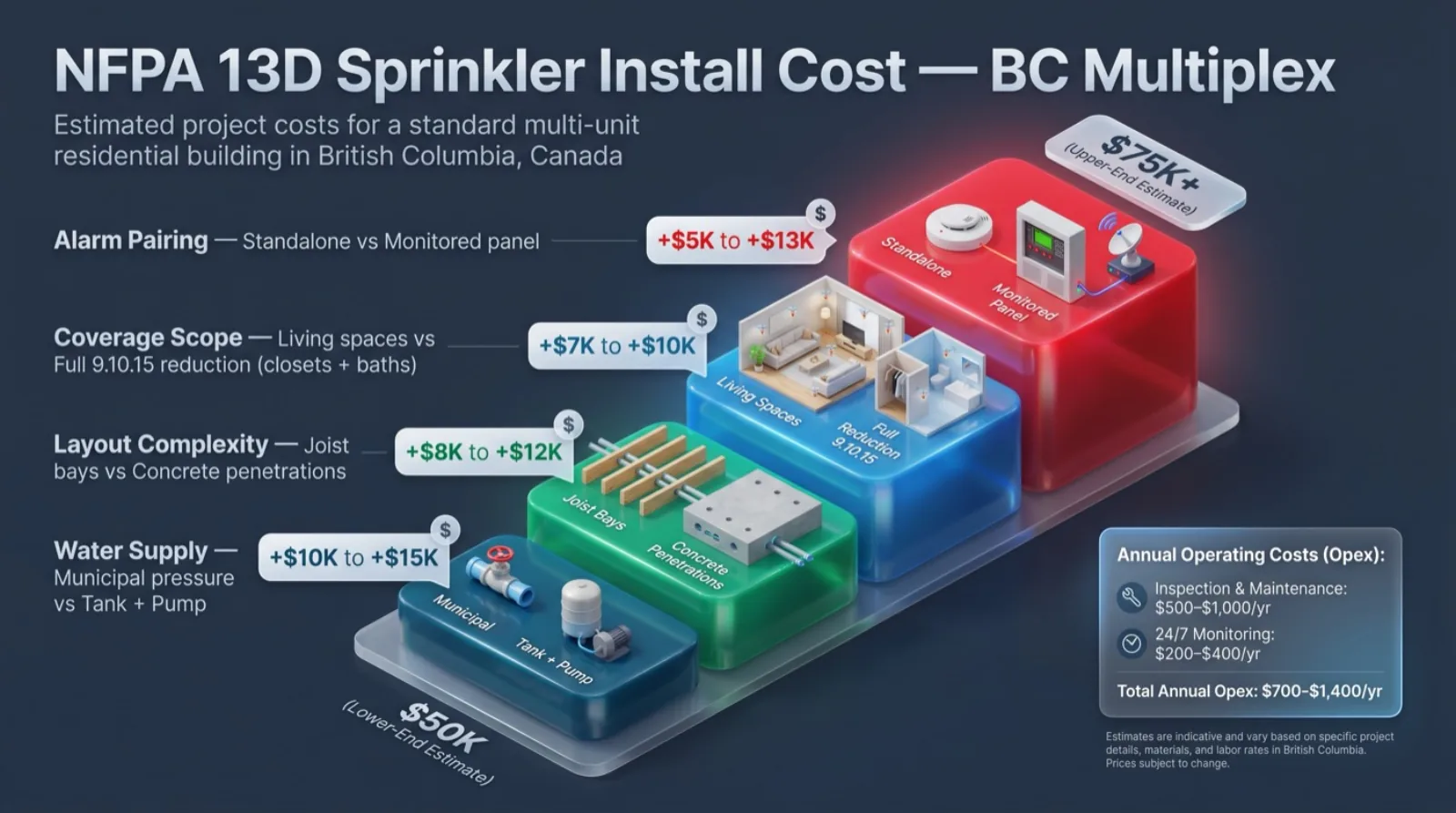
The original builder’s range is realistic, but it’s a wide range for a reason. Two big swing factors:
| Cost driver | Lower end (~$50K) | Upper end (~$75K+) |
|---|---|---|
| Water supply | Municipal pressure adequate, no tank or pump required | Tank + dedicated pump + backup power on a sloped lot or low-pressure feed |
| Layout | Standard joist bays, accessible ceiling, single mechanical room | Concrete slab penetrations, exposed-ceiling design, multiple floors with offset risers |
| Coverage scope | Living spaces only (NFPA 13D baseline) | Living spaces + closets/bathrooms/garages required for 9.10.15 reduction credit |
| Alarm pairing | Standalone NFPA 13D, no monitored alarm | Monitored fire alarm + central station fees |
The closet/bathroom coverage point is easy to miss in budgeting. NFPA 13D exempts those by default. If you want the spatial separation reduction, BCAB decisions have repeatedly held that every room adjoining the exposing face must be sprinklered — exemption stripped. That adds heads, pipe, and a few thousand dollars to the install.
The fire alarm sidecar nobody quotes
A sprinkler isn’t an alarm. On a Part 9 multiplex, you’ll typically end up with:
- Sprinkler waterflow switch wired to a monitored fire alarm panel
- Smoke alarms interconnected per BCBC 9.10.19 (this is required either way)
- Central station monitoring contract — somewhere in the $300–$600/year range per building
Annual sprinkler inspection and backflow testing add another $400–$800/year. Over a 30-year hold, you’re looking at $30K–$45K in opex on the sprinkler + alarm pairing. Not a deal-killer, but it has to live in the proforma if you’re claiming a sprinkler insurance discount on the other side.
Insurance: real discount, smaller than you think
Sprinklered residential buildings do get rated lower for fire premium in BC. The realistic discount on a residential strata or rental multiplex is in the 5–15% range on the property portion of the premium, depending on insurer and whether the alarm is monitored. On a $4,000/year multiplex policy that’s $200–$600/year — meaningful, but it’s not “future insurance costs come down significantly” the way the original question framed it. It’s a useful sidecar to the construction savings, not the main event.
When the trade pencils — and when it doesn’t
It pencils when:
- You have a tight side-yard LD (1.2–2.4 m) on at least one elevation with significant glazing
- The lot has municipal water pressure adequate for NFPA 13D without a tank
- You’d otherwise be ordering 6+ rated glazed units at $2,500–$4,000 each
- The build is 4+ units, so the per-door amortization of the sprinkler + alarm is small
It doesn’t pencil when:
- LDs are generous on every face (≥ 2.4 m all around)
- Lot needs a tank + pump that pushes the install past $80K
- Project is a triplex or smaller where the rated-glazing count was already low
- The exposing face has so much glass that even the doubled cap doesn’t get you compliant — you end up sprinklered AND rated, the worst of both
What to do before your designer commits the path
- Pull the survey and confirm actual limiting distances on every exposing face. Not the setback — the distance to the property line including any encroachments.
- Get a preliminary sprinkler design quote from one NFPA 13D contractor that includes the closet/bathroom coverage required for the 9.10.15 reduction. Get a comparable quote from a glazing supplier for the rated-window package the design would otherwise need.
- Confirm municipal water pressure at the curb stop. The fire department or city engineering will give you a flow test. If you need a tank, that’s a separate $15K–$25K line.
- Price the alarm + monitoring opex and run it through your 10-year hold proforma.
- Then decide.
The sprinkler trade is real and it can save money on tight-lot multiplexes. But the version of this question where someone says “use a sprinkler and skip all the fire-rated stuff” is wrong. The version where someone says “use a sprinkler and right-size the rated glazing to the one elevation that actually needs it” is right.
Frequently asked questions
Does a Part 9 sprinkler eliminate the need for fire-rated windows? No. It reduces the limiting distance restrictions under BCBC 9.10.15, which often means fewer rated windows on the close-yard elevation — but at LDs under 1.2 m, glazing must still be tempered, wired, or laminated, and the exposing face still needs the rated assembly under Article 9.10.14.5.
What NFPA standard applies to Part 9 multiplex sprinklers in BC? NFPA 13D, “Standard for the Installation of Sprinkler Systems in One- and Two-Family Dwellings and Manufactured Homes.” BCBC Part 9 references 13D for residential applications. NFPA 13 (commercial) and 13R (low-rise apartment) apply to Part 3 buildings.
Do I need a fire alarm with a Part 9 sprinkler? Most multiplex projects pair a monitored fire alarm with the sprinkler. The sprinkler waterflow switch is wired to the panel and to a central monitoring station. Smoke alarms are required regardless under BCBC 9.10.19.
How much insurance discount does a sprinkler buy on a multiplex? Typically 5–15% on the property portion of the premium, depending on insurer and whether the alarm is monitored. Useful but not transformative.
Running this trade on your own lot? The VanPlex proforma calculator lets you model sprinkler + alarm capex and opex against the fire-rated assembly alternative on any of the 86,000+ Vancouver and Burnaby properties in the index. The limiting-distance assumption is the one to get right.
Sources: BC Building Code, Section 9.10.15 (free.bcpublications.ca); BC Building Code Appeal Board decisions BCAB 1862, BCAB 1863, BCAB 1942; NFPA 13D residential sprinkler standard.
Original builder discussion thread paraphrased with permission. The Property Pathways Inc. response framing — “LD is the thing, and this is a reduction not an elimination” — is the heart of this post.
— David Babakaiff, Co-Founder, VanPlex | PlexRank™ | Profit with Multiplex