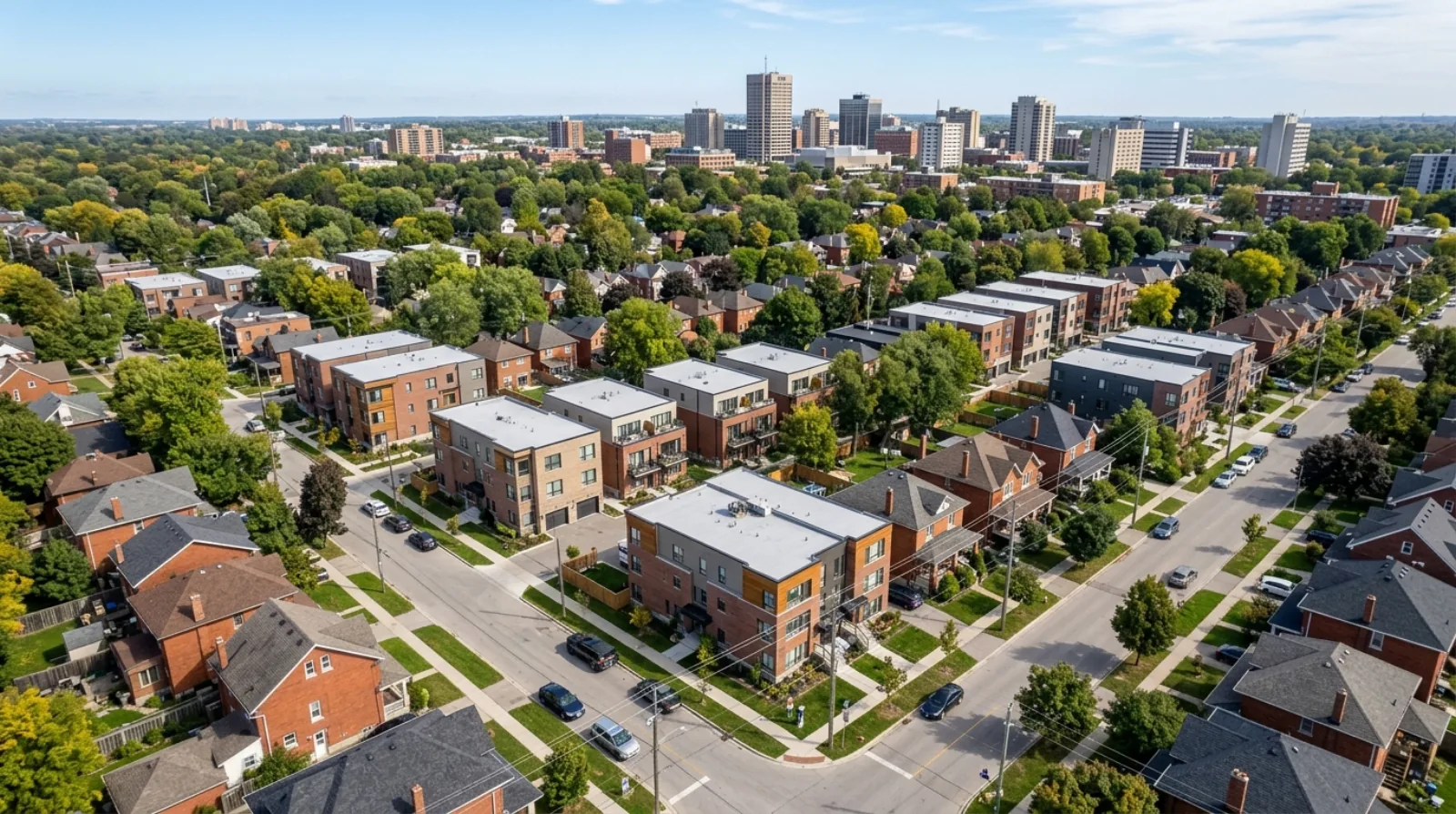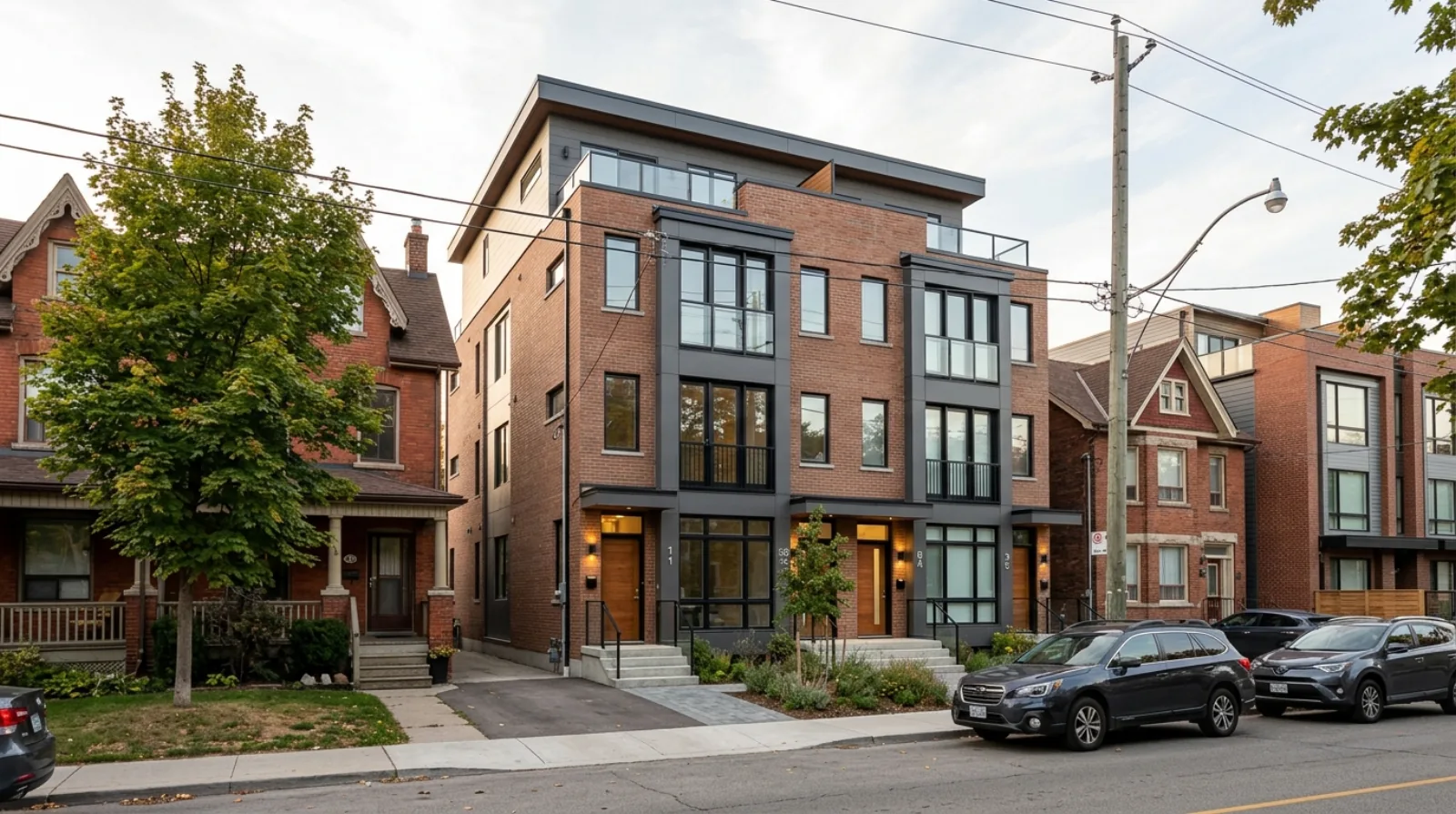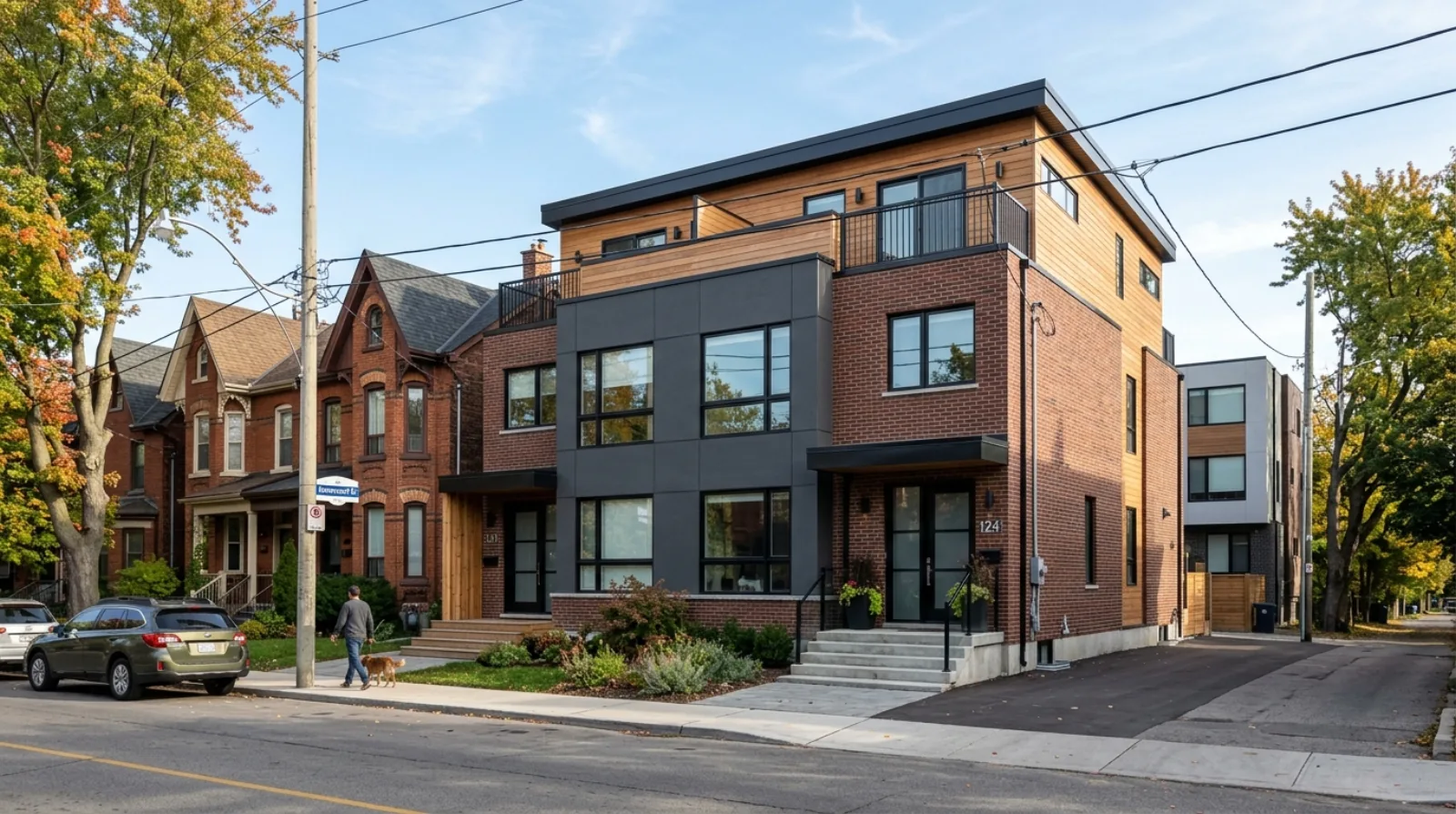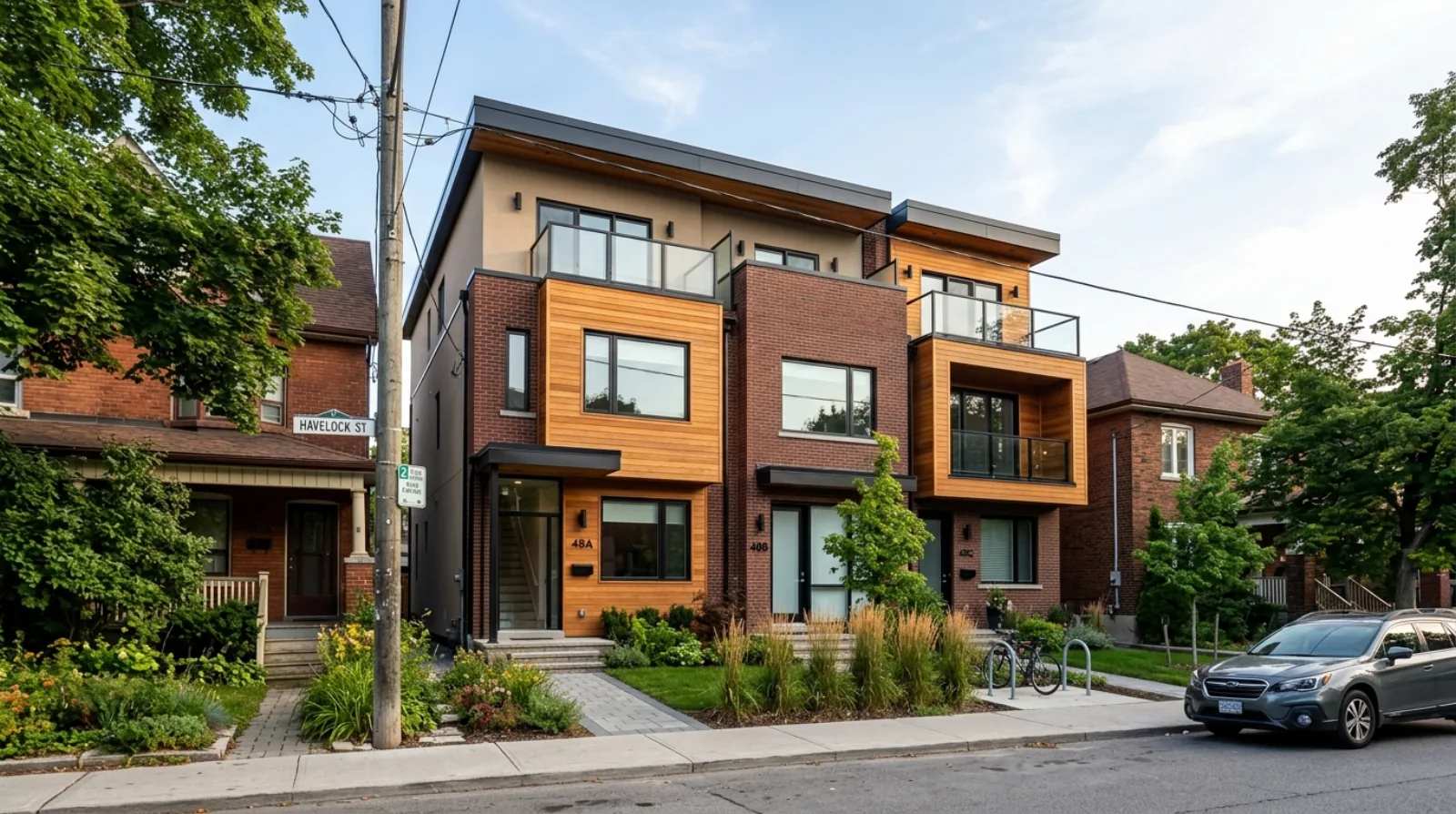

People often say “Toronto allows fourplexes because of Bill 23.” That is not right. The province set a floor of three units. Toronto chose to go to four. Two different governments made two different decisions, and the gap between them matters — especially for development charges, where the provincial exemption stops exactly where the City’s permission keeps going.
TL;DR
- Ontario’s Bill 23 (More Homes Built Faster Act, 2022) received Royal Assent November 28, 2022 and set a province-wide floor of 3 residential units as-of-right on serviced settlement-area lots. Source: ero.ontario.ca.
- Toronto went further: a city-wide fourplex (up to 4 units), adopted by Council May 10, 2023 (OPA Law 0473, Zoning Law 0474). Source: toronto.ca.
- Bill 23 exempts the 2nd and 3rd units from development charges and parkland dedication. It does not automatically exempt a 4th unit.
- Bill 23 also caps required parking at one space per unit and bars minimum-unit-size rules.
- Toronto’s sixplex permissions are a separate, later by-law — 9 wards plus opt-in, not city-wide.
What the province guarantees
Bill 23 amended the Planning Act so that on a serviced parcel inside a settlement area where residential is permitted, up to three units are allowed as-of-right. The standard shapes are three units in the primary building, or two in the primary plus one ancillary (a garden or laneway suite, for example). Alongside that, municipalities can no longer require minimum unit sizes and can no longer demand more than one parking space per unit. The Environmental Registry notice spells this out: ero.ontario.ca/notice/019-6197, with the statute at ontario.ca.
This is a floor, not a ceiling. Every Ontario municipality must permit at least three. Nothing in Bill 23 stops a city from permitting more.
What Toronto added
Toronto added a fourth unit. On May 10, 2023, City Council adopted city-wide permissions for up to four units as-of-right on all Neighbourhoods-designated lands — the RD, RS, and RT residential zones. The Official Plan Amendment is Law 0473 and the zoning by-law is Law 0474; the zoning took effect May 12, 2023 and the OPA on June 14, 2023. The City’s multiplex study page covers the detail, and the by-law text is in the law0473 PDF.
So the honest framing is a synthesis of two sources. The province mandated three; Toronto exceeded it with four. The Toronto by-law does not cite Bill 23 as its authority — the City was free to set the higher number on its own.
The development-charge nuance
This is where builders get tripped up. Bill 23’s DC and parkland exemption is written for the 2nd and 3rd units specifically. Source: ero.ontario.ca/notice/019-6172. If you build a triplex, the province’s text exempts your second and third units from development charges and parkland dedication.
A fourplex is a different animal. The fourth unit exists because of Toronto’s by-law, not the provincial floor — and the provincial exemption is not written to automatically cover it. The treatment of the fourth unit’s development charges is not something to assume. There are no published dollar figures to rely on here, and the City’s current DC by-law is the controlling document. Before you finalize a fourplex pro forma, confirm the DC treatment of the fourth unit with the City directly. Do not carry the “2nd and 3rd are exempt” rule one unit further than the statute does.
Parking and unit size, courtesy of the province
Two more Bill 23 provisions help every Toronto multiplex. The province bars municipalities from requiring more than one parking space per unit on these as-of-right projects. Toronto went further still and removed parking minimums entirely in 2022 — see the parking reform. And because Bill 23 forbids minimum-unit-size rules, a city cannot block a small-unit layout by mandating large floor plans.
Where the two layers leave a builder
Think of it as two layers stacked. The provincial layer (Bill 23) guarantees three units, caps parking, kills minimum-unit-size rules, and exempts the 2nd and 3rd units from DCs. The municipal layer (Toronto’s by-law) adds a fourth unit city-wide and, in nine wards plus opt-in, a fifth and sixth. The two layers do not move together. The clearest example is the DC line: provincial exemption stops at unit three, while municipal permission runs to unit four. Know which layer is doing the work on any given line of your budget.
If you are sizing up Toronto against another Ontario city that also beat the three-unit floor, read Toronto vs Ottawa.
For the full set of Toronto multiplex rules, start with the Toronto Multiplex hub. If what you want is the number for one lot rather than the province-wide floor, PlexCheck returns the ceiling at your address.