
Can you build a multiplex in Arlington, VA? Yes today, but the rule keeps going to court.
In 2023 Arlington County let owners build 2 to 6 homes on lots that used to allow only one house. Since then the rule, called Expanded Housing Options, or EHO, has been voided and revived four separate times in court. Right now it is in effect and the County is issuing permits, but the Virginia Supreme Court is still reviewing the case. This page walks through what EHO allows and the legal risk you take on if you start now.
times the EHO rule has flipped between valid and void in court since 2024. Few housing reforms anywhere have been fought this hard.
Status right now (2026): IN EFFECT, but under review
Arlington is processing EHO permits today. But the Virginia Supreme Court is reviewing the case, so the rule's long-term future is not settled. Treat any new project as carrying real legal risk.
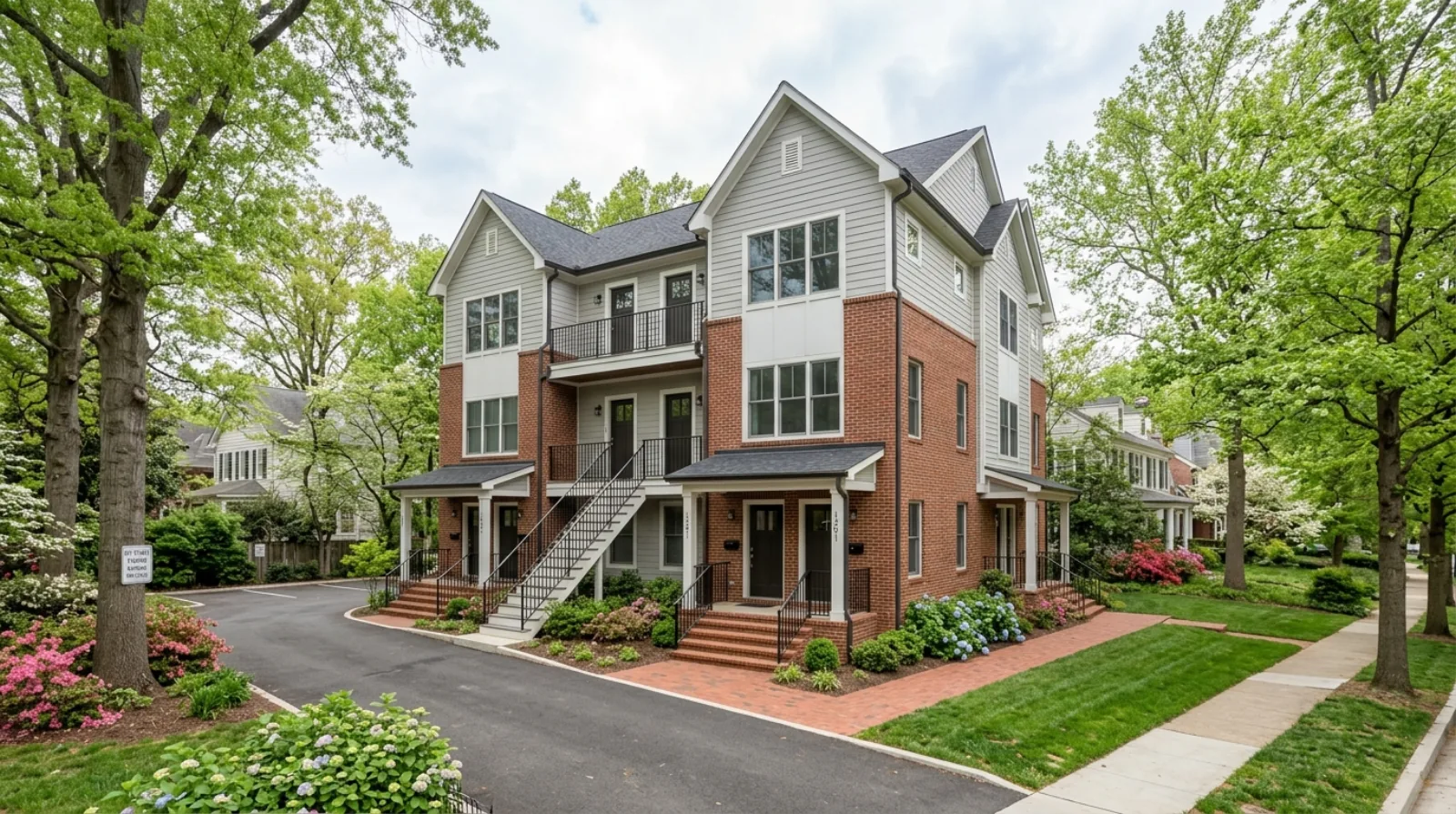
The 30-second answer
- Arlington County, Virginia allows 2 to 6 homes on former single-family lots under its Expanded Housing Options (EHO) rule, adopted March 22, 2023.
- As of July 2026 the EHO rule IS in effect and Arlington is processing EHO permits, but its long-term validity is still under review.
- The rule has flipped between valid and void four times in court since 2024. It is now before the Virginia Supreme Court.
- The Supreme Court is reviewing only a procedural question, not whether the EHO rule itself is good law. A final ruling could take up to a year.
- The County caps EHO at 58 new permits per year through 2028, so the change is deliberately slow and small.
The legal rollercoaster: valid, void, valid, void…
This is the Arlington story, and it is unlike any other reform in this guide. The EHO rule has swung between legal and illegal four times. Green markers below mean EHO was valid; red markers mean a court had voided it; the last step is the current Supreme Court review. Read left to right to see how much back-and-forth an owner has lived through since 2023.
- Mar 22, 2023 Adopted
County Board adopts EHO by unanimous vote; applications open July 1, 2023.
- Sep 27, 2024 Voided
Circuit Court Judge David Schell rules EHO "void ab initio" on procedural grounds. Permits freeze.
- Jun 24, 2025 Reinstated
Virginia Court of Appeals reverses; EHO valid again (plaintiffs failed to name required parties).
- Jul 8, 2025 Void again
The Court of Appeals withdraws its own June opinion and grants a rehearing. EHO void again.
- Sep 5, 2025 Valid again
The Court of Appeals returns to its original ruling. EHO valid; County resumes permits ~Oct 2025.
- May 19, 2026 Under review
Virginia Supreme Court agrees to hear the case, but only on the narrow procedural question.
One thing to hold onto: every one of these flips turned on a procedural question, such as how the County passed the rule, or who was named in the lawsuit, not on whether missing-middle housing is good policy. Even the current Supreme Court review is only about procedure.
What you can build (when in effect)
- 2 to 6 homes on a former single-family lot, countywide.
- 5–6 units only on larger lots (generally above ~6,000–7,000 sq ft).
- 4 or fewer on lots under 7,000 sq ft.
- Parking: 0.5 space/unit near Metrorail, 1 space/unit elsewhere.
The built-in brake: the permit cap
Arlington capped EHO at 58 permits per year for the first five years, through 2028. This was a deliberate choice to keep the change slow and let the County watch the results before allowing more. So even in a strong year, the number of new EHO projects is limited. This was never going to be a fast or large-scale shift.
Where the law stands in 2026: read this carefully
EHO is in effect today. Arlington resumed processing EHO permits around October 2025, after the Court of Appeals returned to its original ruling in September 2025.
But the case is not over. On May 19, 2026 the Virginia Supreme Court agreed to hear it. Here is the part people get wrong: the court is reviewing only the narrow procedural question of whether the right parties were named in the lawsuit, not whether the EHO rule itself is valid. A final decision could take up to a year, so the uncertainty may run into 2027.
What this means for you: EHO is legal to build under right now, but the rule that makes it legal has been frozen by a court before, and could be challenged again. Plan for that possibility.
What EHO has actually built so far
The numbers are small, partly by the 58-permit cap and partly because the legal freezes stalled projects. These figures come from County data as reported by ARLnow, Arlington Magazine, and YIMBYs of NoVA.
EHO permits approved before the Sept 2024 freeze (12 demolition, 7 building permits)
Arlington MagazineThe size gap is the clearest signal of what EHO changes: a new EHO home averages about 1,649 sq ft, while a new single-detached house in Arlington averages 5,348 sq ft. EHO trades one very large house for several smaller, more affordable homes on the same land.
If you own a lot in Arlington
You can apply for an EHO permit today, and many owners are. Your first two checks are practical: confirm your lot area (it decides whether you get 2 units or up to 6) and your distance to Metrorail (it decides your parking count). Both shape what is even possible on your specific land.
But before you spend real money, weigh the legal risk honestly. The rule that makes EHO legal has been frozen by a court once already, and the Virginia Supreme Court is still reviewing the case. A future ruling could disrupt a project mid-build. That does not mean do not build. It means budget for delay, get local legal and permitting advice tied to your exact lot, and do not assume the ground rules are final. If a court freeze would break your financing or timeline, that is a reason to wait for the Supreme Court to rule.
Arlington EHO zoning: questions people ask
Can I build a multiplex in Arlington, Virginia right now?
Yes, as of July 2026 you can apply for an Expanded Housing Options (EHO) permit and the County is processing those applications. EHO lets you build 2 to 6 homes on a lot that used to allow only one detached house. But there is a real legal risk you must understand first. The rule that makes this legal is still being challenged in court, and the Virginia Supreme Court agreed in May 2026 to review the case. The rule is in effect today, but its long-term future is not fully settled.
What is Arlington's "Missing Middle" or EHO rule?
The official name is Expanded Housing Options, or EHO. Most people call it "Missing Middle" because it fills the gap between a single house and a large apartment building: think duplexes, triplexes, fourplexes, and up to six homes in one house-scale building. The Arlington County Board adopted EHO on March 22, 2023 by a unanimous vote, and applications opened on July 1, 2023. It applies countywide to lots that were zoned for single-detached houses.
How many units can I build on an Arlington lot under EHO?
Between 2 and 6 homes, but the exact number depends on your lot size. Larger lots, generally above about 6,000 to 7,000 square feet, can hold 5 or 6 units. Lots smaller than about 7,000 square feet are limited to 4 units or fewer. So the size of your land is the first thing that decides your ceiling. Before planning, confirm your exact lot area, because it sets whether you are looking at a duplex or a full sixplex.
Is EHO in effect in 2026, or has it been struck down?
As of July 2026 EHO is in effect, and Arlington resumed processing EHO permits around October 2025. But the honest answer is more complicated than a simple yes. Since 2024 the rule has been declared void by a court, then valid, then void, then valid again, four flips in total. It is currently valid, but the Virginia Supreme Court is reviewing the case, so the situation could change. Anyone planning a project needs to treat the legal status as unsettled, not final.
What is Miller v. Arlington County?
It is the lawsuit that has driven the whole legal fight over EHO. A group called Neighbors For Neighborhoods, led by named plaintiffs including Miller, sued the County to overturn the rule. Their claims were mostly procedural. For example, that the County's public notice did not clearly state it was amending the zoning ordinance, that the County improperly delegated decisions to staff, and that it skipped a required sewer-capacity review. The case has moved through the Circuit Court, the Court of Appeals, and now the Virginia Supreme Court.
Why did a judge void EHO in September 2024?
On September 27, 2024, Circuit Court Judge David Schell ruled EHO "void ab initio," which is a legal term meaning "void from the very start." His reasoning was procedural, not about whether missing-middle housing is a good idea. He found the County's advertised resolution did not state it was amending the zoning ordinance, that decisions were unlawfully delegated to staff, that no sewer-capacity review was done, and that a tree standard was not met. That ruling froze all EHO permits until it was reversed on appeal.
Why does the rule keep flipping between valid and void?
Because the appeals process itself changed direction more than once. In June 2025 the Court of Appeals reversed the lower court and revived EHO, saying the plaintiffs had failed to name required parties: the developers who already held EHO permits. Then in July 2025 that same court withdrew its own opinion and granted a rehearing, which voided EHO again. In September 2025 the court returned to its original position and revived EHO once more. Each step turned on procedure, which is why the rule flipped back and forth without anyone ruling on whether it is fundamentally sound.
What exactly is the Virginia Supreme Court reviewing?
This is a key point that is easy to misread. On May 19, 2026 the Virginia Supreme Court agreed to hear the case, but it is reviewing only the narrow procedural question of whether the right parties were named in the lawsuit. It is NOT reviewing whether the EHO rule itself is valid or good policy. So even a full win or loss on this specific question may not settle the deeper fight for good. A final decision could take up to a year, which means the uncertainty may continue well into 2027.
What is the legal risk if I start an EHO project now?
The risk is that the rule you built under could later be challenged again, and the courts have already shown they will freeze permits when that happens. During the September 2024 freeze, projects in progress were stalled. If you buy a lot, demolish a house, and start building based on EHO, a future ruling could disrupt your timeline, your financing, or your ability to finish or sell. This does not mean you cannot build, and many owners are, but you should go in with your eyes open, budget for delay, and get local legal and permitting advice specific to your lot before you commit money.
How many EHO homes have actually been built?
The numbers are still small on purpose. Before the September 2024 freeze, the County had approved 45 EHO permits, including 12 demolition permits and 7 building permits. The County's 2025 data report projected roughly 132 net new units over time, and as of May 2026 there were about 59 EHO projects on the County's dashboard. These figures are reported by ARLnow, Arlington Magazine, and YIMBYs of NoVA based on County data. The pace is slow, partly by design and partly because of the legal pauses.
Is there a limit on how many EHO permits Arlington issues each year?
Yes. The County set an annual cap of 58 EHO permits per year for the first five years, through 2028. This cap was a deliberate choice to keep the change gradual and to let the County watch the effects before allowing more. It means EHO was never going to flood Arlington with new buildings quickly. Even in a year with strong demand, the number of new EHO projects is limited by this ceiling.
Do I need to provide parking for an EHO building?
Yes, but the amount is reduced near transit. Within about three-quarters of a mile of a Metrorail station, or about half a mile of premium transit, you need only 0.5 parking spaces per unit. Everywhere else you need 1 space per unit. So a lot near a Metro station carries a lighter parking burden, which frees up land for the building. Because parking rules directly affect how many homes fit, checking your distance to transit is an early and important step.
How does Arlington's reform compare with other cities?
Arlington sits between the biggest and the most cautious reforms. Like Minneapolis, it ended single-family-only zoning, but Arlington allows up to six homes where Minneapolis allowed three. Unlike California's SB 9, which mostly stayed "legal on paper" with little built, Arlington paired its rule with a permit cap and clear built-form limits. What makes Arlington unusual is not the policy. It is the legal chaos. Few reforms anywhere have been voided and revived four times, which makes Arlington a live test of whether a good rule can survive a determined court challenge.
Compare Arlington with other middle-housing reforms
Official sources & reporting
- Arlington County: Expanded Housing Options (EHO) permit program (official) Primary
- Patch: Arlington to begin accepting Missing Middle applications July 1
- Walsh Colucci (thelandlawyers): County Board approves EHO amendments
- ARLnow: Judge overturns Missing Middle zoning changes (Sep 2024)
- McGuireWoods: Court of Appeals overturns Arlington decision (Jun 2025)
- ARLnow: Appeals court flip-flops, striking down ordinance again (Jul 2025)
- ARLnow: Missing Middle scores a win as appeals court returns to original ruling (Sep 2025)
- ARLnow: Virginia Supreme Court agrees to take up Missing Middle lawsuit (May 2026)
- Arlington Magazine: the appeal of EHO housing in Arlington
- YIMBYs of NoVA: Arlington's 2025 EHO report
Several Arlington County pages block automated access, so County figures above are presented as reported by named news and legal sources. Always confirm current status and the exact rules for your lot with Arlington County before acting.
See how Arlington compares to the rest of the world
VanPlex tracks every major multiplex reform on Earth — what each city legalized, what actually got built, and what survived. Put Arlington next to 23 other cities on one scorecard.
Building in British Columbia instead? See what a BC lot allows →