
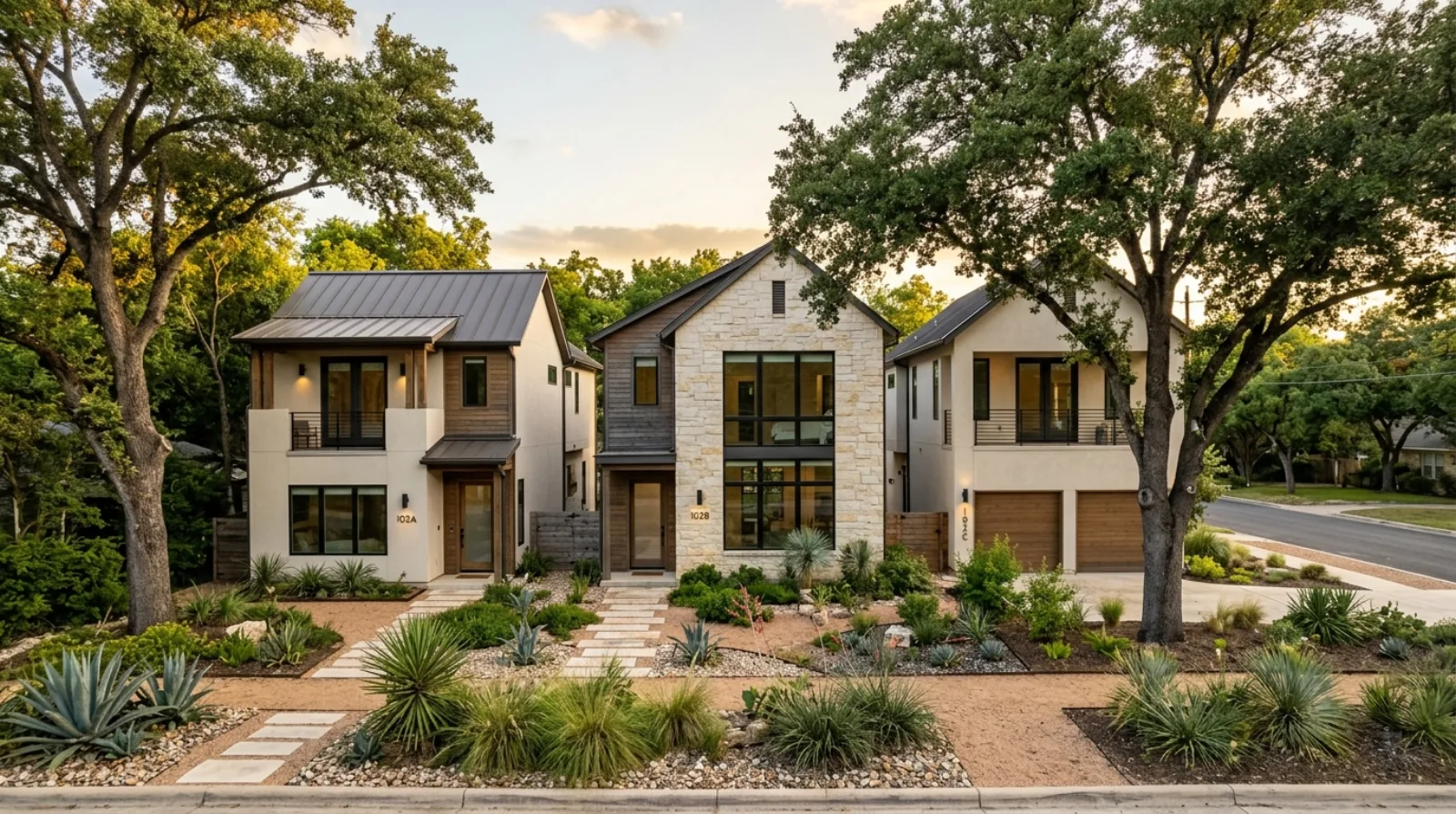
Can you build 3 homes on a lot in Austin? Yes, and the lot can be small.
Austin's HOME initiative did two big things: it let owners put up to three homes on a single-family lot, and it cut the minimum lot size to 1,800 sq ft. That was the first change to that number in about 80 years. It has faced loud opposition and a lot of confusion, but it was never struck down. This is what HOME really allows in 2026, and what it has built so far.
homes now allowed on a single-family lot that used to hold one. A fourth path, splitting the lot itself, was added in Phase 2.
The 30-second answer
- Up to 3 homes are allowed on a single-family lot in Austin under the HOME initiative, in force since applications opened February 5, 2024.
- The minimum lot size was cut from about 5,750 sq ft to 1,800 sq ft in 2024. This was the first change to that standard in roughly 80 years.
- HOME was NEVER struck down by a court. A 2023 ruling voided three other Austin ordinances, not HOME, which passed and stayed in force.
- Austin removed minimum parking rules citywide in November 2023, so a HOME home usually needs no parking.
- As of July 6, 2026 the City had approved 657 of 829 reviewed applications, allowing 1,309 new homes.
HOME by the numbers
Unlike some reforms that look good on paper but build little, Austin's HOME program has a live, public count of what it has approved. The City updates it as applications move through review. Here is where it stood on July 6, 2026, plus the lot-size cut and the price gap that make the program work.
median HOME home vs average new non-HOME home (2025 sales)
Community Impact (May 2026)The minimum lot-size cut: first change in ~80 years
Because the minimum dropped this much, a larger lot can be split into more parcels. The City's own example: an 8,000 sq ft lot can be divided into roughly four separate parcels, each able to hold its own home.
The myth: "a court threw HOME out"
You may have read that a Texas court struck down Austin's zoning reform. That is not true for HOME. The confusion comes from a real court case, but it hit three different rules.
What the court actually voided
On December 12, 2023, Judge Jessica Mangrum (Acuña v. City of Austin) voided three 2022 ordinances (Vertical Mixed Use 2 (VMU2), Residential in Commercial, and Compatibility) because the city missed required notice and protest-rights steps. HOME was not one of them.
What happened to HOME
HOME passed the City Council separately, by a 9–2 vote, despite about 16,000 property-owner protests. Both Phase 1 and Phase 2 have been continuously in force. No court has struck HOME down. Texas HB 24 (2025) later weakened the legal theory that had threatened it.
What you can build (Phase 1)
- 3 homes on a single-family lot (SF-1, SF-2, SF-3).
- Tiny homes allowed: one unit can be 400 sq ft or less.
- No cap on unrelated adults living together in a home.
- No parking required: minimums were removed citywide in Nov 2023.
What Phase 2 added
- Minimum lot size cut to 1,800 sq ft, from about 5,750 sq ft.
- Lot subdivision: split a larger lot into several small parcels.
- Example: an 8,000 sq ft lot → roughly 4 parcels.
- Citywide since Nov 16, 2024 for small-lot applications.
How Austin got here
The court case and the reform ran side by side, which is why so many people mix them up. The timeline keeps them straight.
- Dec 12, 2023
Court ruling (Acuña v. City of Austin, Judge Jessica Mangrum) voids three 2022 ordinances (VMU2, Residential in Commercial, and Compatibility) over notice and protest-rights defects. HOME is NOT among them.
- Dec 7, 2023
City Council adopts HOME Phase 1 by a 9–2 vote, despite about 16,000 property-owner protests. It allows up to 3 homes on single-family lots.
- Nov 2023
Austin eliminates minimum parking requirements citywide, so new HOME homes generally carry no parking mandate.
- Feb 5, 2024
HOME Phase 1 applications open. Owners can now apply to build up to 3 units on SF-1, SF-2, and SF-3 lots.
- May 16, 2024
City Council adopts HOME Phase 2, cutting the minimum lot size to 1,800 sq ft from the roughly 80-year-old 5,750 sq ft standard.
- Aug 16, 2024
HOME Phase 2 takes effect; citywide small-lot applications open November 16, 2024.
- Jun 2025
Texas passes HB 24, raising the zoning-protest threshold to 60% and removing some notice rules. This weakened the legal theory that had threatened Austin reforms.
- May 8, 2026
City Council votes 9–1 to refine HOME rules (lot width, side yards, subdivision process). This is a refinement, not a repeal; revisions are due about December 2026.
The price gap: HOME homes cost about half
Median price of 57 HOME homes sold in 2025.
Average price of 115 new non-HOME homes sold in 2025.
Small-lot buildings (about 40) and lot subdivisions (6) advanced under Phase 2 so far.
HOME homes sit on smaller lots and are smaller buildings, so the land and build cost per home is lower. Source: Community Impact (May 2026).
If you own a lot in Austin
Your right to build up to three homes is real and in force. Do not let the "it got struck down" rumor stop you. That rumor is about three other 2022 ordinances, not HOME. Start by confirming your zoning district (SF-1, SF-2, or SF-3) in the City's property profile tool, then read the HOME amendments page for the current building rules.
If your lot is larger, look at Phase 2. Splitting it into smaller parcels can let you build more homes than the three-per-lot path alone. Two things to watch: the May 2026 refinements to lot width and side yards are due back around December 2026, so check the numbers before you finalize a plan; and since November 2023 you owe no off-street parking, which frees up the lot and cuts the build cost.
Austin HOME zoning: questions people ask
Can I build 3 homes on a single-family lot in Austin?
Yes. Under HOME Phase 1, up to three homes are allowed on a single-family lot in Austin, on the SF-1, SF-2, and SF-3 zoning districts that cover most houses in the city. This has been in force since applications opened on February 5, 2024. The three units can include a tiny home of 400 sq ft or less. You still have to meet the building rules for height, setbacks, and lot coverage, but you no longer need a rezoning to add the second and third home.
What is the Austin HOME initiative?
HOME stands for "Home Options for Mobility and Equity," the City of Austin's name for its 2023–2024 housing reforms (some press also calls it "Home Options for Middle-income Empowerment"). It came in two phases. Phase 1 lets owners build up to three homes on a single-family lot. Phase 2 cut the minimum lot size so lots can be split into smaller parcels. Together they are the biggest change to Austin single-family zoning in decades.
How small can a lot be in Austin now?
As small as 1,800 sq ft. HOME Phase 2 cut the minimum lot size from about 5,750 sq ft (a standard that had stood for roughly 80 years) down to 1,800 sq ft, effective August 16, 2024. This is the change that lets owners split a larger lot into more parcels. For example, an 8,000 sq ft lot can now be divided into roughly four separate parcels, each able to hold its own home. This lot-subdivision path is what makes HOME different from a simple "add more units" rule.
Was the Austin HOME initiative struck down by a court?
No. This is a common myth, and it is wrong. A December 12, 2023 ruling by Judge Jessica Mangrum (Acuña v. City of Austin) voided three OTHER 2022 ordinances (Vertical Mixed Use 2 (VMU2), Residential in Commercial, and Compatibility) because the city had not followed proper notice and protest-rights steps. HOME was not one of those three ordinances. HOME passed the City Council separately, by a 9–2 vote, and both Phase 1 and Phase 2 have been continuously in force. No court has struck HOME down.
Do I need to add parking for a HOME home?
Usually no. Austin removed its minimum parking requirements citywide in November 2023, so a home built under HOME generally carries no parking mandate. You can still build parking if you or your tenants want it, but the city no longer forces you to. On a small lot this matters a lot. A required parking pad can crowd out the space you need for a third home or a lot split, so removing the rule makes the small-lot math work far better.
Is HOME still in force in 2026?
Yes. Both HOME Phase 1 and Phase 2 are the operative zoning law in Austin in 2026. The City is actively processing applications: as of July 6, 2026 it had reviewed 829 applications, approved 657 of them, and approved 1,309 new homes in total. On May 8, 2026 the City Council voted 9–1 to refine some rules (lot width, side yards, and the subdivision process), but that is a refinement, not a repeal. The core rights to build three homes and to use the smaller lot size are intact.
How many homes has HOME actually approved?
As of the City's own data updated July 6, 2026, HOME had approved 1,309 new homes. That came from 657 approved applications out of 829 that had been reviewed. These figures are from the City of Austin Development Services page, which is the primary source and is updated as applications move through review. The approval rate, about 79% of reviewed applications, shows the program is functioning, not stalled.
Are HOME homes cheaper than other new homes in Austin?
Yes, by a wide margin so far. Looking at 2025 sales, 57 HOME homes sold at a median price of about $750,000, while 115 new homes built outside HOME sold at an average of about $1.58 million. That is roughly half the price. The reason is straightforward: HOME homes sit on smaller lots and are smaller buildings, so the land and construction cost per home is lower. This price gap is the main argument supporters use for keeping and expanding the program.
What did the 2023 court ruling actually void, if not HOME?
It voided three separate 2022 ordinances. The first was Vertical Mixed Use 2 (VMU2), which added height and density along some corridors. The second was Residential in Commercial, which allowed homes on commercially zoned land. The third was Compatibility, which had changed the height limits near single-family homes. Judge Mangrum found the city did not follow the required notice and protest-rights process for these three. HOME was passed through a different process and was never part of that case.
What changed with Texas HB 24 in 2025?
HB 24, passed by the Texas Legislature in 2025, raised the threshold for a valid zoning protest to 60% of affected property owners and removed some notice requirements. This matters because the legal theory that had threatened Austin's reforms rested on protest-rights and notice defects, the same kind of defect that sank the three 2022 ordinances. By raising the bar for protests, HB 24 weakened that line of attack, making it harder to challenge HOME or similar reforms on those grounds going forward.
Did about 16,000 people really protest HOME?
Yes. When the City Council voted on HOME Phase 1 in December 2023, there were about 16,000 property-owner protests on the record. Under the old rules a protest of that size could have forced a supermajority vote or blocked the change. The Council adopted HOME anyway, by a 9–2 vote. This is part of why the myth that HOME was "struck down" spread. The fight was loud, but the protests did not stop it, and no court reversed it.
What is the City refining in the May 2026 update?
On May 8, 2026 the Council voted 9–1 to adjust three technical parts of HOME: minimum lot width, side-yard setbacks, and the process for subdividing a lot. These are fixes based on the first two years of real projects, not a rollback. City staff are expected to bring the detailed revisions back around December 2026. So far about 40 small-lot buildings and 6 lot subdivisions have advanced under Phase 2, and the refinements are meant to make those paths smoother, not to close them.
Can I split my lot into several parcels?
Yes, if your lot is large enough. Because HOME Phase 2 cut the minimum lot size to 1,800 sq ft, you can now subdivide a larger lot into several smaller parcels that each meet the minimum. As an example the City has cited, an 8,000 sq ft lot can be split into roughly four parcels. Each new parcel can then hold its own home, and the smaller parcels can also use the three-home allowance from Phase 1. The May 2026 refinements are partly aimed at making this subdivision process clearer.
Where do I confirm the rules for my own lot?
Start with the City of Austin Development Services HOME amendments page, which is the primary source for the rules, the application process, and the live approval count. It links to the ordinance text and the application forms for both phases. Because the May 2026 refinements will change some technical numbers around December 2026, check that page for the current lot-width and side-yard rules before you plan. For your specific zoning district, look up your parcel in the City's property profile tool, which shows whether you are on SF-1, SF-2, or SF-3.
Compare Austin with other reforms
Official sources & studies
- City of Austin: HOME amendments (rules + live approval count) Primary
- Austin Monitor: new minimum lot size goes into effect (Phase 2) Primary
- Austin Monitor: court order overturning three zoning ordinances (not HOME) Primary
- KUT: Texas HB 24 raises the protest threshold (2025)
- Community Impact: Austin leaders seek changes to HOME rules (May 2026)
See how Austin compares to the rest of the world
VanPlex tracks every major multiplex reform on Earth — what each city legalized, what actually got built, and what survived. Put Austin next to 23 other cities on one scorecard.
Building in British Columbia instead? See what a BC lot allows →