
Can you build a townhouse in Houston? Yes, and the reason isn’t zoning.
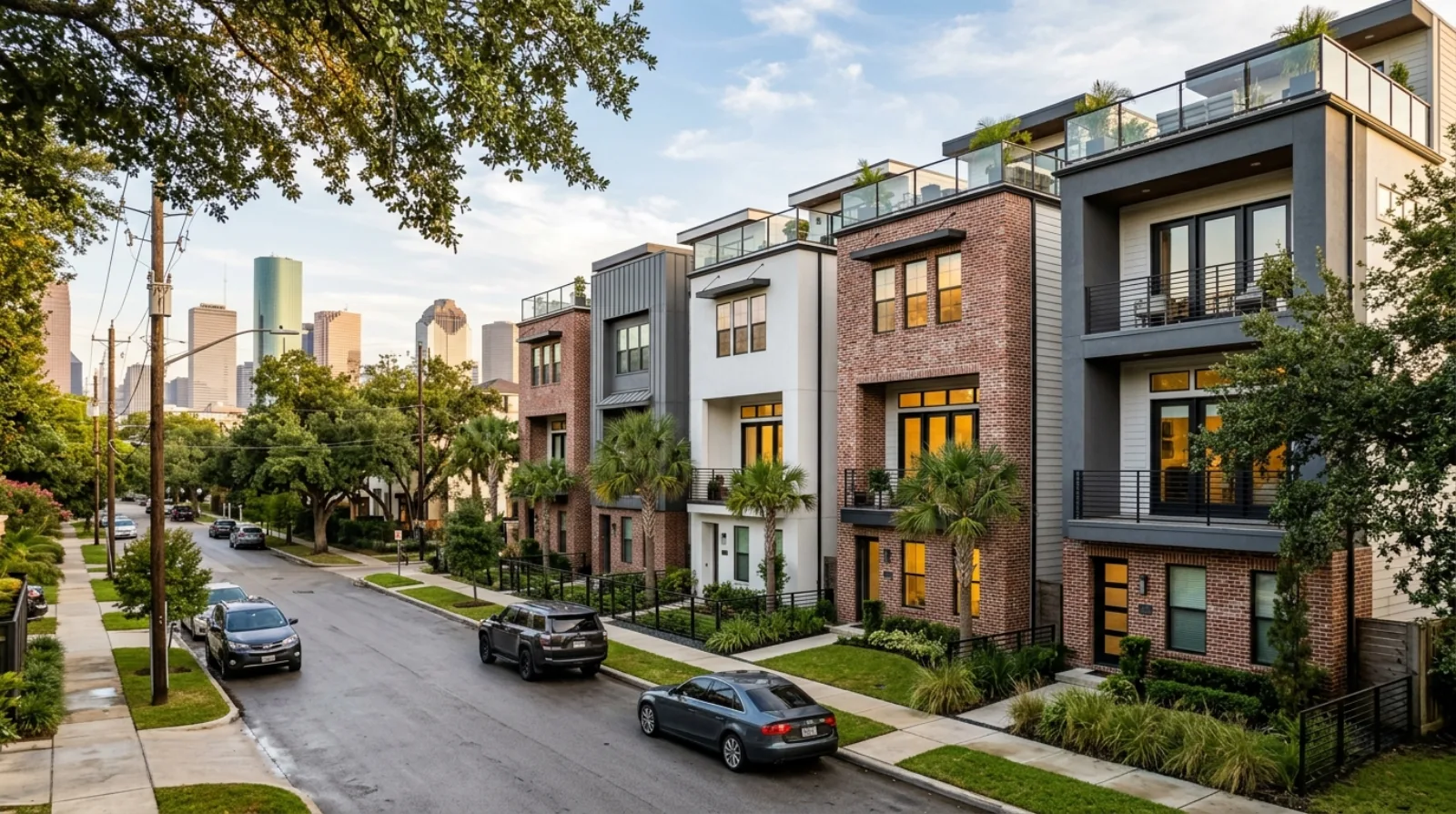
Houston is the largest US city with no zoning. But the change that filled Montrose, Midtown, and Rice Military with narrow three-storey townhomes was not a zoning map. It was a cut to the minimum lot size. This is what the rules allow in 2026, how neighbors can opt out, and how many homes the cut actually built.
Houston voters rejected zoning three times: 1948, 1962, and 1993. The 1993 vote failed 53%–47%. The city runs on lot rules, not a zoning map.
ZONING
Houston never adopted a use-based zoning code. It is the biggest US city with none. So the story people miss is simple: the tool that built the middle housing was not zoning at all.
The real lever: a smaller minimum lot size
5,000 sq ft
3,500 sq ft by right
In 1998 the by-right minimum lot size dropped from 5,000 sq ft to 3,500 sq ft. Qualifying subdivisions that add open space can average about 1,400 sq ft per lot, but the flat by-right floor is 3,500, not 1,400. Smaller lots let one old house lot become several townhouse lots.
small-lot homes built after the reform (Mercatus)
Inner-Loop units 2005–2018, nearly half townhouses (Kinder)
The 30-second answer
- Houston is the largest US city with no conventional use-based zoning. Voters rejected zoning three times: 1948, 1962, and 1993 (1993 failed 53%–47%).
- The thing that built middle housing was not zoning but a minimum-lot-size cut: the by-right minimum dropped from 5,000 sq ft to 3,500 sq ft.
- For qualifying subdivisions that provide compensating open space, lots can average about 1,400 sq ft, but the flat by-right minimum is 3,500 sq ft, not 1,400.
- The reform started inside the I-610 Loop in 1998 and was extended citywide to all sewered land in 2013 (a 13–3 Council vote).
- Neighbors can opt out. A Special Minimum Lot Size Area (SMLSA) petition can lock in the larger lot sizes their block already has.
- The program is still in force in 2026. The City’s planning page and its petition forms are live and dated 2026.
What the rules let you do
Lot-size reform
- 3,500 sq ft by right minimum lot on sewered land, citywide since 2013.
- ~1,400 sq ft average for qualifying subdivisions that add open space.
- 600 sq ft open space rule applies to lots under 3,500 sq ft.
Neighbor opt-out tools
- SMLSA petition locks the block to the lot size 70% of it already meets (60% in Historic Districts); needs 5+ contiguous blocks.
- Minimum Building Line petitions lock front setbacks.
- Private deed restrictions run with the land and are enforceable in court.
The catch: parking
A single-family house normally needs two off-street parking spaces. Houston did not repeal parking minimums citywide. It only removed them in the Downtown CBD and parts of EaDo and Midtown (expanded July 17, 2019). Fitting two spaces on each narrow lot is a real design limit outside those areas.
What actually got built
The lot-size cut added a lot of homes, and it added them at a lower price than a new detached house. The townhouse rows clustered inside the I-610 Loop, in Montrose, Midtown, and Rice Military, where a lot split was worth it.
median new townhouse (2020)
median new single-family detached house (2020)
Price and unit figures: Bipartisan Policy Center and Kinder Institute. Roughly 75,000 Inner-Loop units 2005–2018 was more than San Francisco and Oakland added combined.
How Houston got here
Three failed zoning votes, then a quiet change to the lot rules that did more than any zoning map would have.
- 1948
Houston voters reject zoning at the ballot box for the first time.
- 1962
Voters reject zoning again.
- 1993
Voters reject zoning a third time, 53%–47%. Houston stays the largest US city with no use-based zoning.
- 1998
The City cuts the by-right minimum lot size from 5,000 sq ft to 3,500 sq ft inside the I-610 Loop, and allows an average near 1,400 sq ft for qualifying subdivisions that add open space.
- 2013
Council extends the smaller minimum lot size citywide to all sewered land, by a 13–3 vote.
- Jul 17, 2019
The City expands the areas with no parking minimums: Downtown CBD plus parts of EaDo and Midtown. There is no citywide repeal of parking rules.
- Nov 27, 2023
“Livable Places” amendments to Chapters 42 and 26 take effect: larger ADUs, small 3–8 unit apartment buildings, and courtyard developments.
- 2026
The minimum-lot-size program is still in force. The City’s planning page and petition forms are live and dated 2026.
If you own a lot in Houston
Your ability to split a lot and build townhouses is real, and it rests on the 3,500 sq ft by-right minimum, not on any zoning map. But two things can block you, and you must check both before you plan. First, look up whether your land carries a private deed restriction. Many Houston neighborhoods enforce these in court, and they can ban a lot split as firmly as a zoning rule.
Second, check whether your block is inside a Special Minimum Lot Size Area, which locks in larger lots. If neither blocks you and your land is sewered, a re-plat into narrow lots is on the table. That is how the townhouse rows in Montrose, Midtown, and Rice Military were built. Plan the parking early: outside the downtown-area exceptions, each house still needs two off-street spaces, and that is often what decides how small the lots can go.
Houston zoning & lot-size questions people ask
Does Houston really have no zoning?
Yes. Houston is the largest city in the United States with no conventional use-based zoning code. It never split the city into “residential only” and “commercial only” districts the way most cities do. Voters were asked to adopt zoning three separate times, in 1948, 1962, and 1993, and rejected it each time, with the 1993 vote failing 53% to 47%. Instead of zoning, Houston controls land through other rules: the Chapter 42 subdivision code, minimum lot sizes, setback and parking rules, and private deed restrictions attached to land titles.
If there is no zoning, why can Houston build so much middle housing?
Because the rule that actually shaped the housing was the minimum lot size, not zoning. In 1998 the City cut the by-right minimum lot size from 5,000 sq ft to 3,500 sq ft inside the I-610 Loop, and let qualifying subdivisions reach an average near 1,400 sq ft if they added open space. Smaller minimum lots let a builder split one old house lot into several narrow lots and put a townhouse on each. That single change did more to add homes than most zoning reforms in other cities, because it removed the size floor that had blocked lot splits.
What is the minimum lot size in Houston now?
The flat by-right minimum lot size is 3,500 sq ft on sewered land across the city. That is the number to plan around. For qualifying subdivisions that provide compensating open space, the average lot size can go down to about 1,400 sq ft, and a 600 sq ft open-space rule applies to lots under 3,500 sq ft. Be precise about this: 1,400 sq ft is an average you can reach in a qualifying subdivision, not a flat minimum you get on any single lot. Most straightforward projects are built around the 3,500 sq ft by-right number.
Can I split my lot and build townhouses in Houston?
Often yes, if your lot is on sewered land and no private deed restriction or neighborhood opt-out blocks it. Since 2013 the smaller minimum lot size applies citywide, so a large old single-family lot can be re-platted into several narrow lots at 3,500 sq ft each, or smaller in a qualifying subdivision with open space. This is exactly how the townhouse rows in Montrose, Midtown, and Rice Military got built. Before you plan, you must check two things: whether your land carries a private deed restriction, and whether your block is inside a Special Minimum Lot Size Area that locks in larger lots.
How can neighbors stop lot splits on their block?
Through a Special Minimum Lot Size Area, or SMLSA. Neighbors petition the City to set a minimum lot size for their block group, and the City sets it to the smallest lot size already met by at least 70% of the properties there (60% in a Historic District). The area must cover at least five contiguous blocks. There are also Minimum Building Line petitions that lock in front setbacks, and private deed restrictions that owners can enforce among themselves. These tools let a neighborhood opt out of the smaller-lot rules while the rest of the city keeps them.
Do I need to build parking for a Houston townhouse?
Usually yes. A single-family house in Houston normally needs two off-street parking spaces. Houston did not repeal parking minimums citywide. It removed them only in specific areas: the Downtown Central Business District, and parts of EaDo and Midtown, with that no-parking zone expanded on July 17, 2019. Outside those areas the two-space rule still applies to a house, so a townhouse project has to fit parking on each narrow lot, which is one of the real design limits on how small the lots can go in practice.
What did the “Livable Places” changes do?
The Livable Places amendments changed Chapters 42 and 26 of the city code and took effect on November 27, 2023. They made three practical additions: they allowed larger accessory dwelling units (the small second home in a backyard), they allowed small apartment buildings of about 3 to 8 units, and they allowed courtyard-style developments where several homes share a common open space. These changes build on the minimum-lot-size reform by adding a few more small building types, rather than replacing it.
Is Houston’s lot-size reform still in effect in 2026?
Yes. The smaller minimum lot size, the citywide 2013 extension, and the SMLSA opt-out process are all still in force. You can confirm this on the City of Houston Planning and Development page for Minimum Lot Size and Minimum Building Line, which is live and carries petition forms dated 2026. Nothing has repealed the 3,500 sq ft by-right minimum. If anything, the 2023 Livable Places changes added more small building types on top of it.
How many new homes did the lot-size cut actually produce?
The counts are large. The Mercatus Center estimates about 80,000 homes were built on small lots after the reform. The Kinder Institute at Rice found roughly 75,000 housing units added inside the I-610 Loop from 2005 to 2018, and nearly half of them were townhouses, more than San Francisco and Oakland added combined over the same period. The Bipartisan Policy Center counts more than 25,000 homes built on lots under 5,000 sq ft between 1999 and 2016, plus more than 5,300 single-family lots converted to townhouses between 2005 and 2020.
Are Houston townhouses cheaper than new detached houses?
Yes, and by a wide margin. In 2020 the median new townhouse in Houston sold for about $340,000, while the median new single-family detached house sold for about $545,000. The gap comes straight from the land: a townhouse sits on a narrow split lot, so each home carries a smaller share of the land cost. This is the core payoff of the lot-size cut. It let builders deliver a new home at a price point that a detached house on a full lot could not reach.
Which part of the city code covers all this?
Chapter 42 of the Houston Code of Ordinances, the subdivision and development ordinance. Chapter 42 sets lot sizes, block and street rules, and how land is platted and re-platted. The minimum-lot-size rules and the SMLSA opt-out process live there. The 2023 Livable Places changes amended Chapter 42 and Chapter 26. Because Houston has no zoning code, Chapter 42 does much of the work that a zoning ordinance does in other cities. It is the document to read before planning a lot split.
Who studied and popularized the Houston story?
A few names come up often. The urban planner M. Nolan Gray wrote widely about how Houston’s lack of zoning and its lot-size reform shaped its housing, which brought the story to a national audience. The careful empirical work on how the smaller minimum lot size raised land values and added homes is by the economist Emily Hamilton at the Mercatus Center at George Mason University, published in HUD’s Cityscape journal. If you want the numbers behind the story rather than the story itself, Hamilton’s research is the primary source.
Where in Houston are the townhouses concentrated?
Mostly inside the I-610 Loop, in neighborhoods close to downtown. The clearest clusters are in Montrose, Midtown, and Rice Military, where older single-family lots were split into narrow lots and lined with three-storey townhomes. These are the areas where land was valuable enough to make a lot split worth it, and where the 1998 Inner-Loop reform applied first. The citywide 2013 extension then opened the same pattern to sewered land across the rest of the city, though the densest results are still near the core.
Does “no zoning” mean anything can be built anywhere in Houston?
No, and this is a common misreading. Houston has no use-based zoning, but it still has many land rules: the Chapter 42 subdivision code, minimum lot sizes, setbacks, parking minimums outside the downtown-area exceptions, and (very importantly) private deed restrictions that run with the land and are enforceable in court. Many Houston neighborhoods are tightly controlled by deed restrictions that ban apartments or commercial use just as firmly as a zoning map would. So the freedom to split lots and build townhouses is real, but it is bounded by these other rules, not unlimited.
Compare Houston with other reforms
Official sources & studies
- City of Houston: Minimum Lot Size & Minimum Building Line (official) Primary
- City of Houston: Livable Places (Chapters 42 & 26, official) Primary
- Mercatus Center: Learning from Houston’s townhouse reforms
- Bipartisan Policy Center: reducing minimum lot sizes in Houston
- Kinder Institute (Rice): lot size matters
- Parking Reform Network: Houston parking mandate map
- St. Louis Fed / FRASER: Houston zoning rejected (historical)
See how Houston compares to the rest of the world
VanPlex tracks every major multiplex reform on Earth — what each city legalized, what actually got built, and what survived. Put Houston next to 23 other cities on one scorecard.
Building in British Columbia instead? See what a BC lot allows →