
Can you build a fourplex in Seattle? Yes, on every Neighborhood Residential lot.
As of January 21, 2026, the One Seattle Plan lets at least 4 homes stand on any Neighborhood Residential lot that used to allow one house. Near transit, or with some affordable units, that number climbs to 6, 9, even 12. This is the first full rewrite of that zone since 1982. Here is exactly what it allows.
homes now allowed on a single Neighborhood Residential lot: 4 at the base, up to 12 near transit when half the homes are affordable.
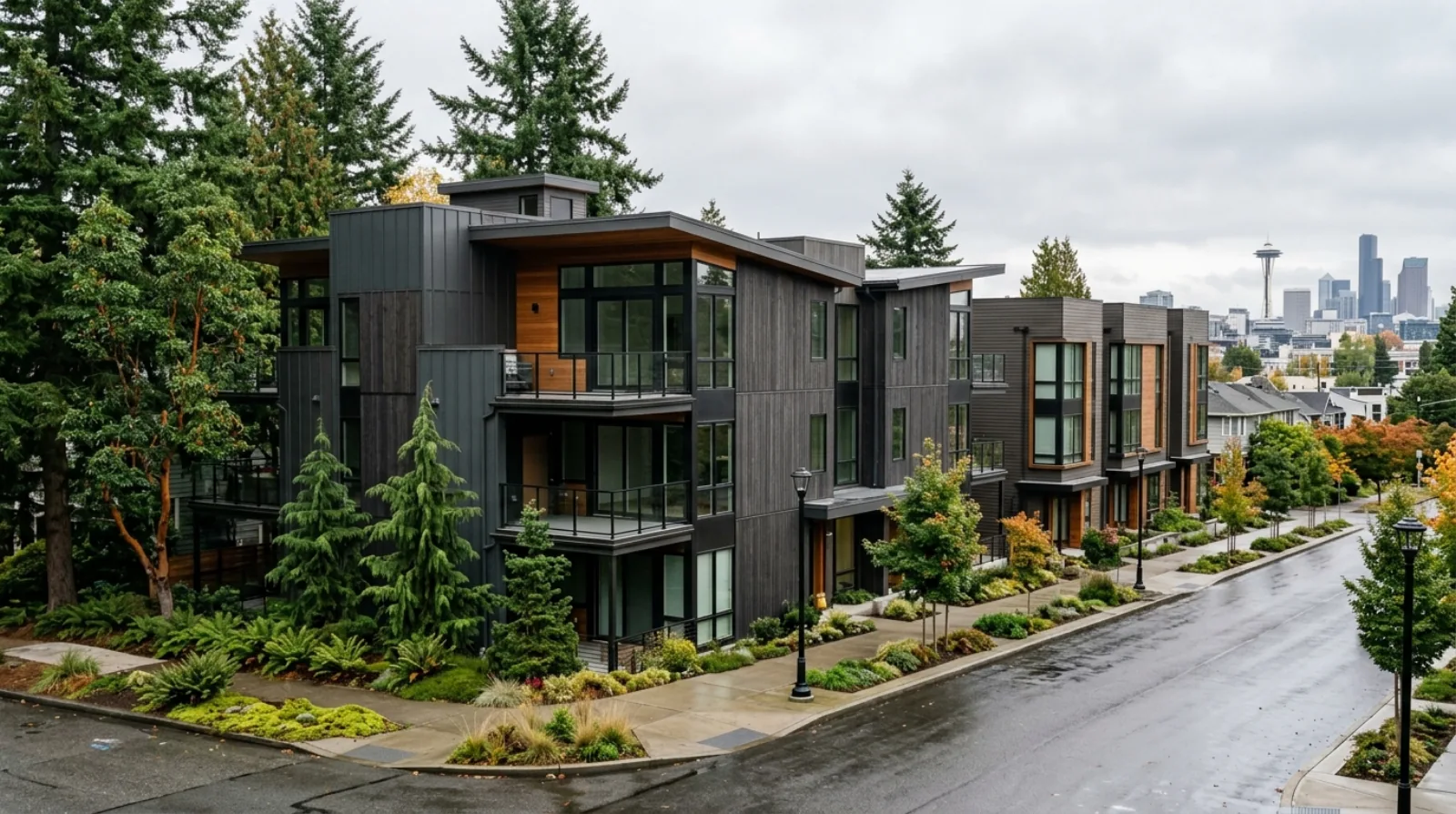
The 30-second answer
- Every Neighborhood Residential (NR) lot in Seattle now allows at least 4 homes, permanent as of January 21, 2026.
- Near a major transit stop, or with at least 2 affordable units, the base rises to 6 homes on the same lot.
- A stacked-flats bonus reaches 9 homes on a lot of 6,000 sq ft or more within a quarter-mile of major transit.
- A low-income bonus reaches 12 homes if at least half the units are affordable, the most any NR lot can hold.
- No parking is required within a half-mile walk of light rail, commuter rail, or bus rapid transit, or for any home 1,200 sq ft or smaller.
- This is the first full rewrite of the Neighborhood Residential zone since 1982; single-family-only zoning has effectively ended in Seattle.
The density ladder: how high one NR lot can go
Seattle’s rules are not one flat number. They climb in steps, based on how close the lot is to transit and how many homes you make affordable. Here is the ladder from the 4-home base to the 12-home ceiling on a single Neighborhood Residential lot.
The floor on any Neighborhood Residential lot. The rule is the greater of 1 unit per 1,250 sq ft or 4 units. ADUs count toward the total.
Within a quarter-mile of a major transit stop, or if at least 2 of the units are affordable, the base rises to 6 homes.
On a lot of 6,000 sq ft or more within a quarter-mile of major transit, a stacked-flats building can reach 9 homes at 1.8 floor-area ratio.
If at least half the homes are affordable (60% of area median income for rentals, 80% for ownership) a 5,000 sq ft lot near transit reaches 12 homes, 1.8 FAR, 4 stories.
Every rung of this ladder traces to the City’s permanent state-zoning compliance summary. The two top rungs, 9 and 12 homes, depend on being within a quarter-mile of a major transit stop.
What you can build
- 4 homes by right on any Neighborhood Residential lot, citywide.
- Up to 12 homes near transit when half the units are affordable.
- Up to 2 ADUs per lot: no owner-occupancy, no parking, DADU capped at 1,000 sq ft.
- Often no parking near frequent transit or for homes 1,200 sq ft or smaller.
The envelope limits
- Height: 32 ft, rising to 42 ft if you keep existing trees.
- Lot coverage: 50% maximum, so at least half the lot stays open.
- Floor-area ratio: 0.6 up to 1.6 by density, 1.8 with the transit bonuses.
- Lot splitting: new lots under 5,000 sq ft cannot be created.
Where it stands in 2026
Permanent Neighborhood Residential rules take effect (Council Bills 120993 and 120985).
Interim rules (CB 120969) had already taken effect to meet the state deadline.
The first full rewrite of the Neighborhood Residential zone in more than 40 years.
No published middle-housing build count exists yet. The permanent rules are only months old. Source: Seattle City Council.
The ADU boom that came first
Before the fourplex rules, Seattle already had years of proof that easier rules build homes. In 2019 the city removed the owner-occupancy and parking requirements for accessory dwelling units and raised the limit to 2 per lot. Permits took off, and backyard cottages became one of the most common ways Seattle adds homes.
Under the 2026 rules those ADUs now count toward your total unit limit, so a lot with 2 ADUs and 2 main homes already reaches the 4-home base.
How Seattle got here
The path ran from ADU reform, through a state law, to the permanent citywide rewrite.
- 2019
Seattle rewrites its ADU rules: up to 2 ADUs per lot, no owner-occupancy requirement, no parking requirement. DADUs capped at 1,000 sq ft.
- 2023
Washington passes HB 1110, the statewide middle-housing law that requires cities like Seattle to allow more homes on residential lots.
- May 27, 2025
Seattle Council passes the interim ordinance (Council Bill 120969) to meet the state deadline while the full plan is finished.
- June 30, 2025
The interim Neighborhood Residential rules take effect.
- Dec 16, 2025
Council adopts the permanent legislation, the Comprehensive Plan (CB 120985) and the NR zoning (CB 120993), as part of the One Seattle Plan.
- Jan 21, 2026
The permanent Neighborhood Residential rules take effect. Every NR lot now allows at least 4 homes.
If you own a lot in Seattle
Your right to build at least 4 homes is real and settled. The rules are permanent as of January 21, 2026. The two facts that decide whether you can go higher are your distance to a major transit stop and your lot size. Within a quarter-mile of major transit, a 6,000 sq ft lot can reach 9 homes, and making half the homes affordable can reach 12.
Two things often cost you nothing: near frequent transit, or for homes 1,200 sq ft or smaller, you owe no parking, which frees up the lot and cuts the build cost. And if you are already planning a house, adding up to 2 ADUs is one of the simplest ways to reach the 4-home base. Seattle has years of ADU permits proving it works.
Seattle middle-housing zoning: questions people ask
Can I build a fourplex in Seattle?
Yes. Every Neighborhood Residential (NR) lot in Seattle now allows at least 4 homes, and that rule became permanent on January 21, 2026 under the One Seattle Plan. The exact base is "the greater of 1 unit per 1,250 sq ft, or 4 units," so most standard lots land at 4. Any accessory dwelling units you build count toward that total. If your lot is near frequent transit or you make some homes affordable, the ceiling goes higher than four.
How many units can I really put on one Seattle lot?
It depends on where the lot sits and whether you include affordable homes. The base is 4 homes anywhere in the NR zone. Within a quarter-mile of a major transit stop, or if at least 2 homes are affordable, the base rises to 6. A stacked-flats building on a lot of 6,000 sq ft or more near major transit can reach 9. And if at least half the homes are affordable, a 5,000 sq ft lot near transit can reach 12, the highest the NR zone allows.
What is the One Seattle Plan?
The One Seattle Plan is Seattle's update to its Comprehensive Plan and the zoning that carries it out. It is how the city met the requirements of Washington's state middle-housing law, HB 1110. The permanent version was adopted by the City Council on December 16, 2025 through two bills: Council Bill 120985 for the Comprehensive Plan and Council Bill 120993 for the Neighborhood Residential zoning. The zoning took effect on January 21, 2026.
Did Seattle end single-family-only zoning?
Effectively, yes. The One Seattle Plan is the first full rewrite of the Neighborhood Residential zone since 1982, and it means every NR lot now allows at least 4 homes rather than one house. The city did not ban detached houses. You can still build a single home if you want. But the old "one house only" rule is gone across the Neighborhood Residential zone, which covers most of Seattle's residential land.
What are the stacked-flats and low-income bonuses?
These are the two ways to build above the 4-to-6 base. The stacked-flats bonus lets a lot of 6,000 sq ft or more within a quarter-mile of major transit hold up to 9 homes, at a floor-area ratio of 1.8. The low-income bonus goes further: if at least half the homes are affordable (60% of area median income for rentals, or 80% for ownership) a 5,000 sq ft lot near transit can reach 12 homes, at 1.8 floor-area ratio and up to 4 stories. Both bonuses are tied to being near major transit.
Do I need to provide parking for a new middle-housing building?
Often no. No off-street parking is required within a half-mile walk of light rail, commuter rail, or bus rapid transit. No parking is required for any home that is 1,200 sq ft or smaller, wherever it sits. ADUs never require parking. Outside those cases, the rule is 1 parking space for every 2 homes. Because so much of Seattle sits near frequent transit or involves smaller units, many projects owe no parking at all.
How tall can these buildings be, and how much of the lot can they cover?
The base height limit is 32 feet, which rises to 42 feet if you keep existing trees on the lot. Lot coverage is capped at 50%, so at least half the lot stays open. Floor-area ratio starts at 0.6 and rises to as much as 1.6 by density, and the two transit bonuses reach 1.8. These envelope rules, height, coverage, and floor area, usually decide what actually fits on a given lot, more than the unit count alone.
What are the rules for ADUs and backyard cottages in Seattle?
Seattle rewrote its ADU rules in 2019, and they are some of the most flexible in the United States. You can build up to 2 ADUs per lot: either 2 attached units, or 1 attached plus 1 detached backyard cottage (a DADU). There is no owner-occupancy requirement, so you do not have to live on site to rent them out, and there is no parking requirement for an ADU. Detached backyard cottages are capped at 1,000 sq ft. Under the 2026 rules, ADUs also count toward your total unit limit.
How big is Seattle's ADU boom?
It is large and still growing. ADU permits rose from 482 in 2020 to 987 in 2023, roughly double in three years. ADUs now outnumber new single-family-home permits by about 2 to 1. And about 70% of new single-family permits now include an ADU, so most people building a house are adding a second home at the same time. The 2019 rules that removed the owner-occupancy and parking requirements are widely credited for that jump.
Is the One Seattle Plan actually in force in 2026?
Yes. Interim rules (Council Bill 120969) took effect on June 30, 2025 to meet the state deadline, and the permanent rules took effect on January 21, 2026 after the Council adopted them on December 16, 2025. As of July 2026 the permanent Neighborhood Residential zoning is the law that applies. This is not a proposal or a pilot. It is the current, adopted zoning across the NR zone.
How much middle housing has actually been built so far?
There is no published build count yet, and it would be misleading to give one. The permanent rules only took effect on January 21, 2026, so the city has not had time to accumulate meaningful permit or completion data under them. The honest answer is that the outcome is still unknown. What we can measure is the ADU trend, which has been strong for years, and the fact that every NR lot now legally allows at least 4 homes.
Can I split my lot into smaller lots in Seattle?
Not below 5,000 sq ft. Under the current rules, new lots smaller than 5,000 sq ft cannot be created. Separate lot-splitting legislation was expected in 2026 to allow smaller lots, but as of July 2026 it is not confirmed that it passed, so do not count on it. For now, the way to add homes is to build more units on your existing lot under the 4-to-12 density rules, not to divide the land into new parcels.
How did Seattle's reform connect to the state law, HB 1110?
Washington passed HB 1110 in 2023, a statewide middle-housing law that requires larger cities to allow more homes on residential lots. Seattle carried out that requirement through the One Seattle Plan. The interim ordinance in mid-2025 met the state deadline, and the permanent One Seattle Plan zoning in early 2026 replaced it. So Seattle's rules are the local version of a state-wide policy, which is why other Washington cities are making similar changes.
If I own a Seattle house, what should I check first?
Start with two things: whether your lot is within a quarter-mile of a major transit stop, and your lot size. Those two facts decide whether you are limited to the 4-home base or can reach 6, 9, or 12. Then look at the envelope rules, the 32-foot height, 50% lot coverage, and the floor-area ratio for your density, because those usually decide what physically fits. If you are near transit or building smaller units, you likely owe no parking, which frees up the lot and lowers the build cost.
Compare Seattle with nearby reforms
Official sources & studies
- City of Seattle: One Seattle Plan permanent state-zoning compliance summary (PDF) Primary
- Seattle City Council: final Comprehensive Plan legislation passed (Dec 16, 2025) Primary
- City of Seattle: One Seattle Plan (official hub) Primary
- City of Seattle: One Seattle Plan zoning update FAQ (PDF) Primary
- KUOW: Seattle's ADU boom outnumbers single-family permits 2 to 1
- Sightline: Seattle approves best backyard-cottage rules in the US (2019)
See how Seattle compares to the rest of the world
VanPlex tracks every major multiplex reform on Earth — what each city legalized, what actually got built, and what survived. Put Seattle next to 23 other cities on one scorecard.
Building in British Columbia instead? See what a BC lot allows →