
Start Here | The Scorecard
The Global Multiplex Zoning Scorecard
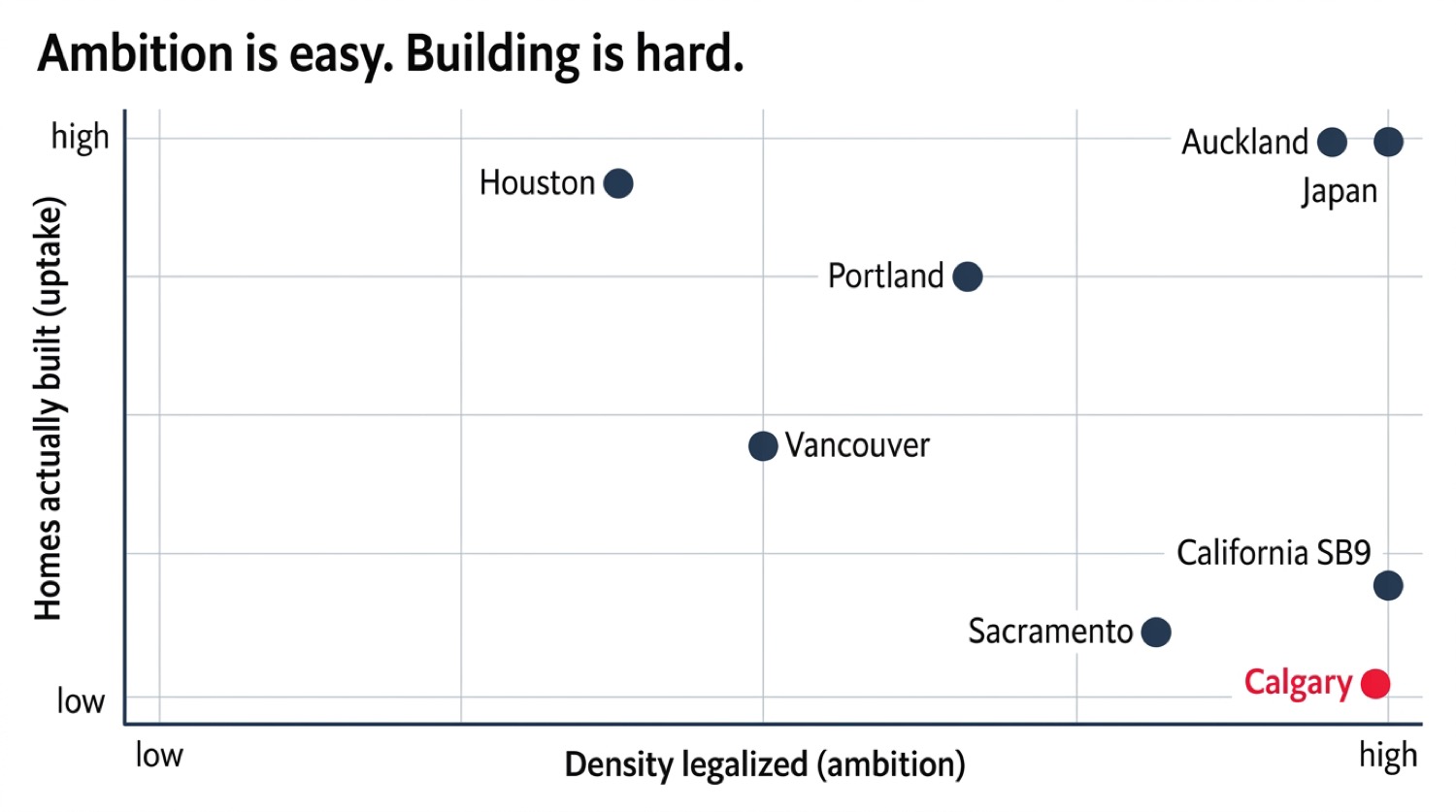
Twenty-four reforms, three questions each: How much density did it legalize? How much housing did it actually produce? Did it survive? Ambition is everywhere. Uptake and durability are rare. That gap is the whole story.
All 24, ranked by overall score
| # | Jurisdiction | Max units | Status | Ambition | Uptake | Durability | Overall |
|---|---|---|---|---|---|---|---|
| 1 | 🇯🇵 Japan (national) | Small apartments in low-rise zones | In force | | | | 15/15 |
| 2 | 🇺🇸 Portland | 4 (6 with affordability) | In force | | | | 14/15 |
| 3 | 🇳🇿 Auckland | 3 storeys (up to 5–7 near centres) | In force | | | | 14/15 |
| 4 | 🇺🇸 Houston | Townhouses on small lots | In force | | | | 13/15 |
| 5 | 🇨🇦 Edmonton | Up to 8 | In force | | | | 13/15 |
| 6 | 🇺🇸 Oregon (statewide) | 4 (fourplex) | In force | | | | 12/15 |
| 7 | 🇺🇸 Seattle | 4 (fourplex) + 2 ADUs | In force | | | | 12/15 |
| 8 | 🇨🇦 British Columbia (province) | 3 / 4 / 6 | In force | | | | 12/15 |
| 9 | 🇺🇸 Minneapolis | 3 (triplex) | In force | | | | 11/15 |
| 10 | 🇺🇸 Washington (statewide) | 6 (near transit / affordable) | In force | | | | 11/15 |
| 11 | 🇨🇦 Vancouver | 6 strata / 8 rental | In force | | | | 11/15 |
| 12 | 🇨🇦 Halifax | 4 | In force | | | | 11/15 |
| 13 | 🇺🇸 Austin | 3 per lot | In force | | | | 10/15 |
| 14 | 🇳🇿 New Zealand (national MDRS) | 3 (3 storeys) | Made optional | | | | 10/15 |
| 15 | 🇦🇺 Sydney (New South Wales) | Up to 6 storeys near centres | In force | | | | 10/15 |
| 16 | 🇦🇺 Melbourne (Victoria) | Deemed-to-comply to 3 storeys | In force | | | | 10/15 |
| 17 | 🇺🇸 Berkeley | Up to 8 | In force | | | | 9/15 |
| 18 | 🇺🇸 Sacramento | 4+ (no unit cap; size-limited) | In force | | | | 8/15 |
| 19 | 🇨🇦 Ontario & Toronto | 3 (province) / 4 (Toronto) | In force | | | | 8/15 |
| 20 | 🇨🇦 Calgary | 3–4 (rowhouse) | Repealed | | | | 8/15 |
| 21 | 🇬🇧 England (United Kingdom) | Conversions / upward extensions | In force | | | | 8/15 |
| 22 | 🇺🇸 California (statewide) | 4 (duplex + lot split) | In force | | | | 7/15 |
| 23 | 🇺🇸 Gainesville | 4 (then back to 1) | Repealed | | | | 6/15 |
| 24 | 🇺🇸 Arlington | 6 | In force | | | | 5/15 |
Scores are VanPlex's editorial read of the cited evidence on each city's page, not an official index. Tap any city to see the data behind its scores.
Turned permission into homes
- 🇺🇸 Houston , ~80,000 homes: Nearly 80,000 homes have been built on small lots cumulatively since the reform.
- 🇳🇿 Auckland , +21,808 homes: Greenaway-McGrevy & Phillips found 21,808 additional dwellings permitted over the five years after the reform (~4.1% of the stock).
- 🇯🇵 Japan (national) , 142,417 starts: In 2014 Tokyo recorded 142,417 housing starts — more than all of England and more than double California's permits.
Reversed, paused or downgraded
- 🇺🇸 Arlington , Voided in 2024, then flipped several times on appeal, and back in effect since September 2025 — now under Virginia Supreme Court review on a procedural question.
- 🇺🇸 Gainesville , Reversed within months by a newly elected commission; single-family-only zoning restored April 2023.
- 🇺🇸 Sacramento , Interim ordinance under-performing; a more permanent version is expected by end of 2026.
- 🇨🇦 Calgary , Adopted in 2024, repealed in April 2026 — the major reversal case in Canada.
- 🇳🇿 New Zealand (national MDRS) , Made optional after the 2023 election; a cautionary tale about durability.
Where British Columbia sits
BC's Bill 44 ranks near the top on ambition. It's a province forcing 3 to 6 homes onto single-family lots, scaled by transit, with no city opt-out. That puts it in the same class as Washington's HB 1110 and New Zealand's national MDRS. The honest question isn't ambition. It's whether BC ends up like Auckland (homes actually built, rents softened) or like Sacramento (legal on paper, quiet on the ground).
That's decided lot by lot. The right to build 3–6 homes is now provincewide, but only a small fraction of lots pencil once land cost, construction, financing and design limits are counted, which is exactly what every low-uptake city on this table proves.
About the scorecard
What does the scorecard measure?
Three things, each out of 5: Ambition (how much density was legalized), Real uptake (how much housing actually got built or permitted), and Durability (whether it survived courts, councils and elections). The overall score is out of 15.
Which reform scores highest overall?
Japan and Auckland sit at the top because they pair broad legalization with measurable, durable production. Portland and Houston also rank high. The bottom of the table is held by reforms that were repealed, paused in court, or produced almost no housing.
Why do some ambitious reforms score low?
Because ambition is cheap and building is hard. Sacramento legalized up to ten units per lot but built zero mid-size projects in 18 months; California SB 9 was modeled for hundreds of thousands of homes and produced a few hundred. High ambition with low uptake is the most common failure pattern.
Key cross-jurisdiction sources
See What Your Own Lot Can Do
These reforms are global. The opportunity is local. Enter any BC address to see the units your lot is zoned for and whether the project actually pencils.