
Does Oregon’s missing-middle law let you build on your lot?
In 2019 Oregon became the first US state to broadly end single-family-only zoning. What you can build depends on one thing above all: how big your city is. This guide shows the tier your city falls into, what House Bill 2001 lets you build in 2026, and how the 2025 HB 2138 upgrade changes the rules again.
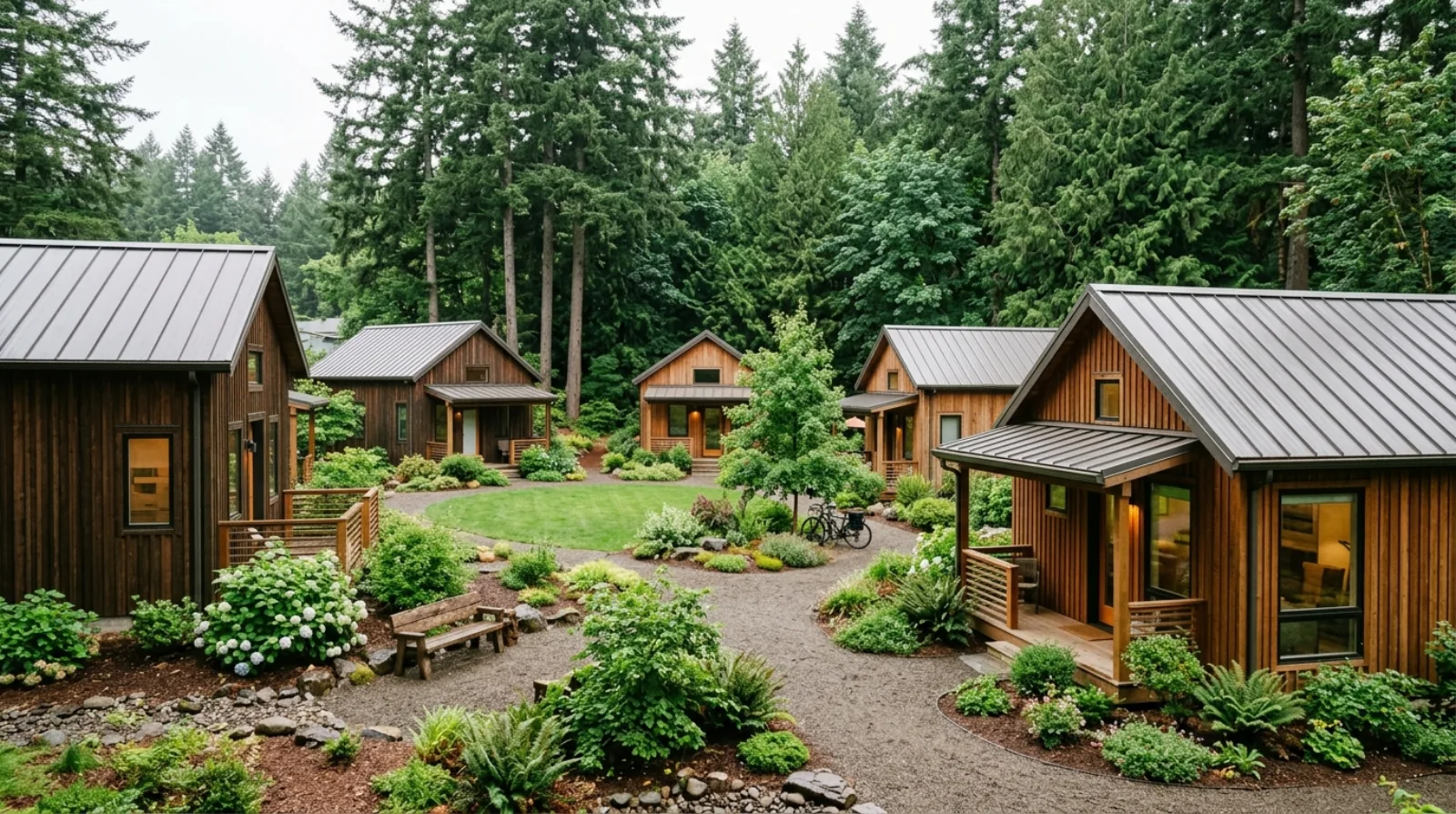
The 30-second answer
- Oregon was the first US state to effectively end single-family-only zoning, through House Bill 2001 (signed August 8, 2019).
- Cities over 10,000 people must allow a duplex on any single-family lot. Cities over 25,000 and the whole Portland metro must also allow triplexes, fourplexes, townhouses and cottage clusters.
- The law covers cities that hold about 68% of Oregon’s population.
- A 2025 upgrade, HB 2138, redefines a duplex to allow two detached homes, bars traffic studies for projects under 12 units, and voids old deed rules that banned middle housing (those parts take effect January 1, 2027).
- Middle housing rose from about 8% to 11% of all permits across 45 affected cities; in Portland it reached about 400 homes a year.
Find your city’s tier
Oregon did not set one rule for the whole state. It set a floor that rises with city size. Look up your city’s population and read across.
Cities 10,000 – 25,000
Duplex
Must allow a duplex on every lot that allows a detached house. Deadline was June 30, 2021.
Cities 25,000+ and all of Portland Metro
Up to a fourplex + more
Must allow duplexes, triplexes, fourplexes, townhouses and cottage clusters by right. Deadline was June 30, 2022.
Cities under 10,000 people are not required to change, though many did. The covered cities hold about 68% of Oregon’s population.
New in 2025 · HB 2138
Oregon just upgraded the law again
A duplex can now be two detached homes, not just two joined under one roof, which is far more flexible on an odd-shaped lot.
Cities can no longer demand a traffic study for projects under 12 units, removing a common delay.
Old deed rules and HOA covenants that banned middle housing are voided, even ones written before 2019.
A faster land-division process lets you put each unit on its own lot to sell separately. These parts take effect January 1, 2027.
What it actually built
new middle-housing homes in Portland by year three, or 26% of its permits
Sightline (2025)Honest caveat: Oregon’s total housing production is in a market slump. 2024 multifamily permits were the lowest in 12 years, so the zoning changed what can be built more than it changed how much is being built.
Timeline
- Aug 8, 2019
Governor Kate Brown signs House Bill 2001, the first US state law to broadly end single-family-only zoning.
- Dec 9, 2020
The Land Conservation and Development Commission adopts the Large Cities Middle Housing Model Code (rules under OAR 660-046).
- Jun 30, 2021
Medium cities (10,000–25,000) must allow duplexes by this date.
- Jun 30, 2022
Large cities (25,000+) and the Portland metro must allow all middle housing types by this date.
- Jul 2025
HB 2138 (Chapter 476) becomes law, expanding middle housing further and voiding old anti-density deed rules.
- Jan 1, 2027
The HB 2138 land-division and covenant-removal sections take effect.
If you own a lot in Oregon
Start by finding your city’s population, because it decides everything. Over 25,000 or in Portland metro, and the full menu, up to a fourplex, townhouses and cottage clusters, is open to you by right. Between 10,000 and 25,000, you are guaranteed at least a duplex. Then read your city’s own development code, because the state sets the floor but your city writes the detailed rules on setbacks, height and design.
Two things make Oregon unusually workable: parking requirements are capped low or removed, and you can split the units onto their own lots to sell separately. If an old HOA covenant is blocking you, HB 2138 will void it as of January 2027.
Oregon missing-middle housing: questions people ask
Does Oregon’s missing-middle law apply to my town?
It depends on your city’s population. If your city has 10,000 or more people, it must allow a duplex on any lot that allows a detached house. If your city has 25,000 or more people, or sits inside the Portland metro service district, it must allow the full set of middle housing types: duplexes, triplexes, fourplexes, townhouses and cottage clusters. Cities under 10,000 are not required to change their zoning, though many have. Together the covered cities hold about 68% of Oregon’s population, so the law reaches most Oregonians.
Can I build a fourplex in my Oregon city?
Yes, by right, if your city has 25,000 or more people or is in the Portland metro area. "By right" means the fourplex is a permitted use: you do not need a rezoning or a discretionary hearing if your plans meet the objective standards in your city’s development code. In cities between 10,000 and 25,000 people the state only requires duplexes, so a fourplex may or may not be allowed depending on your local code.
Can I build a duplex if my town has only 12,000 people?
Yes. Any Oregon city with 10,000 or more residents must allow a duplex on each lot that permits a detached single-family house. This was the lower of the two tiers the state set, and the compliance deadline for these medium cities was June 30, 2021, so the rule has been in force for years.
What middle housing types does HB 2001 allow?
In the larger cities the required types are duplexes, triplexes, quadplexes (fourplexes), townhouses, and cottage clusters. A cottage cluster is a group of at least four small detached homes, each with a footprint under about 900 square feet, arranged around a shared common courtyard. This range is what lets an owner match the building to the lot, from a simple duplex to a courtyard of small cottages.
What is HB 2138 and how does it change things?
HB 2138 is a 2025 law (Oregon Laws 2025, Chapter 476) that builds on HB 2001. It redefines a duplex so the two homes can be attached or fully detached, creates a faster process to split middle-housing units onto their own lots, bars cities from requiring a traffic impact study for developments under 12 units, and, importantly, retroactively voids private deed restrictions and HOA covenants that banned duplexes, triplexes or ADUs. The covenant-removal and land-division parts take effect January 1, 2027.
Can my HOA or an old deed rule still block a duplex?
Not for much longer. HB 2138 voids deed restrictions and homeowners-association covenants that forbid middle housing, even ones written before 2019. That part of the law becomes operative on January 1, 2027. Until then, check whether your specific covenant is still being enforced, but the direction of the law is clear: private rules cannot be used to keep middle housing off a lot the state has legalized.
Do I need off-street parking for middle housing in Oregon?
Usually very little, and sometimes none. The state Large Cities Model Code caps required parking sharply: on lots of 3,000 square feet or smaller a city can require no more than one space total for the first four homes; up to 5,000 square feet, no more than two; up to 7,000 square feet, no more than three. Some cities that adopted the model code require zero parking. Your exact number depends on which code your city adopted, so confirm locally.
What is the minimum lot size for middle housing?
Under the state model code most middle housing types are allowed on lots of at least 4,000 square feet, and cottage clusters need a lot of at least 7,000 square feet. Cities keep some flexibility to set lot sizes in specific districts, so the exact minimum for your property is set by your local development code, but the state floor prevents cities from using very large minimum lot sizes to block middle housing.
Did HB 2001 actually get homes built?
It moved the needle without transforming the market. Across 45 affected cities, middle housing rose from about 8% to 11% of all housing permits. Portland reached roughly 400 new middle-housing homes a year, about a quarter of its permits, and small cities like Keizer and Troutdale saw middle housing become 42% and 47% of their permits. But Oregon’s total housing production is in a slump for market reasons, which caps how much gets built regardless of what zoning allows.
Is middle housing cheaper than a single-family house?
On average, yes. Sightline found newly built middle housing sold for about $300,000 less than new detached houses in the same markets. That is the core promise of the "missing middle" idea: smaller attached and clustered homes on the same land cost less per home than a large single house, which puts ownership within reach of more households.
Who enforces the law and where are the exact rules?
The Oregon Department of Land Conservation and Development (DLCD) administers HB 2001, and the Land Conservation and Development Commission (LCDC) writes the rules, found in Oregon Administrative Rules Chapter 660, Division 046. Each large city adopted either the state model code, its own minimum-compliance code, or a mix, so your city’s development code is the final word on your specific lot. DLCD’s implementation guidance was last updated in April 2026.
Is Oregon’s law still in force in 2026?
Yes. HB 2001 has been in force statewide since 2019, all compliance deadlines have passed, and no court has overturned it. The 2025 HB 2138 upgrade strengthens it rather than rolling it back. If anything, Oregon is deepening its commitment to middle housing, not retreating from it.
Can I split my lot and sell the middle-housing units separately?
Increasingly, yes. Oregon already allowed "middle housing land divisions" so each unit could sit on its own lot, and HB 2138 adds an expedited process for this that takes effect January 1, 2027. Being able to sell each home separately is a big deal for feasibility, because it lets a builder recover costs unit by unit instead of holding the whole building as one rental.
Why did some cities see middle housing drop at first?
A few cities reported the 2-to-4-unit share of permits dipping in the first year after they complied. This is usually a timing effect: permits already in the pipeline under the old rules finish first, and it takes a year or two for builders and lenders to adjust to the new options. The multi-year trend across the state is clearly upward, from about 8% to 11% of permits.
Compare Oregon with related reforms
Official sources & studies
- Oregon DLCD: Housing Choices / HB 2001 program Primary
- Oregon DLCD: Large Cities Middle Housing Model Code (Dec 2020) Primary
- Oregon DLCD: Model Codes Implementation Guidance (Apr 2026) Primary
- Oregon Legislature: HB 2138 (2025 / Chapter 476) Primary
- 1000 Friends of Oregon: HB 2001 signed into law
- Sightline Institute: Oregon’s zoning reforms are working (2025)
- The Century Foundation: the case of Oregon (68% figure)
See how Oregon (statewide) compares to the rest of the world
VanPlex tracks every major multiplex reform on Earth — what each city legalized, what actually got built, and what survived. Put Oregon (statewide) next to 23 other cities on one scorecard.
Building in British Columbia instead? See what a BC lot allows →