
Can you build a triplex in Minneapolis? Yes, anywhere in the city.
In 2020 Minneapolis became the first big US city to let three homes stand on any lot that used to allow only one. Six years on, the rule has survived a court fight and taught the rest of North America a hard lesson: making density legal is the easy part. This is what the rule actually allows in 2026, and what it really built.
major US city to end single-family-only zoning citywide. Portland, then whole states, followed the path Minneapolis cut.
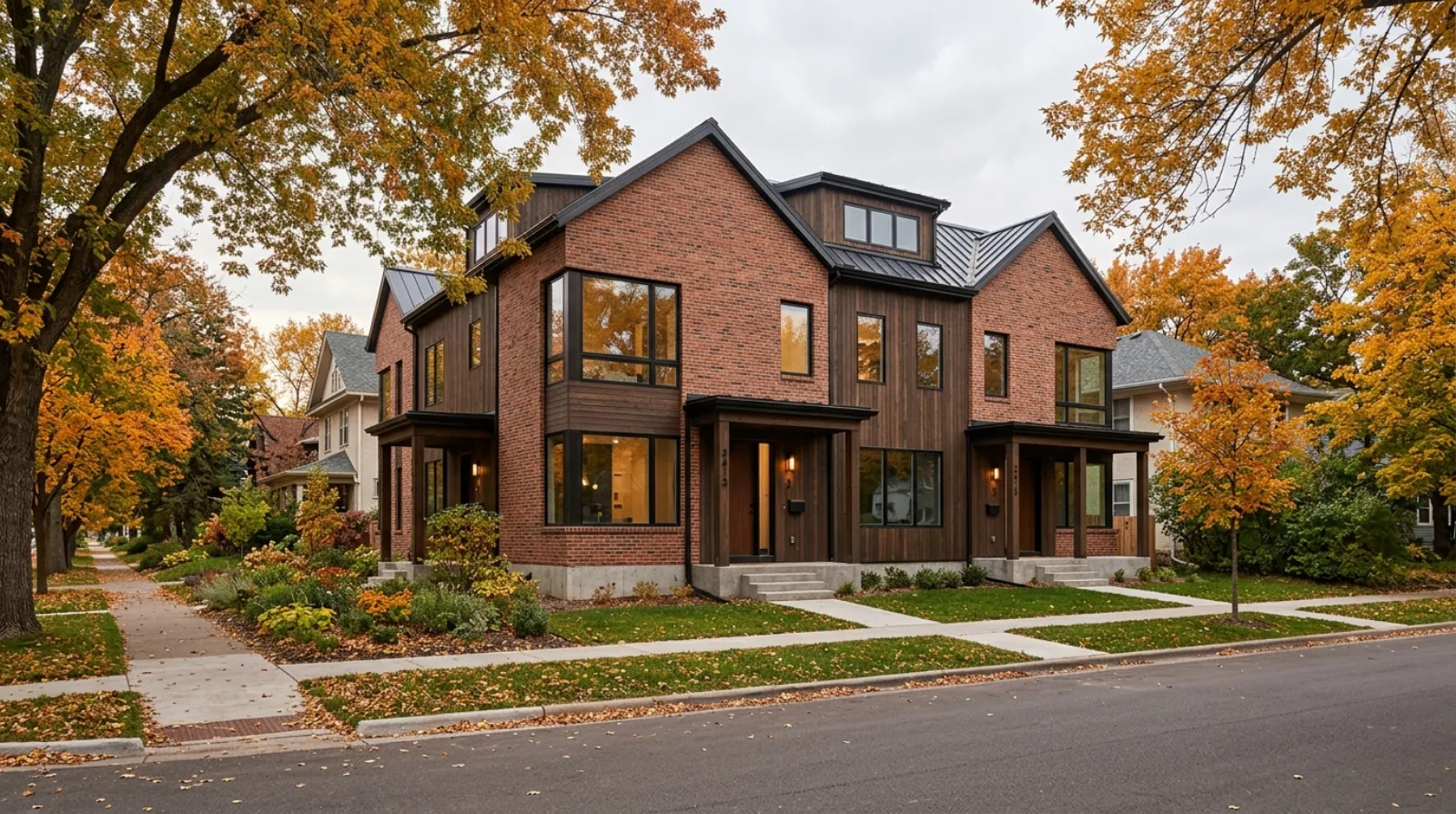
The 30-second answer
- Up to 3 units (a triplex) are allowed by right on any residential lot in Minneapolis, citywide, since January 1, 2020.
- Minneapolis was the first major US city to end single-family-only zoning citywide.
- Off-street parking minimums were removed everywhere in the city in 2021. A new triplex needs no parking.
- The plan is fully in force in 2026: the environmental lawsuit against it was dismissed in January 2025.
- The surprise: from 2017–2022 about 87% of new homes came from 20+ unit buildings, and only about 1% from 2-to-4-unit buildings.
The twist: triplexes got legal, but they didn’t get built
This is the part most headlines miss, and the most useful thing an owner or builder can know. Minneapolis legalized triplexes on every lot, and then almost no triplexes were built. The homes that did get built came from apartments on the upzoned transit corridors, not from the citywide triplex rule.
The lesson every later reform copied, from Oregon, California, Washington and British Columbia, is that a unit limit on the map does not build homes on its own. The building-size rules, the land cost, and the financing decide what actually gets built.
What you can build
- 3 units by right on any residential lot (R1–R2B), citywide.
- No parking required: off-street minimums were removed in 2021.
- More on corridors: transit and downtown districts allow apartments.
The catch: built-form limits
Height, setbacks, lot coverage and a total floor-area cap were kept close to the old single-family rules. In the Interior 1 and 2 districts the whole building is capped at about 4,000–4,500 sq ft, roughly 1,333 sq ft per unit across three homes. That is why many lots only fit a house or a duplex in practice, even though three is legal.
The court fight that nearly killed it
The reform’s biggest risk was not planning. It was a single environmental lawsuit that froze the whole plan for the better part of a year. Politics, not planning, saved it.
- Oct 2019
City Council adopts the Minneapolis 2040 Comprehensive Plan.
- Jan 1, 2020
Triplex and duplex zoning takes effect on every residential lot citywide.
- 2021
Minnesota Supreme Court rules residents can sue a comprehensive plan under the Minnesota Environmental Rights Act (MERA), letting the case go forward.
- May 2021
City eliminates off-street parking minimums citywide (effective May 22, 2021).
- Sep 5, 2023
Judge Joseph Klein orders the city back to its old 2030 plan pending an environmental review, stalling 30+ projects, roughly 500 homes.
- May 2024
The Legislature exempts current and future comprehensive plans from MERA suits, and the Court of Appeals lifts the injunction. The plan resumes.
- Aug 2024
The Minnesota Supreme Court declines to review the case; the reversal stands.
- Jan 13, 2025
Judge Klein dismisses the lawsuit outright, citing the new state law. The fight is over.
Did it lower rents? Mostly, with an honest caveat
Minneapolis rent growth 2017–2022, versus +14% for the rest of Minnesota.
Estimated yearly saving per renter compared with the statewide rent trend (Pew).
Growth in the city’s housing stock over the same period, mostly from larger buildings.
The Minneapolis Fed adds a fair caveat: a drop in rental demand hit at the same time as the new supply, so not all of the slow rent growth can be credited to the zoning alone. Sources: Pew · Minneapolis Fed.
If you own a lot in Minneapolis
Your right to build up to three homes is real and settled. The lawsuit that threatened it is over. But do not assume three homes automatically fit. Before you plan a triplex, check your built-form district (Interior 1, 2, or 3), because the floor-area cap, not the unit limit, usually decides how many homes your lot can hold.
The upside that costs nothing: since 2021 you owe zero off-street parking on a new home, which frees up the lot and cuts the build cost. If your lot sits on or near a transit corridor, the ceiling is higher than three. That is where Minneapolis actually added most of its new homes.
Minneapolis multiplex zoning: questions people ask
Can I build a triplex in Minneapolis?
Yes. Up to three units (a triplex) are allowed by right on any residential lot in Minneapolis, citywide, as long as the design meets the zoning code. "By right" means you do not need a rezoning, a variance, or a public hearing for the third unit itself; if your plans fit the built-form rules for your district, the city must approve them. The right applies to the standard residence districts (R1 through R2B), which cover the great majority of the city's houses. The practical limit is not the unit count but the building envelope, which covers height, setbacks, lot coverage and the total floor-area cap, and is what actually decides how many homes fit on your specific lot.
Is single-family-only zoning still banned in Minneapolis in 2026?
Yes. Minneapolis became the first major US city to end single-family-only zoning citywide, effective January 1, 2020, and that has not been reversed. It is important to read this correctly: the city did not ban detached houses. You can still build a single house. The city simply also allows a duplex or triplex on those same lots, so the "one house only" rule is gone. The 2040 plan that made this change survived a court challenge and remains the operative zoning law in 2026.
Is the Minneapolis 2040 plan still in effect after the lawsuit?
Yes, and the legal cloud over it has lifted. A group of environmental plaintiffs won an injunction in September 2023 that briefly forced the city back to its older 2030 plan. In 2024 the Minnesota Legislature changed the underlying law to exempt comprehensive plans from that kind of environmental suit, the Court of Appeals lifted the injunction, and the state Supreme Court declined to hear a further appeal. In January 2025 the trial judge dismissed the case entirely. As of July 2026 there is no active challenge, and the triplex rules are fully in force.
Do I need to add off-street parking for a new triplex?
No. Minneapolis removed all off-street parking minimums citywide in 2021 (adopted May 14, 2021, effective May 22, 2021). This is one of the most valuable and least understood parts of the reform. You may still build parking if you or your renters want it, but the city no longer forces you to, which frees up lot space for the building and garden and can meaningfully cut construction cost, especially on a narrow lot where a required parking pad would have crowded out a third unit.
How many units can I put on a normal residential lot?
Three on a standard residential lot in the R1 through R2B districts, which is most of the city. If your lot sits on or near one of the upzoned transit corridors, or in a higher-intensity district, the ceiling is higher. Those areas were rezoned to allow small apartment buildings. The single most useful thing you can do before planning is confirm both your residence district and your built-form district (Interior 1, 2, or 3), because together they set your unit count and your size cap.
If triplexes are legal everywhere, why don’t I see many being built?
Because legal permission and financial feasibility are two different things. When Minneapolis legalized triplexes it kept the built-form rules (height, setbacks, lot coverage and a total floor-area cap) close to the old single-family standards. On many lots that envelope only fits a house or a duplex once you account for real construction. The numbers show it plainly: 2-to-4-unit "missing middle" permits ran only about 57 a year in 2020–2022, and just about 1% of the roughly 21,000 homes permitted from 2017–2022 came from 2-to-4-unit buildings. The lesson later reforms learned from Minneapolis is that you also have to give the smaller buildings enough floor area to pencil out.
How big can each triplex unit be?
It depends on your built-form district, not just the unit count. In the lower-intensity Interior 1 and Interior 2 districts the whole building is capped at roughly 4,000–4,500 sq ft, which works out to about 1,333 sq ft average per unit across three homes. The Interior 3 district is more generous, allowing three units of about 1,500 sq ft each. That total floor-area cap, combined with setbacks and height limits, is usually the real constraint. Many builders find the math works better at two larger units than three smaller ones.
Did the reform actually lower rents?
It held rents down more than almost anywhere else in the state. Pew found Minneapolis rents rose only about 1% from 2017–2022 while the rest of Minnesota rose about 14%, and estimated that the typical renter pays roughly $1,700 a year less than they would have if rents had tracked the statewide trend. There is an honest caveat: the Minneapolis Fed points out that a drop in rental demand hit at the same time as the new supply, so not every bit of the slow rent growth can be credited to the zoning alone. The fair reading is that adding a lot of supply clearly helped, even if it was not the only factor.
Where did the new housing actually come from, if not triplexes?
Overwhelmingly from apartments on the upzoned transit corridors and in downtown, not from the citywide triplex rule. About 87% of the roughly 21,000 homes permitted in 2017–2022 were in buildings of 20 or more units. This is the core insight of the Minneapolis story: the headline "end of single-family zoning" got the attention, but the corridor and downtown upzoning did most of the real work on actual supply. For an owner, that means the biggest opportunity is on or near a transit corridor, where the ceiling is far above three homes.
What was the lawsuit against the 2040 plan about?
Three groups, Smart Growth Minneapolis, the local Audubon chapter, and a migratory-bird protection group, sued under the Minnesota Environmental Rights Act (MERA). Their argument was that a denser citywide plan would increase stormwater runoff and pollution and therefore needed a full environmental review the city had not done. The case reached the Minnesota Supreme Court, which in 2021 ruled that residents could indeed challenge a comprehensive plan under MERA. That is what led to the 2023 injunction, and what prompted the Legislature to change the law in 2024 so comprehensive plans could not be blocked this way.
Which zoning rules and chapter cover multiplexes in Minneapolis?
The rules live in Title 20 of the city code (the Zoning Code), Chapter 546, which governs the Residence Districts. Districts R1 through R2B list two- and three-unit dwellings as permitted uses. Alongside the residence districts, the built-form districts (including Interior 1, 2 and 3) set the size and shape limits. If you are checking your own lot, you will want to look up both your residence district and your built-form district in the city's zoning code on Municode.
Is a newer plan replacing the 2040 plan?
The city has begun work on a successor, informally called "Minneapolis 2050," but that is a future planning process. The 2040 zoning, including the citywide triplex rule and the removal of parking minimums, is still the law that applies today, and none of those core rules have been rolled back. If anything, the successor planning is expected to build on the same direction rather than reverse it.
Is Minneapolis a good model for other cities to copy?
It is the most important early experiment, and its lesson is double-edged. On the good side, it proved a big city could end single-family-only zoning, survive the political and legal backlash, and hold rents down while supply grew. On the cautionary side, it showed that a unit limit on the map does almost nothing on its own. The citywide triplex rule barely produced triplexes because the building-size rules were too tight. Later reforms in Oregon, Portland, Washington and British Columbia all borrowed the ambition while trying to fix that gap by giving smaller buildings more floor area.
Compare Minneapolis with the reforms it inspired
Official sources & studies
- City of Minneapolis: Residential (3 units) zoning amendment Primary
- Minneapolis 2040: parking & mobility regulations (official) Primary
- Minneapolis 2040: built-form / triplex size Q&A (official) Primary
- Minneapolis city code: Title 20, Chapter 546 (Residence Districts) Primary
- Pew: Minneapolis land-use reforms (outcome data)
- Bipartisan Policy Center: Minneapolis zoning reform
- Minneapolis Fed: supply & demand in rent trends since 2040
- Star Tribune: lawsuit dismissed (Jan 2025)
- Minnesota Reformer: 2024 law protecting the 2040 plan
See how Minneapolis compares to the rest of the world
VanPlex tracks every major multiplex reform on Earth — what each city legalized, what actually got built, and what survived. Put Minneapolis next to 23 other cities on one scorecard.
Building in British Columbia instead? See what a BC lot allows →