
Portland made the fourplex actually pencil
Plenty of cities legalized more homes and got almost none. Portland is the one that worked, and the reason is a single clever rule: the bigger you build in homes, the more floor area you are allowed. Here is what the Residential Infill Project lets you build in 2026, and the design that other cities are now trying to copy.
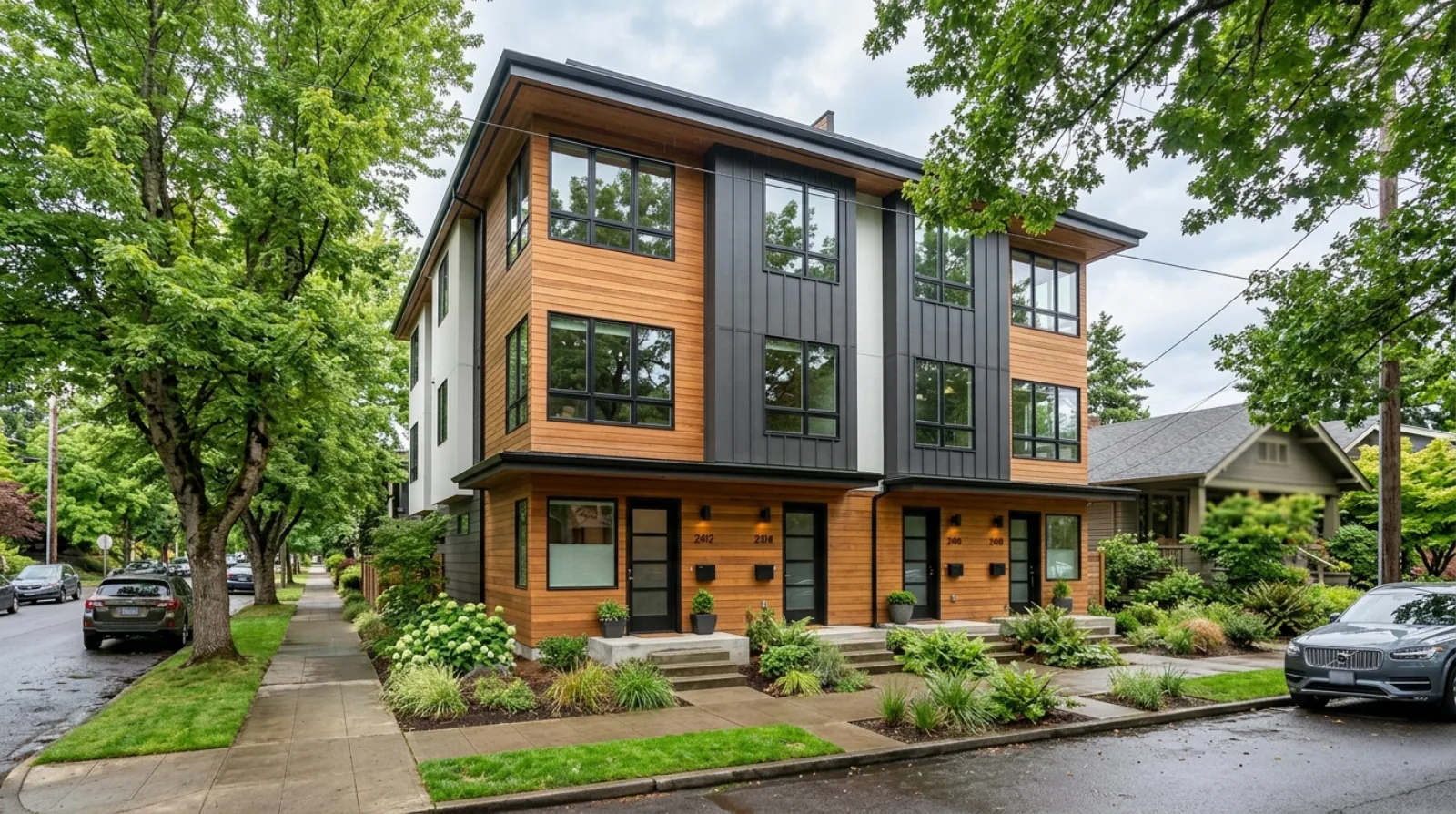
The 30-second answer
- Portland’s Residential Infill Project (RIP) lets you build up to 4 units on almost any residential lot (a duplex, triplex or fourplex) with no off-street parking required.
- You can reach 6 units if at least half of them are affordable to households earning up to 60% of the median family income.
- The key design: the allowed floor area rises with each unit you add, so a fourplex gets more building than a single house. That is why Portland actually produced middle housing.
- From August 2021 to mid-2024, single-family zones went from 23% to 43% of Portland’s new housing. Middle housing became the most common type built there.
- A new market-rate middle-housing unit averaged about $460,000 in 2024, versus about $916,000 for a new detached house.
The rule that made it work: more homes, more building
On a standard R5 lot, the allowed floor area climbs with each home you add. A fourplex is allowed about 60% more building than a single house on the same land. That is the reverse of most cities, and it is why builders in Portland choose four units, not one.
Base floor area ratio in the R5 zone. Keeping an existing house, or making one unit affordable, bumps each row up one more tier. Source: City of Portland FAR guidance.
The base: up to 4 units
A duplex, triplex or fourplex is allowed by right on almost any single-dwelling lot, citywide, with no off-street parking required. The fourplex is the most common choice because it unlocks the top floor-area tier.
The bonus: up to 6 units
Build six units if at least half are affordable to households at up to 60% of median family income. The affordable rental units stay affordable for 99 years under a covenant certified by the Portland Housing Bureau.
What actually got built
middle-housing + ADU units permitted in single-family zones, Aug 2021 – Jun 2024
City of Portland (2025)Timeline
- Aug 12, 2020
City Council adopts the Residential Infill Project (RIP) on a 3–1 vote.
- Aug 1, 2021
RIP takes effect: up to 4 units by right, parking mandates removed, floor area tied to unit count.
- Jun 30, 2022
RIP Part 2 takes effect, extending middle housing into the lowest-density R10 and R20 zones and adding cottage clusters and townhouses citywide.
- Jan 2025
City progress report (data to mid-2024) shows middle housing became the most common home type built in single-family zones.
If you own a lot in Portland
Run the floor-area math first, because it, not the unit limit, decides your best option. On a typical R5 lot a fourplex gives you the most building per dollar of land, and you owe no parking. If you can make one unit affordable, or keep your existing house, you jump a floor-area tier and may reach five or six homes.
Then decide your exit: the land-division rules let you put each home on its own lot and sell them one by one, which is usually how the numbers close. Book a city early-assistance meeting to confirm your FAR tier before you pay for design.
Portland fourplex & RIP zoning: questions people ask
Can I build a fourplex in Portland?
Yes. Up to four units (a duplex, triplex or fourplex) are allowed by right on almost any lot in Portland’s single-dwelling zones, subject to size and scale limits. "By right" means it is a permitted use: if your design fits the objective standards, the city approves it without a rezoning or a discretionary hearing. The fourplex is in fact the most popular choice under the rules, because it unlocks the most floor area per lot.
How do I get to 6 units in Portland?
You can build up to six units on a site if at least half of them are affordable to households earning up to 60% of the median family income. This is the "deeper affordability" bonus that Portland built into the rules deliberately. The affordable units carry a recorded covenant certified by the Portland Housing Bureau: for rental units the affordability lasts 99 years at 60% of median income, and for for-sale units it lasts 10 years at 80% of median income.
What is the FAR bonus and why does it matter?
FAR means floor area ratio, the total building floor area divided by the lot area. Portland’s breakthrough was to set a higher FAR for each additional unit. On a standard R5 lot, a single house is capped at 0.5 FAR, a duplex at 0.6, a triplex at 0.7, and a fourplex at 0.8, so four homes are allowed about 60% more building than one house. This is the opposite of most cities, which let a big single house use as much floor area as four small homes, and it is the main reason Portland’s reform actually produced middle housing instead of just legalizing it on paper.
Do I need off-street parking for a Portland fourplex?
No. RIP removed the off-street parking requirement across the single-dwelling zones, about three-quarters of the city’s residential land. You can add parking if you want, but the city does not force you to, which frees up the lot for the building and can be the difference between three units fitting and four fitting.
Which zones does RIP apply to?
RIP Part 1 covered the R2.5, R5 and R7 single-dwelling zones. RIP Part 2, effective mid-2022, extended the middle-housing rules into the lowest-density R10 and R20 zones as well, and added cottage clusters and attached houses (townhouses) citywide. In practice that means the middle-housing options now reach essentially all of Portland’s house-zoned land.
Can I keep my existing house and add units?
Yes, and you may earn a bonus for doing it. Retaining an existing home while adding new units qualifies for the same higher tier of floor area as the affordability bonus. This makes it attractive to add two or three new homes behind or beside a house you keep, rather than demolishing and rebuilding.
Can I sell each unit separately?
Yes. Portland allows middle-housing land divisions under Oregon’s Senate Bill 458, which let each unit sit on its own separately-ownable lot. Being able to sell the homes one at a time, rather than holding the whole building as a single rental, is a major reason the numbers work for small builders and owners.
What is a cottage cluster in Portland?
A cottage cluster is a group of at least four small detached homes, each with a footprint under about 900 square feet, arranged around a shared common courtyard. RIP Part 2 allowed cottage clusters citywide, including in the low-density R10 and R20 zones, giving owners of larger lots a way to add several small homes while keeping a detached, low-rise character.
How much middle housing did Portland actually build?
A lot, by the standard of these reforms. From August 2021 to mid-2024 the city permitted more than 1,400 middle-housing and ADU units in single-family zones, and the share of the city’s total new homes coming from those zones jumped from 23% in 2023 to 43% in the first half of 2024. Middle housing became the most common type of home being built in the single-family zones, the outcome most other cities hoped for and did not get.
Is middle housing really cheaper than a house in Portland?
Yes, by a wide margin. In 2024 a new market-rate middle-housing unit averaged about $460,000, while a new detached house averaged about $916,000, roughly half the price. That gap is the practical payoff of the reform: it put new-construction ownership within reach of buyers who could never afford a new single house on the same land.
Why is Portland called the best low-density reform in US history?
The Sightline Institute gave it that label because of the FAR-by-unit design. Most cities that "ended single-family zoning" kept the building-size rules so tight that middle housing did not pencil out. Minneapolis is the classic example, where triplexes were legal but barely built. Portland instead rewarded more units with more building and removed parking mandates, and the production numbers followed. It is the reform other cities, including in British Columbia, are now studied against.
Is RIP still in force in 2026?
Yes. Both RIP Part 1 (2021) and Part 2 (2022) are in force, and no repeal or major amendment has occurred. The most recent city milestone is the January 2025 progress report measuring what got built. The rules that let you build up to four units, or six with affordability, remain fully in effect.
Where can I get help before applying?
The City of Portland offers early-assistance appointments for residential infill projects, where staff review your lot and options before you file a full application. Because the floor-area math and the affordability covenant terms decide whether a project works, using an early-assistance meeting to confirm your FAR tier and unit count is worth doing before you spend on design.
Compare Portland with related reforms
Official sources & studies
- City of Portland: Residential Infill Project (about) Primary
- City of Portland: RIP Part 2 (R10/R20, cottage clusters) Primary
- City of Portland: deeper affordability FAR program (code 30.01.140) Primary
- City of Portland: 2025 progress report release (production data) Primary
- Sightline Institute: “the best low-density zoning reform in US history”
See how Portland compares to the rest of the world
VanPlex tracks every major multiplex reform on Earth — what each city legalized, what actually got built, and what survived. Put Portland next to 23 other cities on one scorecard.
Building in British Columbia instead? See what a BC lot allows →