
Can you build 8 homes on one house lot in Edmonton? Yes.
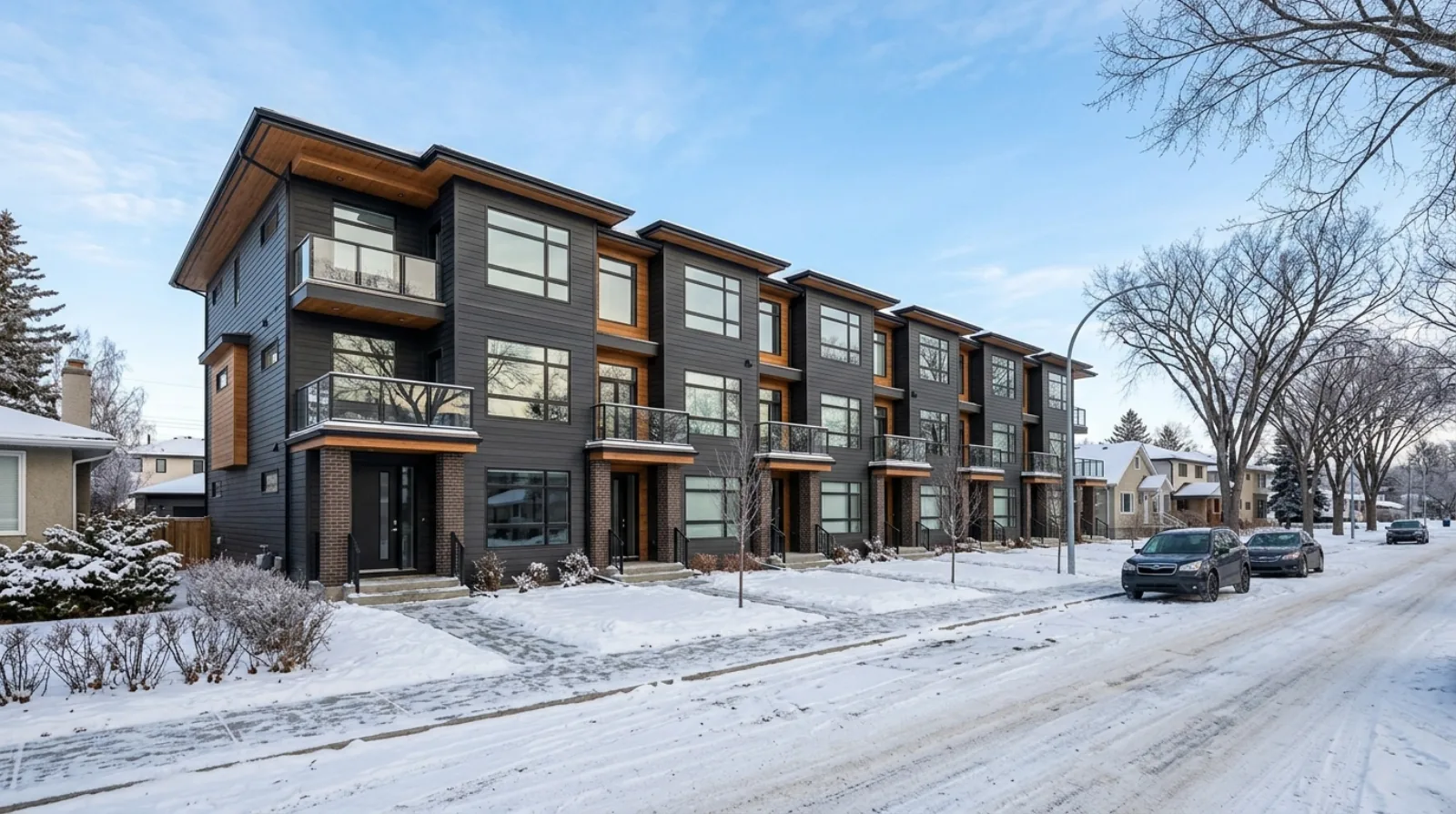
In 2024 Edmonton replaced most of its single-house zones with one zone that lets you build up to 8 homes on a standard lot, with no required parking. It is the boldest low-rise zoning change of any big city in Canada. This is what the rule allows in 2026, the fight over whether to cut it to 6 units, and what actually got built.
homes allowed on a standard mid-block lot in the RS zone, the highest blanket limit of any major Canadian city. And a new home owes zero required parking.
The 30-second answer
- Edmonton allows up to 8 homes on a standard mid-block house lot in the RS (Small Scale Residential) zone. This is one of the highest blanket limits of any big North American city.
- The RS zone took effect January 1, 2024 and replaced most of the old single-house zones citywide.
- The 8-unit maximum is still in force in 2026. On February 17, 2026, City Council voted 8–4 to keep it after a motion to cut it to 6 units.
- You get 8 units at 75 m² of site area per home, so a lot needs about 600 m² to reach the full eight.
- Edmonton has no required off-street parking on a new home. The city removed parking minimums citywide in July 2020.
The headline number: 8 homes on a house lot
Most cities that reformed their zoning allowed 3 or 4 homes on a lot. Edmonton went to 8. On a standard mid-block lot in the RS zone you can build up to eight homes, up to three storeys, with no required parking. Here is how that limit compares to the other big Canadian and North American reforms.
Homes allowed on a standard lot in each city's default residential rule. Edmonton's RS zone sets the highest limit. The catch is site size: you need about 600 m² (75 m² per home) to reach all eight. Parking minimums removed citywide in 2020.
What you can build (RS zone)
- Up to 8 homes on a standard mid-block lot, by right.
- Up to 3 storeys, 10.5 m tall (dropping to 9.5 m on Aug 1, 2026).
- 75 m² of site area per home, so about 600 m² for the full eight.
- No required parking: minimums were removed citywide in 2020.
- Detached, semi, row, or multiplex: one zone covers all these forms.
The honest fine print
The 8-unit count is still the rule in 2026, but the building is getting a bit shorter. On April 27, 2026, Council cut the RS height limit from 10.5 m to 9.5 m, effective August 1, 2026. The three-storey and 8-unit rules stay the same.
Your lot size, not the unit limit, usually decides your real number. A lot under 600 m² cannot reach eight homes at 75 m² each. Check your address on the city zoning map before you plan.
The fight: keep 8, or cut to 6?
The 8-unit rule was popular with builders but not with everyone. Through 2025 and early 2026, Edmonton held long public hearings about whether to lower the mid-block cap. Twice, Council chose to keep it at 8.
July 2025 vote to keep the 8-unit maximum, after days of public hearings.
February 17, 2026 vote defeating a motion to cut the mid-block cap from 8 to 6 units.
The one change Council did make: a lower height limit from Aug 1, 2026, not a lower unit count.
What actually got built
Unlike some reforms that stayed legal on paper but built little, Edmonton's RS zone produced real homes fast. Row-house building jumped in the first year, and by 2025 the full 8-unit projects were the most common form in the five-to-eight-unit group.
row-house units per year: the 2019–2023 average versus 2024, the first year of the RS zone
STOREYS (2025)"missing middle" units permitted: 2023 versus 2024, it more than doubled
STOREYS (2025)2025 RS-zone permits, by unit count (five-to-eight-unit group)
eight-unit projects permitted in the RS zone in 2025
1,824 homes
seven-unit projects
182 homes
six-unit projects
270 homes
five-unit projects
80 homes
Eight-unit projects were by far the most common, a sign that once the rules settled, builders chose to use the full cap. Edmonton permitted a record of over 17,500 homes citywide in 2025. Source: Jacob Dawang, two-year review.
How the rule got here
Edmonton removed parking minimums first, then rewrote the whole zoning bylaw, then defended the 8-unit rule twice at the council table.
- Jun 2020
Council removes required off-street parking citywide ("Open Option Parking"), effective July 2, 2020. Edmonton was the first big Canadian city to do this.
- Oct 23, 2023
Council approves the first full rewrite of the zoning bylaw in over 60 years: Zoning Bylaw 20001.
- Jan 1, 2024
The RS (Small Scale Residential) zone takes effect. It replaces most single-house zones and allows up to 8 homes on a standard lot.
- 2024
Row-house permits jump from a 146/year average to 1,216 units. Missing-middle housing more than doubles year over year.
- Jul 2025
After days of public hearings, Council votes 6–5 to keep the 8-unit maximum. A push to cut it fails.
- Feb 17, 2026
A motion by Councillor Karen Principe to cut the mid-block cap from 8 to 6 units is defeated 8–4. The 8-unit maximum stays.
- Apr 27, 2026
Council approves a lower height limit for the RS zone (9.5 m instead of 10.5 m), effective August 1, 2026. The 8-unit count is not changed; the building just has to be a bit shorter.
If you own a lot in Edmonton
Your right to build up to 8 homes is real and settled for 2026. Council kept it after two votes. But start with your lot size, not the cap. At 75 m² of site area per home, you need about 600 m² to reach the full eight; a smaller lot allows fewer. Look up your address on the city zoning map to confirm you are in the RS zone.
Two things to plan around. First, the height limit drops from 10.5 m to 9.5 m on August 1, 2026, so an application after the cut-off must fit the shorter building. Second, you owe no required parking on a new home, which frees up lot space and cuts cost, but check that your design still works for the people who will live there.
Edmonton multiplex zoning: questions people ask
Can I build 8 units on a house lot in Edmonton?
Yes, on most standard mid-block lots. Edmonton's RS (Small Scale Residential) zone allows up to 8 homes on an interior (mid-block) lot, as long as the lot is big enough. The rule is 75 m² of site area per home, so 8 homes needs about 600 m². This is one of the highest "by right" limits of any large city in North America. "By right" means you do not need a rezoning or a public hearing for the units themselves if your plans fit the zone. The 8-unit limit is still in force in 2026.
Is the 8-unit maximum still the rule in 2026, or was it cut to 6?
It is still 8. This is the fact most people get wrong, because Edmonton had a long public fight about it. In July 2025 Council voted 6–5 to keep the 8-unit maximum. Then on February 17, 2026, Councillor Karen Principe put forward a motion to cut the mid-block cap from 8 to 6 units, and Council defeated it 8–4. So as of July 2026 the maximum is still 8 homes on a standard mid-block lot. There is one honest change to note, but it is about height, not unit count. See the height question below.
Did Edmonton change anything about the RS zone in 2026?
Yes, but not the unit count. On April 27, 2026, Council approved a lower maximum building height for the RS zone (9.5 metres instead of the old 10.5 metres) which takes effect August 1, 2026. The three-storey and 8-unit rules stay the same; the building just has to be a bit shorter. This was a response to complaints that some new buildings felt too tall and bulky next to older houses. Applications submitted before the cut-off dates in mid-2026 are still reviewed under the old 10.5 m limit.
How big does my lot need to be for 8 units?
About 600 m² (roughly 6,460 sq ft). The RS zone sets a minimum of 75 m² of site area per home, so 8 homes × 75 m² = 600 m². Many older Edmonton lots are close to this size, which is a big reason the 8-unit rule reaches so many properties. Smaller lots still allow fewer homes under the same per-unit math. Corner lots can sometimes go above 8 because they have two street frontages, but the standard mid-block ceiling is 8.
Do I need to build parking for a new multiplex in Edmonton?
No. Edmonton removed all required off-street parking citywide in 2020, under a policy it calls "Open Option Parking," effective July 2, 2020. Edmonton was the first big Canadian city to do this. You can still build parking if you or your renters want it, but the city does not force a set number of stalls. This matters a lot on a narrow infill lot, where a required parking pad would have taken up space you now use for another home or a yard. Accessible parking and bicycle parking rules still apply.
What is the RS zone and what did it replace?
RS stands for "Small Scale Residential." It is the default residential zone created by Zoning Bylaw 20001, which took effect January 1, 2024. The RS zone replaced most of Edmonton's old single-house zones in one step. Instead of a long list of narrow zones that each allowed only one or two housing types, the RS zone allows a range of small homes on the same lot: detached houses, semi-detached, row houses, and multiplexes up to 8 units and 3 storeys. It was the first full rewrite of the city's zoning bylaw in more than 60 years.
How tall can an RS-zone building be?
Up to 3 storeys. The height limit is 10.5 metres today, dropping to 9.5 metres on August 1, 2026 after the April 2026 council vote. The storey count does not change (you can still build three storeys), but the total height allowed is a bit lower, which pushes builders toward slightly shorter floor-to-floor heights or a lower roof. If you are planning a project, check which height limit applies to you based on your application date.
Did builders actually use the full 8 units, or fewer?
In the first year the answer was mixed, but by 2025 the 8-unit projects clearly won out. In 2025 Edmonton permitted a record of over 17,500 homes citywide. Inside the RS zone's five-to-eight-unit group, eight-unit projects were by far the most common: 228 eight-unit projects (1,824 homes), compared with 45 six-unit, 26 seven-unit, and 16 five-unit projects. So while the earliest projects often stopped short of the cap, the market moved toward building the full 8 once the rules settled and financing caught up.
How much new housing did the RS zone actually add?
A lot, quickly. Row-house units jumped from a 146-per-year average (2019–2023) to 1,216 units in 2024, the first year of the RS zone. Total "missing middle" housing more than doubled from 2023 to 2024: from a bit over 1,000 units to about 2,300 units. Then 2025 set a citywide record of over 17,500 permitted homes. Edmonton is one of the clearest cases where a bold zoning change was quickly followed by real building, not just legal permission that nobody used.
Which bylaw and zone cover multiplexes in Edmonton?
Zoning Bylaw 20001, section 2.10, the RS (Small Scale Residential) zone. That section sets the 8-unit maximum on an interior site, the 3-storey and 10.5 m (soon 9.5 m) height limits, and the 75 m² of site area per home. The parking rules live in a separate part of the bylaw (section 5.80), which no longer sets a minimum number of stalls for homes. If you want to confirm what applies to your own lot, look up your address on the city's zoning map to see whether it is in RS or a different zone.
Why did some people want to cut the cap from 8 to 6?
The main worries were about the effect of full 8-unit buildings on older streets: parking spilling onto the road, garbage and recycling for eight households, construction disruption, and buildings that felt too big next to single houses. Councillor Karen Principe, who led the push, called a 6-unit cap "a reasonable compromise." On the other side, councillors and city staff warned that a lower cap would build fewer homes, raise costs, and make housing choices tighter. Council sided with keeping the 8-unit rule but softened the height limit instead as a middle path.
How does Edmonton compare with other Canadian cities?
Edmonton allows more homes per standard lot than any other major Canadian city's default residential zone. Its 8-unit limit is double Toronto's 4-unit multiplex rule and double British Columbia's province-wide small-scale rule of up to 4 homes on most lots. Calgary moved to allow row houses and other forms citywide, but did not set as high a unit count. Edmonton's combination of a high unit limit, no required parking, and fast building uptake makes it the boldest low-rise reform among big Canadian cities so far.
Compare Edmonton with other Canadian reforms
Official sources & studies
- City of Edmonton: RS Small Scale Residential Zone (Bylaw 20001, s. 2.10) Primary
- City of Edmonton: Zoning Bylaw 20001 (full text) Primary
- City of Edmonton: Open Option Parking (parking minimums removed) Primary
- City of Edmonton: Multi-unit Housing in the zoning bylaw Primary
- CTV News: Council keeps 8 units as the mid-block maximum (Feb 17, 2026)
- CBC News: Principe motion to cut cap from 8 to 6 fails (8–4 vote)
- CBC News: Council keeps 8-unit maximum after summer hearings (July 2025)
- STOREYS: Missing middle housing more than doubles after zoning overhaul
- Jacob Dawang: 2025, the year Edmonton built the missing middle (permit data)
See how Edmonton compares to the rest of the world
VanPlex tracks every major multiplex reform on Earth — what each city legalized, what actually got built, and what survived. Put Edmonton next to 23 other cities on one scorecard.
Building in British Columbia instead? See what a BC lot allows →