
Can you still build a rowhouse in Calgary? For most lots, no. The citywide rule was repealed.
In 2024 Calgary made rowhouses legal on almost every residential lot. Less than two years later a new council repealed it. On August 4, 2026, about 99% of those lots go back to their old, lower-density zoning. This page explains what a Calgary owner can actually build now, and how a reform that was building homes got undone.
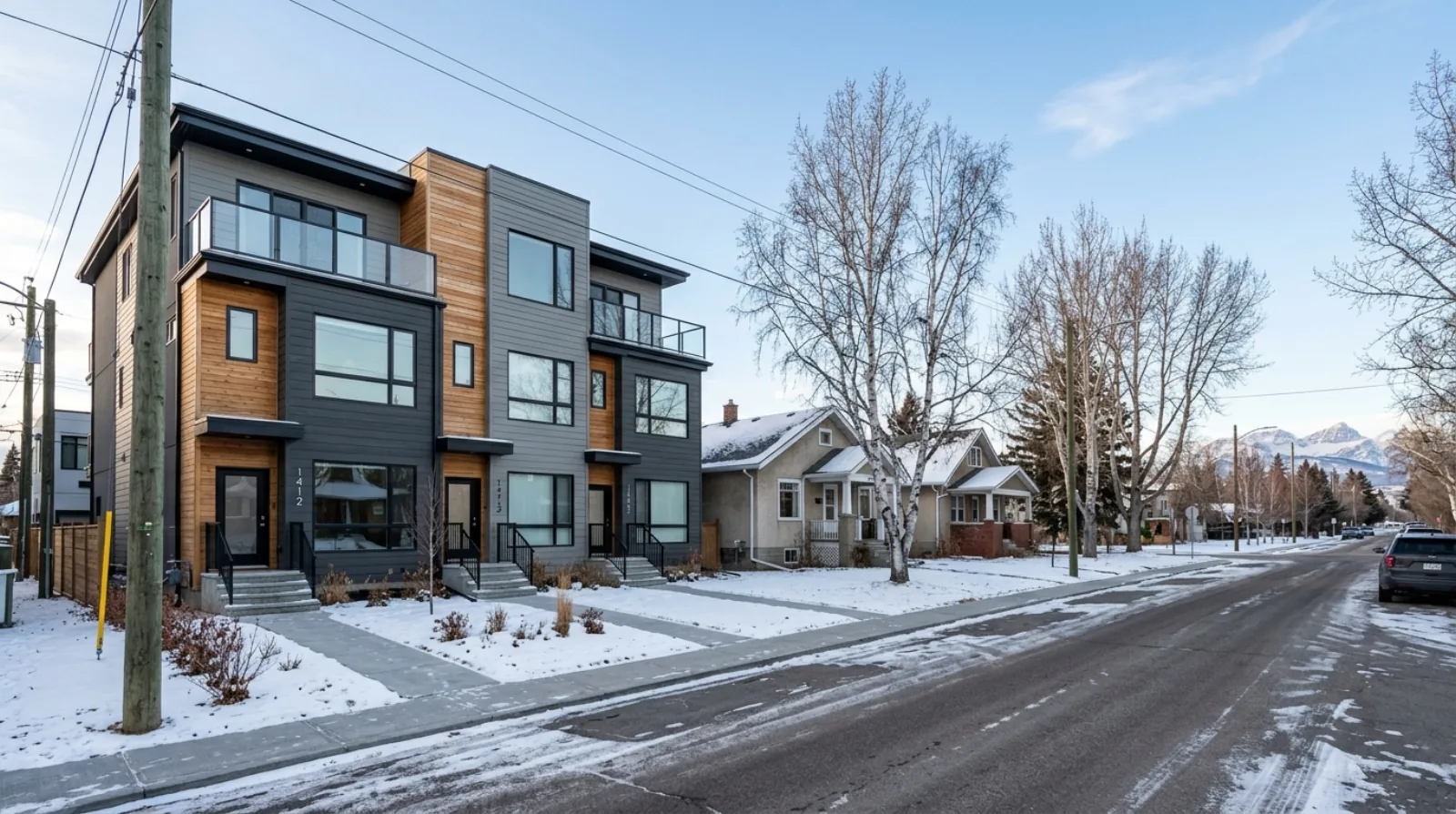
Council's vote on April 8, 2026 to repeal the citywide rezoning. Calgary is the main reversal story in Canada. Most cities are still adding density, not removing it.
The 30-second answer
- Calgary made R-CG (rowhouse) the default zoning on most residential lots in August 2024, allowing up to about 4 homes on a normal lot.
- Calgary City Council voted 12–3 on April 8, 2026 to repeal that citywide rezoning.
- The repeal takes effect August 4, 2026. On that date about 99% of the rezoned lots go back to the zoning they had before 2024.
- Lots that already have an approved permit or a project underway keep their R-CG zoning. They are not rolled back.
- On lots that stay R-CG, the maximum drops from 4 homes to 3, and rowhouses are no longer allowed in the middle of a block.
- Calgary is the main reversal story in Canada: a citywide upzoning that produced real homes was undone less than two years after it started.
Adopted, then repealed: the whole story in two steps
Calgary is unusual. Most cities in this guide moved once: they legalized more homes and kept it. Calgary moved twice: it made rowhouses legal citywide, then took it back. Here is the arc, and why the second step happened.
R-CG becomes the default on most lots
Council made R-CG, a district that allows rowhouses and townhouses plus secondary suites, roughly 3 to 4 homes on a standard lot, the base zoning across the city. An owner no longer needed a separate rezoning to build a small multi-home building.
Council votes 12 to 3 to repeal it
After a new mayor and council took office in the October 2025 election, council reversed the policy. About 99% of the rezoned lots return to their pre-2024 zoning on August 4, 2026. Lots with an approved permit or a project already underway keep R-CG.
The reversal did not happen because the rezoning failed to build homes. It happened because the people in charge changed. That is the part every owner and builder should take from Calgary: a rule can be sound and still be undone by the next election.
What the 2024 rule permitted
- R-CG as the default district on most residential lots, citywide.
- Rowhouses and townhouses plus secondary suites, roughly 3 to 4 homes on a standard lot.
- No separate rezoning needed for a small multi-home building, so no case-by-case public hearing.
What the 2026 repeal changed
- ~99% of lots revert on August 4, 2026 to their pre-2024 lower-density districts.
- R-CG lots that stay drop from 4 homes to 3, with no rowhouses mid-block.
- Approved or in-progress projects are exempt and keep their R-CG zoning.
Why it was repealed
Four things drove the reversal: a huge and angry public hearing in 2024, strong opposition in established neighbourhoods, an election that turned zoning into a wedge issue, and a new council with the votes to undo it.
people spoke at the 2024 public hearing, the longest and largest in the city's history, over ~100 hours.
CBC Newswritten submissions were filed on top of the spoken ones; more than 50,000 people watched the hearing livestream.
CBC Newsmunicipal election: blanket rezoning became a wedge issue, and Jeromy Farkas won the mayor's race promising to repeal and replace it.
CTV Newsthe final repeal vote on April 8, 2026. The new council had the numbers to undo the 2024 change.
CBC NewsWhat a Calgary owner can build now
2026 is the date the repeal takes effect. Before it, R-CG still applied to rezoned lots; after it, most revert.
of the rezoned lots go back to pre-2024 districts (R-C1, R-C2 and similar), usually a single house, not a rowhouse.
homes is the new maximum on lots that keep R-CG (down from 4), and rowhouses are no longer allowed mid-block.
The plain summary: there is no longer a citywide by-right rowhouse rule in Calgary. Whether you can build a rowhouse now depends on your specific lot: either it kept R-CG through an approved or in-progress project, or it reverted and you would need a separate rezoning. Confirm your parcel on the City of Calgary rezoning page.
What it actually built before the repeal
By late 2025 the city reported that the rezoning had enabled 478 development permits, creating 1,904 homes, in a little over a year. This matters for how you read the story: Calgary's reform was not a rule that looked good on paper but built nothing. It was producing real homes when the council reversed it. Most of those approved homes are protected by the exemption rules and can still go ahead.
Source: LiveWire Calgary (Dec 2025) →The full timeline
From the record 2024 hearing to the 2026 repeal that takes effect in August.
- Apr–May 2024
Calgary holds the longest public hearing in its history on the "Rezoning for Housing" plan: about 736 speakers over roughly 100 hours, plus 6,101 written submissions.
- May 14, 2024
Council approves the citywide rezoning by a 9–6 vote, making R-CG the default district on most residential lots.
- Aug 6, 2024
The rezoning takes effect. R-CG becomes the base zoning citywide.
- Oct 2025
Calgary's municipal election. Blanket rezoning is a major campaign issue. Jeromy Farkas wins the mayor's race on a promise to repeal and replace it.
- Dec 2025
The new council votes 13–2 to start the repeal process and sets a public hearing.
- Apr 8, 2026
Council votes 12–3 to repeal the citywide rezoning and to tighten the remaining R-CG rules.
- Aug 4, 2026
The repeal takes effect. About 99% of rezoned lots return to their pre-2024 zoning. Lots with an approved permit or a project underway keep R-CG.
The lesson from Calgary
Calgary shows that a housing reform is only as durable as the political majority behind it. The 2024 rezoning was passing homes at a real rate, but it never won broad agreement in the neighbourhoods it touched. When those neighbours turned it into an election issue and a new council took over, the rule was gone, even though it worked.
For anyone who buys land or plans a project around a zoning rule, the practical takeaway is to price in the risk that the rule can change mid-cycle. Reforms that pass with a narrow vote and heavy local opposition, as Calgary's did (9–6 in 2024), are the ones most likely to be undone. A rule that stands only until the next election is not the same as a settled right.
Calgary rezoning repeal: questions people ask
Can I still build a rowhouse or multiplex in Calgary in 2026?
It depends on your lot. Calgary repealed the citywide rezoning on April 8, 2026, and the change takes effect August 4, 2026. After that date, about 99% of the lots that were rezoned in 2024 go back to their older, lower-density zoning. On most of those, a rowhouse or multiplex is no longer allowed by right. But some lots keep the R-CG rowhouse zoning: any lot that already has an approved permit, a project underway, or an owner-initiated rezoning after August 6, 2024. So the honest answer is that you must check your specific lot's zoning, because the answer is now different from one property to the next.
When exactly did Calgary repeal blanket rezoning, and when does it take effect?
Calgary City Council voted 12–3 to repeal the citywide rezoning on April 8, 2026. The vote itself did not change any zoning that day. The changes take effect on August 4, 2026. On that date the rezoned lots that do not qualify for an exemption return to the zoning they had before the 2024 rezoning. The gap between the April vote and the August effective date gave owners a window to apply under the R-CG rules before they were pulled back.
What was "blanket rezoning" or "Rezoning for Housing" in the first place?
In 2024 Calgary made a district called R-CG the default base zoning on most residential lots across the whole city. R-CG stands for a grade-oriented infill district: it allows rowhouses and townhouses, plus secondary suites, which works out to roughly 3 to 4 homes on a standard lot. Before this, an owner who wanted to build a rowhouse usually had to apply for a separate rezoning, which meant a public hearing and months of uncertainty. The 2024 change removed that step for small multi-home buildings and applied the same base rules citywide, which is why people called it "blanket" rezoning.
What does my lot revert to after August 4, 2026?
It reverts to whatever low-density district it held before the 2024 rezoning. The city is bringing back the earlier residential districts under Land Use Bylaw 1P2007: districts such as R-C1, R-C1L, R-C1N, R-C2, R-1, R-1N, R-2, and R-CGex. Most single-detached neighbourhoods go back to a district that allows a single house (often with a secondary suite), not a rowhouse. The exact district depends on your address, so the only reliable way to know is to look up your parcel in the City of Calgary's zoning records.
I already have R-CG zoning or a permit, do I lose it?
No, if you meet the exemption rules. Lots keep their R-CG zoning if they received a permit or subdivision approval before August 4, 2026, if an application was submitted before the first reading of the repeal bylaw, or if the owner applied for the rezoning themselves after August 6, 2024. In plain terms, projects that were already approved or already in the pipeline are protected. What reverts are the lots that were rezoned automatically in 2024 but never had a project attached to them.
Did the R-CG rules change even on lots that keep it?
Yes. Council did not only repeal the citywide default. It also tightened the R-CG district itself for the lots that stay. The maximum number of homes on an R-CG lot drops from 4 to 3. Rowhouses and townhouses are no longer allowed in the middle of a block, so in practice only corner lots and the lots next to a corner can hold a rowhouse. Council also lowered the maximum building height (from 11 m to 10 m) and cut lot coverage (from 60% to 55%), and adjusted setbacks and parking. So even a lot that keeps R-CG can build less than it could before.
Why did Calgary repeal a policy that was building homes?
The short answer is politics, not housing numbers. The 2024 rezoning passed after the longest public hearing in the city's history, where about 736 people spoke over roughly 100 hours and thousands more filed written objections. Many established neighbourhoods opposed it. Blanket rezoning then became a major issue in the October 2025 municipal election. A new mayor, Jeromy Farkas, and a new council took office having promised to repeal and replace it, and they had the votes. The result was that a policy which had already produced hundreds of homes was reversed because the political majority changed.
How many homes did the rezoning actually produce before it was repealed?
By late 2025 the city reported that the rezoning had enabled 478 development permits, creating 1,904 units, in a little over a year. That is a real number of homes, not a projection. It is one of the reasons the repeal is such a clear case study: unlike some reforms that legalized density on paper but built almost nothing, Calgary's change was producing housing when it was reversed. Those already-approved units are largely protected by the exemption rules.
Who is Jeromy Farkas and what did he promise on zoning?
Jeromy Farkas won the Calgary mayor's race in the October 2025 municipal election, by a narrow margin over Sonya Sharp and incumbent Jyoti Gondek. During the campaign he said Calgary needs more homes but argued that the citywide rezoning created instability rather than certainty. He promised to repeal the blanket rezoning bylaw and replace it with a more targeted approach that supports gentle density in specific places rather than everywhere at once. After the April 2026 repeal vote he described the public hearing as "direct democracy in action."
Is there a new plan coming to replace the repealed rezoning?
Council framed the repeal as "repeal and replace," so a more targeted approach is expected rather than a full return to the old system forever. As of mid-2026 the specifics were still being worked out, and council directed staff to look at further R-CG changes at later hearings, including a possible cut to R-CG maximum density. What matters for an owner today is that there is no citywide by-right rowhouse rule anymore, and any replacement plan is a future process, not something you can build under yet.
What zoning bylaw and district names should I look up for my Calgary lot?
The rowhouse district is R-CG in Calgary's land use bylaw. The districts your lot may revert to come from Land Use Bylaw 1P2007 and include R-C1, R-C1L, R-C1N, R-C2, R-1, R-1N, R-2, and R-CGex. To find which one applies to your address, use the City of Calgary's zoning search or the official rezoning project page. Because the answer now differs lot by lot after the repeal, do not assume your neighbour's zoning matches yours. Confirm your own parcel from the city's record.
How is Calgary different from other Canadian cities on zoning?
Calgary is the exception. Most of the reform stories in Canada move in one direction: toward allowing more homes. British Columbia legalized up to 3 to 6 homes on most single-family lots province-wide, and Edmonton kept its citywide "up to 8 units" rule after debate. Calgary is the one large Canadian city that adopted a citywide upzoning and then reversed it. That makes it the clearest example in the country of how a housing reform can be undone when a new political majority takes over, even after the reform has started producing homes.
If I own a Calgary lot, what should I do right now?
First, look up your parcel's current zoning in the City of Calgary's records, because after August 4, 2026 the answer is no longer the same across the city. If your lot kept R-CG through an approved permit or a project underway, remember the tightened rules: a maximum of 3 homes, no mid-block rowhouses, lower height and coverage. If your lot reverted, you are back to lower-density rules and would need a separate rezoning to build a rowhouse, with the public hearing that comes with it. The main lesson is that zoning certainty in Calgary is lower than it looks, so confirm the current rule before you price or plan any project.
Compare Calgary with other reforms
Official sources & reporting
- City of Calgary: Repeal of Citywide Rezoning (official project page) Primary
- City of Calgary: Blanket rezoning (Ward topic page) Primary
- CBC News: Council votes 12–3 to repeal blanket rezoning (Apr 2026)
- CBC News: Longest public hearing in the city's history (2024)
- CTV News: Farkas unveils vision, including repeal of blanket rezoning
- LiveWire Calgary: Council approves repeal of citywide rezoning
- LiveWire Calgary: Data on rezoning impact (478 permits / 1,904 units)
See how Calgary compares to the rest of the world
VanPlex tracks every major multiplex reform on Earth — what each city legalized, what actually got built, and what survived. Put Calgary next to 23 other cities on one scorecard.
Building in British Columbia instead? See what a BC lot allows →