
Can you build a triplex in Ontario, or a fourplex in Toronto? Yes to both.
Ontario sets a floor: three units on most lots, anywhere in the province. Toronto builds on top of it: a fourth unit citywide, and a sixth in nine wards. This is how the province rule and the city rule stack together in 2026, and why Toronto took a $10 million funding cut rather than allow six units everywhere.
units allowed, depending on where your lot sits. Three is the provincial floor; four is the Toronto citywide rule; six applies in nine wards.
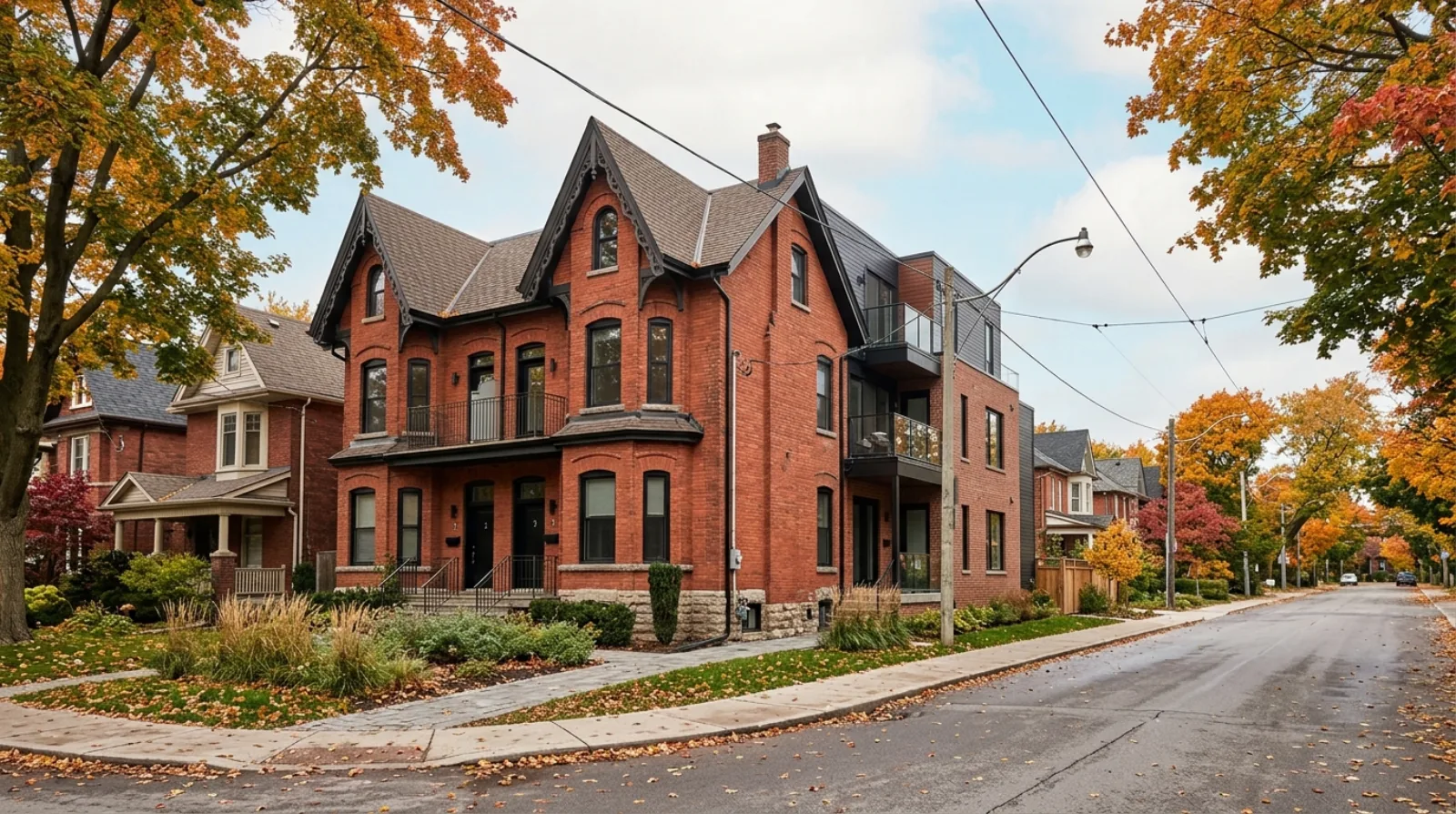
The 30-second answer
- Ontario allows up to 3 residential units as-of-right on most lots that already hold one home, under Bill 23 (the More Homes Built Faster Act, 2022).
- The 2nd and 3rd units under Bill 23 are exempt from development charges and parkland dedication fees.
- Toronto goes further: since May 2023 up to 4 units (a fourplex) are allowed as-of-right on residential lots across the whole city.
- In June 2025 Toronto added sixplexes (up to 6 units) as-of-right, but only in 9 wards, not citywide. Other wards can opt in.
- Because the sixplex rule was not citywide, Ottawa cut Toronto's federal housing money by $10 million in January 2026.
One province floor, stacked with Toronto’s extras
The clearest way to read Ontario’s rules is as layers. The province guarantees a base number of units everywhere. Then a city like Toronto can stack more units on top of that base. Here is how the stack builds up: from the provincial floor of three, to Toronto’s citywide four, to six in nine wards.
Up to 3 units as-of-right on most lots with one home. Units 2 and 3 pay no development charges. This is the minimum every Ontario municipality must allow.
Toronto stacked a 4th unit on top of the provincial 3, citywide, in May 2023. So the whole city sits one unit above the Ontario floor.
A 6th unit was added in June 2025, but only in 9 downtown-and-east wards plus a Scarborough North pilot. The rest of the city is still capped at 4 unless a councillor opts the ward in.
Read it top to bottom: the province gives every lot three units. Toronto adds a fourth on top, citywide. In nine wards, Toronto adds two more to reach six. Outside those nine wards, the Toronto ceiling is four, unless the ward opts in.
Ontario (Bill 23): the floor
- 3 units by right on most residential lots with an existing home.
- No development charges on units 2 and 3, and no parkland dedication fee.
- Province-wide. Every Ontario municipality must allow at least this.
Toronto: stacked on top
- 4 units by right citywide since May 2023 (a fourplex).
- 6 units by right in 9 wards plus a Scarborough North pilot, since June 2025.
- No parking minimums. Toronto removed them citywide in 2021.
Where things stand in 2026
All three layers are in force. Ontario’s three-unit floor and Toronto’s citywide four-unit rule are settled and unchallenged. The open question is the sixth unit. Toronto chose to allow sixplexes in only nine wards, not citywide, so in January 2026 the federal government cut $10 million from Toronto’s Housing Accelerator Fund. Toronto still receives $461 million of the original $471 million deal.
The door is not shut. Council built in an opt-in path, so any ward can still add sixplexes, and a citywide expansion stays under study. If enough wards opt in, the federal money could be restored. For now, check your ward before you assume you can build six.
What the rules actually built
Legal permission is one thing; homes on the ground are another. Toronto’s multiplex permits rose sharply after the citywide rule, but from a small base, and still below the city’s own target. Here are the numbers, each with a live source.
new multiplex units given building permits in Toronto from May 2023 to Nov 2024 (first 18 months of the citywide rule)
City Hall Watcheryearly multiplex permits more than tripled from 2022 to 2024, but still below the 600–3,000/yr the city's own housing plan called for
City Hall Watcherfederal housing money Ottawa cut from Toronto in Jan 2026 because sixplexes were not made legal citywide
TorontoTodayestimated infrastructure funding gap for Ontario's 29 largest cities from Bill 23's fee cuts, 2023–2031
AMOHow the rules were built, step by step
The reform came in layers over four years: a provincial law first, then a city bylaw, then the sixplex fight and its funding cost.
- Nov 28, 2022
Bill 23, the More Homes Built Faster Act, receives Royal Assent. Up to 3 units are now allowed as-of-right on most Ontario lots, and units 2 and 3 are exempt from development charges.
- May 10, 2023
Toronto City Council adopts the citywide multiplex bylaw (part of Expanding Housing Options in Neighbourhoods). Up to 4 units are allowed as-of-right on residential lots across the whole city.
- 2023
Toronto signs a 4-year, $471 million deal with the federal Housing Accelerator Fund. One condition: legalize sixplexes citywide.
- Jun 25–26, 2025
Council votes to allow sixplexes as-of-right in only 9 wards, plus a Scarborough North pilot, with an opt-in path for others. OPA 818 and Zoning By-law 654-2025 pass.
- Jan 16, 2026
Ottawa cuts $10 million from Toronto's Housing Accelerator Fund because the sixplex rule was not made citywide. Toronto still receives $461 million.
- 2026
A citywide sixplex expansion stays under active study, and individual wards can still opt in to recover the lost funding.
If you own a lot in Ontario or Toronto
Start by finding which layer you are in. Anywhere in Ontario, you can plan for three units, and units two and three cost you no development charges, real money saved. If your lot is in Toronto, you can plan for four units citywide. If it sits in one of the nine sixplex wards or the Scarborough North pilot, you can plan for six.
Two things decide whether the units actually fit. First, the building-size rules (height, setbacks, lot coverage, and floor area) usually matter more than the unit cap. Second, your servicing: the lot needs enough water and sewer capacity. Confirm both with the city, and confirm the development-charge treatment of a fourth unit before you set your budget.
Go deeper on Toronto
This page covers the province floor and how Toronto stacks on top of it. Our Toronto guide goes lot by lot: the by-law text, the envelope you have to build inside, the permit route, and what each unit count costs to build.
What Council actually adopted, and the dates each part took effect
The RD, RS and RT residential zones a multiplex has to fit inside
Height, setbacks and lot coverage, the rules that decide if units fit
From drawings to building permit when the design is as-of-right
What happens when the design pushes past the envelope
Where the money goes on a Toronto multiplex build
Toronto addresses are modelled today
PlexCheck Toronto stamps the zoning from the City Zoning By-law 569-2013 layer, applies the ward-specific unit ceiling, and prices the build against CMHC survey rents.
Free. City-stamped zoning and CMHC survey rents. Takes about 30 seconds.
Ontario & Toronto multiplex zoning: questions people ask
How many units does Ontario allow as-of-right?
Up to three. Under Bill 23, the More Homes Built Faster Act, 2022, most residential lots in Ontario that already hold one home can add a second and a third unit as-of-right. "As-of-right" means you do not need a rezoning, a minor variance, or a council vote for those units. If your plans meet the zoning rules, the city must approve them. This three-unit floor applies province-wide and is the minimum every Ontario municipality has to allow. A city can permit more than three, but it cannot allow fewer.
Can I build a fourplex in Toronto?
Yes, anywhere in the city. Since Toronto adopted its citywide multiplex bylaw on May 10, 2023, up to four units (a fourplex) are allowed as-of-right on residential lots across the whole city. This sits one unit above Ontario's three-unit floor. You still have to meet the building rules (height, setbacks, lot coverage, floor area, and so on), but you do not need a rezoning or a public hearing for the fourth unit itself. The practical limit on most lots is the building size the zoning allows, not the unit count.
What is the difference between Bill 23 and Toronto's bylaw?
Bill 23 is the provincial law and Toronto's bylaw is the city rule that goes further. Bill 23 sets the province-wide floor of three units. Toronto's multiplex bylaw stacks a fourth unit on top of that floor, citywide. So think of it as two layers: the province guarantees three units everywhere in Ontario, and Toronto adds a fourth on its own lots. In parts of Toronto the city has added even more, but the three-unit provincial floor is what every Ontario town shares.
Did Toronto approve sixplexes?
Only partly. In June 2025 council voted to allow sixplexes (up to six units) as-of-right, but only in nine wards, plus a pilot in Scarborough North, not across the whole city. The nine wards are mostly downtown and in the east end. The rest of the city is still capped at four units unless that ward's councillor asks to opt in. Council did not reject sixplexes outright; it made them local instead of citywide, which is what led to the federal funding cut.
Which Toronto wards allow sixplexes?
Nine wards, plus a Scarborough North pilot. Based on the June 2025 vote, sixplexes are allowed as-of-right in Ward 4 (Parkdale–High Park), Ward 9 (Davenport), Ward 10 (Spadina–Fort York), Ward 11 (University–Rosedale), Ward 12 (Toronto–St. Paul's), Ward 13 (Toronto Centre), Ward 14 (Toronto–Danforth), Ward 19 (Beaches–East York), and a pilot area in Ward 23 (Scarborough North). Other wards can be added later if their councillor opts in. If your lot is outside these areas, the citywide fourplex rule still applies, so you can still build up to four units.
Why did Toronto lose federal housing money over sixplexes?
Because a citywide sixplex rule was a condition of the federal deal, and Toronto did not deliver it. In 2023 Toronto signed a four-year, $471 million agreement with the federal Housing Accelerator Fund. One of the promises was to legalize sixplexes across the whole city. When council limited them to nine wards in June 2025, Ottawa treated that as not meeting the condition. In January 2026 the federal government cut Toronto's funding by $10 million. Toronto still receives $461 million, and the money could be restored if more wards opt in.
Are the new multiplex homes actually getting built?
Building is up, but from a low base. City Hall Watcher, reading the city's own planning data, counted 393 new multiplex units given building permits in the first 18 months of the citywide rule (May 2023 to November 2024). The yearly number of multiplex permits more than tripled from 2022 to 2024. That is real growth, but it is still below the 600 to 3,000 units a year the city's own housing plan said the reform could produce by 2031. So the rule is working, just slower than hoped.
Do I need to add parking for a new multiplex in Toronto?
Generally no. Toronto removed minimum parking requirements across the city in 2021, before the multiplex bylaw. That means a new fourplex or triplex does not have to provide a set number of off-street parking spaces. You can still build parking if you or your tenants want it, but the city no longer forces it. Removing that requirement frees up lot space and can lower build cost, which matters most on narrow lots where a required parking pad would have crowded out a unit.
Do the extra units pay development charges under Bill 23?
The second and third units do not. Bill 23 exempts units 2 and 3 from development charges and from parkland dedication fees. This is one of the most valuable parts of the law for a small builder, because development charges can add tens of thousands of dollars per unit. The exemption does not automatically cover a fourth unit, so in Toronto the fourth unit may still be charged depending on the local rules. Always confirm the fee treatment for your specific project with the city before you budget.
Why did municipalities object to Bill 23?
Because the fee cuts left them short of money for roads, water, and sewers. Development charges are how cities pay for the infrastructure that new housing needs. When Bill 23 waived those charges on the second and third units, cities said they would have to cover the gap another way, usually from property taxes or by delaying projects. The Association of Municipalities of Ontario estimated the fee cuts could cost the province's 29 largest cities up to $1 billion a year between 2023 and 2031. The province promised to make cities "whole," and that debate is still going.
Does Bill 23 apply to every lot in Ontario?
It applies to most residential lots, not literally every one. The three-unit floor covers lots with an existing detached house, semi-detached house, or rowhouse, in most residential areas. There are limits: the units still have to meet servicing rules (water and sewer), building code, and the shape rules in the local zoning bylaw. Some lots, for example very small ones or those with servicing problems, may not physically fit three units even though the law allows them. The law removes the zoning barrier; it does not remove the physical and engineering ones.
Is Ontario a good model for other places to copy?
It is a useful case study with a clear warning. The good part: a three-unit floor across a whole province, plus a big city adding a fourth citywide, is a strong base for gentle density. The warning part is what happened with sixplexes. Even with $471 million of federal money on the line, Toronto council chose to limit sixplexes to nine wards rather than the whole city, and accepted a $10 million cut rather than go citywide. The lesson is that legal power at the province level does not guarantee a city will use all of it. Local politics still sets the real ceiling.
Compare Ontario with other reforms
Official sources & studies
- Ontario: Bill 23, More Homes Built Faster Act, 2022 (full text) Primary
- City of Toronto: Council adopts citywide multiplex study (May 2023) Primary
- City of Toronto: Expanding Housing Options in Neighbourhoods (multiplex) Primary
- AMO: Housing Backgrounder (Bill 23 fee-gap estimate) Primary
- CBC: Council allows sixplexes in 9 wards, others opt in (June 2025)
- CBC: Toronto risks losing $30M after sixplex vote
- TorontoToday: Toronto loses $10M from federal fund (Jan 2026)
- City Hall Watcher: Toronto's multiplex permit data
See how Ontario & Toronto compares to the rest of the world
VanPlex tracks every major multiplex reform on Earth — what each city legalized, what actually got built, and what survived. Put Ontario & Toronto next to 23 other cities on one scorecard.
Building in British Columbia instead? See what a BC lot allows →