
What your Vancouver lot can really build under R1-1
Vancouver is the market we build in every day. In 2023 the city merged nine old single-house zones into one R1-1 zone and legalized the multiplex, so most house lots can now hold 3 to 6 homes, or up to 8 as rental. But the headline hides the real story: a floor-area rule, not the unit limit, decides what actually gets built. Here is how it works in 2026.
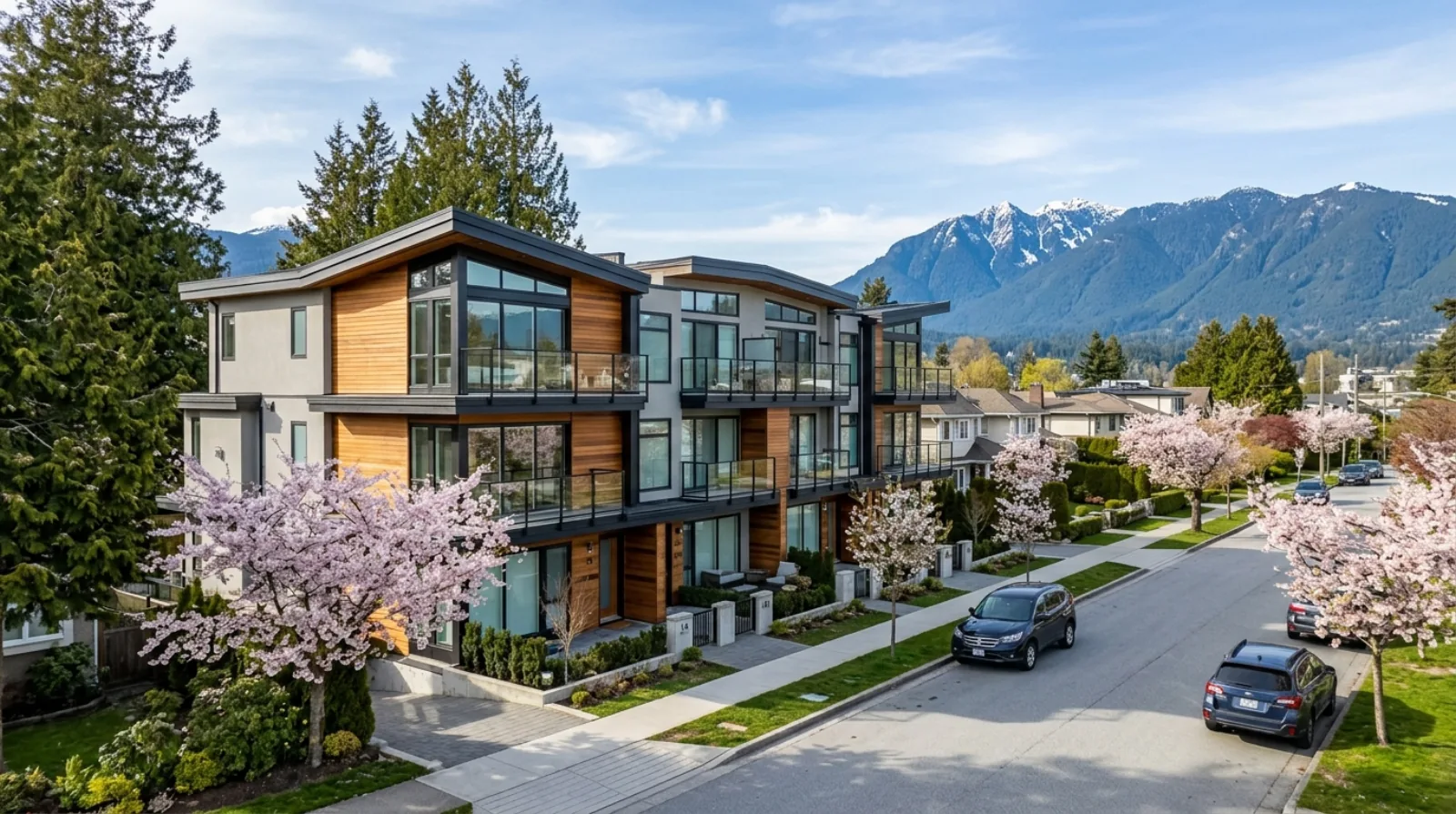
The 30-second answer
- Vancouver’s R1-1 “Residential Inclusive” zone replaced nine old RS single-house zones, so most Vancouver house lots can now become a multiplex.
- You can build 3 to 6 ownership (strata) homes, or up to 8 secured rental homes, on a single lot.
- The floor-area rule is the real limit: a market strata multiplex is held to 0.70 FSR, while an all-rental building can reach 1.0 FSR, roughly 40% more building.
- That is why six homes is hard in practice: on most market lots the math settles at three or four larger homes, not six small ones.
- As of 2026 the rules are being reviewed (Council’s Motion 9), and applications far outnumber finished buildings.
Two ways to build it, and the choice decides everything
R1-1 gives you a fork. One path is simpler; the other unlocks more homes, more building, and the financing that makes them work. Picking the right one for your lot is the whole game.
Market strata
Sell each home separately
The simple path. But the 0.70 floor-area cap means many lots only pencil at three or four larger homes, not six small ones.
Secured rental
Keep as rental (one owner-occupied unit allowed)
Commit the building to rental and you unlock ~40% more building and CMHC MLI Select financing. This is usually the only way the higher unit counts actually work.
Why six homes is hard: the floor-area math
FSR cap on a market strata multiplex: about 2,800 sq ft of building on a 4,000 sq ft lot.
more building you get by committing to secured rental (1.0 FSR), which is how eight units become possible.
homes most market lots actually pencil to, once land cost and design rules are counted, not six.
Analysts note the province’s standards imply roughly 1.8 FSR against the city’s 1.0 cap, so Vancouver allows about half as much floor space. Source: More Housing analysis.
The pipeline reality
The multiplex became the most common application type in the R1-1 zone, but an application is a request to build, not a finished home, and completions lag far behind.
multiplex applications, roughly 1,500 homes, by March 2025, and still climbing through 2026.
actually finished. The gap between applications and completed buildings is where the difficulty lives.
Source: City of Vancouver memo to Council (May 2025).
Timeline
- Sep 14, 2023
Council approves adding multiplexes and simplifying the low-density zones.
- Oct 17, 2023
The R1-1 District Schedule is enacted, consolidating nine RS zones (RS-1 through RS-7) into one Residential Inclusive zone.
- Nov 2023
The city begins accepting multiplex applications.
- Mar 31, 2025
A city memo to Council reports about 370 multiplex applications, representing roughly 1,500 homes.
- May 20, 2026
Council approves Motion 9, directing a review of the multiplex rules (massing, height, lot coverage, trees) and alignment with the province’s Bill 25.
If you own a lot in Vancouver
Four things decide your project. First, your lot is almost certainly R1-1 now, so the right to build a multiplex very likely exists. Second, do not assume six homes. On most market lots the 0.70 floor-area rule pushes the realistic answer to three or four. Third, if you want the higher counts, the secured-rental path plus CMHC MLI Select is usually the route that works, not market strata.
Fourth, and most important: screen the specific lot before you commit. Land cost, lot shape, and the design rules decide whether a given address pencils, and they decide it lot by lot. Run the numbers on your actual lot first. That is exactly what VanPlex does.
Vancouver R1-1 multiplex zoning: questions people ask
Is my Vancouver lot zoned R1-1?
Very likely, if it used to be one of the nine RS zones: RS-1, RS-1A, RS-1B, RS-2, RS-3, RS-3A, RS-5, RS-6, or RS-7. In October 2023 the city merged all nine into a single R1-1 “Residential Inclusive” zone, so a lot that once read, for example, RS-1 now reads R1-1. That covers the great majority of Vancouver’s low-density house lots, so the right to build a multiplex almost certainly exists on your property.
How many units can I build under R1-1?
Between 3 and 6 ownership units held as strata title, or up to 8 units if the whole building is secured as rental. Strata title means each home can be owned and sold separately, like a condo. Secured rental means the homes are legally committed to staying rentals. The District Schedule only allows the highest counts, 7 or 8 units, where all the units are non-stratified secured rental, though one of them may be occupied by the owner.
Why is building six homes so hard in Vancouver?
Because of arithmetic, not permission. A market strata multiplex is held to a floor space ratio (FSR) of 0.70, which is the total building floor area divided by the lot area. On a 4,000 square foot lot that is about 2,800 square feet of building. Split across six homes, each becomes small enough that buyers hesitate, so many Vancouver multiplexes settle at three or four larger homes. Design rules, setbacks, height, tree retention, and high land cost all subtract further, so the practical ceiling is usually below the legal one.
What is FSR and why does 0.70 vs 1.0 matter so much?
FSR, or floor space ratio, is the total floor area of the building divided by the area of the lot. Under R1-1, a market strata multiplex is capped at 0.70 FSR, but an all-secured-rental building of up to eight units can reach 1.0 FSR, roughly 40% more building on the same lot. That extra floor area is the city’s deliberate reward for choosing rental over resale, and it is often the difference between a project that pencils and one that does not.
Should I build strata or secured rental?
It depends on your lot and your goals. Market strata is simpler and lets you sell each home, but the 0.70 FSR cap usually limits you to three or four homes. Secured rental unlocks the 1.0 FSR maximum, up to eight homes, and CMHC MLI Select financing, but you keep the building as a rental rather than selling the homes one by one. On many Vancouver lots, rental plus MLI Select is the only version of the math that works at the higher unit counts.
What is CMHC MLI Select and why does it matter for a multiplex?
MLI Select is a federal mortgage-insurance program built for purpose-built rental, and it requires a minimum of five self-contained rental units, which an R1-1 rental multiplex of up to eight units can meet. It uses a points system rewarding affordability, energy efficiency, and accessibility, and the financing it unlocks can reach up to 95% of cost with a much longer amortization than a normal mortgage. A longer amortization means lower monthly payments, which is frequently what makes a small rental building cover its own debt. One deadline to know: the older energy-standard attestation route is available only until September 30, 2026.
Are there rules about the mix of home sizes?
Yes. The R1-1 schedule requires some family-sized homes rather than letting a project be all studios. For a three- or four-unit building, one to two homes must have two or more bedrooms; for five or six units, two to three must have two or more bedrooms. The intent is to keep some family housing in the supply. Confirm the exact current requirement against the R1-1 District Schedule, since the mix rules are set there.
Is there a way to get more floor area without going full rental?
Yes, through a below-market ownership route. A project of up to six units can reach the higher floor area if it includes at least one below-market ownership home delivered through a BC Housing partnership, or contributes affordable-housing space to the city. So the extra building is available either by committing to secured rental or by including a below-market ownership unit; a straight market-strata project is held to the lower 0.70 cap.
How does Vancouver compare with the provincial minimum and with Portland?
Vancouver is tighter than both on the thing that matters most: floor area. Analysts note the province’s standards imply roughly 1.8 FSR, against Vancouver’s 1.0 cap, so the city allows only about half as much floor space. Portland, often cited as a model, ties allowed floor area to unit count so a fourplex gets more building than a house, and permits up to six units when half are affordable. Vancouver gives less floor area to work with, which is the structural reason six homes is harder here than the headline suggests.
What is actually getting built, and is the reform working?
Applications are strong, but finished buildings lag badly. A city memo reported about 370 applications (roughly 1,500 homes) by March 2025, and during 2024 the multiplex became the most common application type in the R1-1 zone. But an accepted application is a request to build, not a finished building. By 2026 the city counted hundreds of projects submitted and approved against only a small number completed. The honest reading: real demand exists, but the gap between applications and completed multiplexes is where most of the difficulty lives.
What is Motion 9 and could the rules change before I build?
On May 20, 2026, Council approved Motion 9, which directs staff to review and refine the multiplex rules based on early experience, looking at massing, height, lot coverage, privacy, shadowing, and tree retention, and to align the rules with the province’s Bill 25. The motion also says any changes should keep certainty for applicants and not harm project viability. So the rules are under active review in 2026, which is worth factoring into your timing, though the core right to build a multiplex is not in question.
Do I need a rezoning to build a multiplex?
No. That is the point of R1-1: the multiplex is a permitted use in the zone, so you do not need a rezoning or a public hearing. You still need a development and building permit and must meet the detailed R1-1 standards for floor area, height, setbacks, and design. Removing the rezoning step is what turned the multiplex from a rare, negotiated project into something an ordinary owner can pursue.
Should I just assume my lot pencils to six homes?
No. That is the most common and costly mistake. On most market lots the 0.70 FSR rule pushes the realistic answer to three or four homes, and whether even that pencils depends on land cost, lot shape, and the design rules, which vary lot by lot. If you want the higher unit counts, the secured-rental path with CMHC MLI Select is usually the route that works. Run the specific lot first, then decide. Do not commit based on the headline “3 to 6.”
Compare Vancouver with related reforms
Official sources & analysis
- City of Vancouver: R1-1 Residential Inclusive District Schedule Primary
- City of Vancouver: May 29, 2025 memo to Council (multiplex update) Primary
- City of Vancouver: housing options in lower-density areas Primary
- CMHC: MLI Select (rental financing) Primary
- More Housing: Vancouver multiplex floor-area analysis
See What Your Own Lot Can Do
These reforms are global. The opportunity is local. Enter any BC address to see the units your lot is zoned for and whether the project actually pencils.