
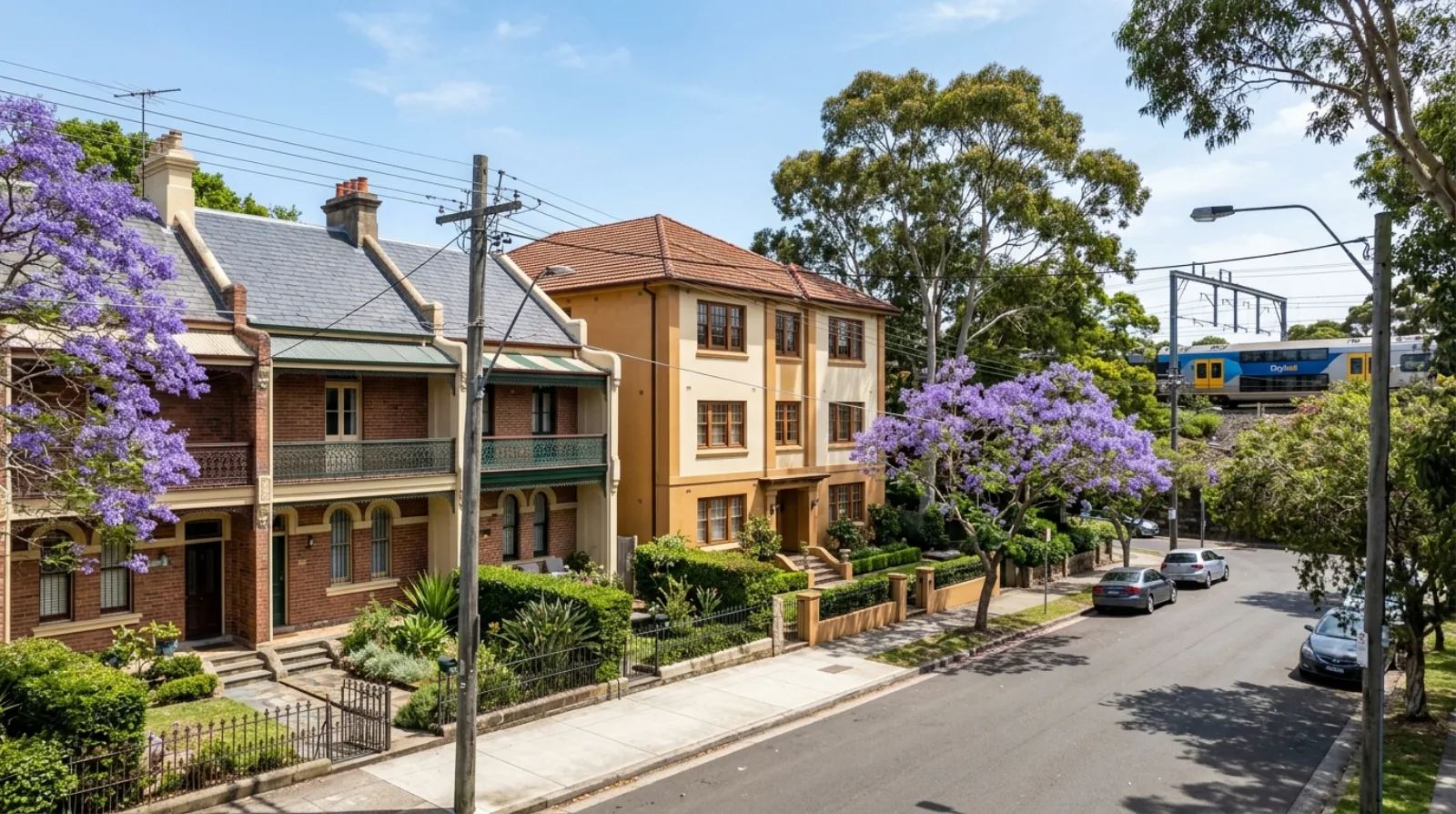
Can you build a terrace or townhouse in NSW? It depends how close you are to a station.
New South Wales changed its housing rules in two stages, in 2024 and 2025. The clever part is the trigger: what you can build is set by how far your lot is from a train station or town centre. The closer you are, the more homes you can fit. This is what the rules allow in 2026, in plain numbers.
town centres and train or light-rail stations now have an 800-metre band around them where terraces, townhouses and mid-rise apartments are allowed as-of-right.
The 30-second answer
- Dual occupancies (two homes on one lot) are allowed as-of-right in the R2 low-density zone across all of NSW since 1 July 2024.
- Since 28 February 2025, terraces, townhouses and low-rise apartments (manor houses) are allowed near 171 town centres and train/light-rail stations.
- The reforms use an 800-metre walking distance, about a 10-minute walk, from a nominated centre or station to set what you can build.
- Within 400 metres of a centre or station you can build a mid-rise apartment building up to 22 metres and about 6 storeys; from 400 to 800 metres the limit drops to about 4 storeys.
- A separate Transport Oriented Development (TOD) program allows apartments up to about 6 storeys within 400 metres of 37 metro and rail stations.
- The NSW Government estimates the low and mid-rise reforms could deliver up to 112,000 homes over five years.
The signature idea: distance from the station sets what you can build
This is the part that makes the NSW reforms different. Instead of one flat rule for a whole suburb, the rules draw rings around each of the 171 centres and stations. Walk out from the station and the height limit steps down. Here are the three bands, from anywhere in the state to right next to the platform.
Lower mid-rise apartments · 17.5 m · FSR 1.5:1
Tallest mid-rise apartments · 22 m · FSR 2.2:1
Dual occupancy in R2 · 9.5 m · no station needed
In the R2 low-density zone across the whole state you can build two homes on one lot. Minimum lot size 450 m², minimum width 12 m, height up to 9.5 m.
The strongest allowance. In R3 and R4 zones you can build a residential flat building up to 22 m (about 6 storeys) at a floor space ratio of 2.2:1. No minimum lot size.
Further out the ceiling drops. In R3 and R4 zones a residential flat building is capped at 17.5 m (about 4 storeys) and a floor space ratio of 1.5:1.
What each home type needs
The low-rise forms, the ones up to 9.5 m, each have their own set numbers for lot size, width, floor space ratio and height. Meet the numbers and the council assesses your plans against these state rules, not the old local ban.
| Home type | Min lot | Min width | Max FSR | Max height |
|---|---|---|---|---|
| Dual occupancy Two homes on one lot. Allowed in R2 statewide since Jul 2024. | 450 m² | 12 m | 0.65:1 | 9.5 m |
| Terraces Three or more attached homes in a row. Near the 171 centres. | 500 m² | 18 m | 0.7:1 | 9.5 m |
| Townhouses (multi-dwelling) Three or more dwellings on one lot. Near the 171 centres. | 600 m² | 12 m | 0.7:1 | 9.5 m |
| Manor houses / low-rise flats A small apartment building, up to 4 homes over 2 storeys. | 500 m² | 12 m | 0.8:1 | 9.5 m |
FSR = floor space ratio (total floor area divided by lot area). Standards from NSW Planning and the Bartier Perry Stage 2 summary.
What you can build
- Dual occupancy statewide in the R2 zone since July 2024, no station needed.
- Terraces, townhouses, manor houses near the 171 centres since February 2025.
- Mid-rise apartments up to ~6 storeys within 400 m of a centre or station.
- Separate titles: you can subdivide a dual occupancy or terrace and sell the homes.
The catch: it is early and site-specific
The mid-rise rules only reach lots inside the 800-metre walking bands around the 171 centres. Most of the state is not covered by the taller allowances. Stage 2 only started at the end of February 2025, so there is not yet public data on how many homes have actually been approved or built under these rules. The 112,000-home figure is a government target, not a count of finished homes.
There is a second, taller program too: Transport Oriented Development
Alongside the low and mid-rise rules, NSW runs a separate program called Transport Oriented Development, or TOD. It targets a smaller set of high-capacity stations and allows apartments within a tight 400-metre ring.
metro and rail stations get TOD controls within 400 metres.
height for a residential flat building, about 6 storeys, at FSR 2.5:1.
homes the government projects over 15 years across the 37 precincts.
TOD developments over 2,000 m² of floor area must set aside at least 2% of floor space for affordable housing, kept that way in perpetuity. A lot near one of the 37 TOD stations may be covered by both TOD and the wider low and mid-rise rules. Source: NSW Planning: TOD.
How the reforms rolled out
The two programs came in over about eighteen months, from the first announcement in late 2023 to Stage 2 starting in February 2025.
- Dec 2023
The Minns Labor Government announces the Transport Oriented Development (TOD) program for 37 metro and rail stations, and flags the wider low and mid-rise reforms.
- Apr 2024
TOD planning controls are added to the State Environmental Planning Policy (Housing) 2021, allowing apartments within 400 m of the TOD stations.
- Jul 1, 2024
Stage 1 of the low and mid-rise policy starts: dual occupancies and semi-detached homes become allowed in the R2 low-density zone across all of NSW.
- Feb 21, 2025
The government announces Stage 2 and the 112,000-home estimate. It notes only 2 of 33 Greater Sydney councils allowed terraces and townhouses in low-density zones, and 60% of medium-density zones banned apartments.
- Feb 28, 2025
Stage 2 starts: terraces, townhouses, manor houses and mid-rise apartments become allowed as-of-right near 171 town centres and stations, across Greater Sydney, the Central Coast, the Lower Hunter/Newcastle and the Illawarra-Shoalhaven.
- 2026
Both programs are in force. TOD controls are applied at most of the 37 stations, with alternative council schemes used in some precincts.
If you own a lot in NSW
Start with two questions: which zone is your lot in, and how far is it from a nominated centre or station? If your lot is in the R2 zone, you can build a dual occupancy today, no matter where in the state it sits. If it is within 800 metres of one of the 171 centres, you may be able to build terraces, townhouses or a mid-rise apartment building, and the tightest 400-metre ring gives you the most, up to about 6 storeys.
The value in these rules is that they are as-of-right. If your plans meet the set numbers for lot size, width, floor space ratio and height, the council cannot refuse them on density grounds and you skip the slow rezoning step. Check your exact distance to the nearest nominated station before you plan, because the difference between the inner and outer band is the difference between about 6 storeys and about 4.
NSW low and mid-rise housing: questions people ask
Can I build a terrace in NSW?
Yes, in more places than before, but it depends on where your lot sits. Since 28 February 2025, terraces, three or more attached homes in a row, are allowed as-of-right in the R1, R2, R3 and R4 residential zones when your lot is within an 800-metre walk of one of the 171 nominated town centres or stations. Your lot needs to be at least 500 m² and 18 m wide, and the building can be up to 9.5 m tall at a floor space ratio of 0.7:1. "As-of-right" means that if your plans meet these set numbers, the council cannot refuse them on density grounds. You do not need a rezoning. Outside the 800-metre bands, terraces are only allowed where a council already permitted them.
What is the NSW Low and Mid-Rise Housing Policy?
It is a set of statewide planning rules that make it easier to build medium-density homes near shops and transport. It came in two stages. Stage 1, from 1 July 2024, allowed a dual occupancy (two homes on one lot) in the R2 low-density zone across the whole state. Stage 2, from 28 February 2025, added terraces, townhouses, manor houses and mid-rise apartment buildings near 171 selected town centres and train or light-rail stations. The government put the changes into the State Environmental Planning Policy (Housing) so the same rules apply no matter which council area you are in.
How does the distance from a train station change what I can build?
Distance is the core of the mid-rise part of the policy. The rules draw two rings around each of the 171 nominated centres and stations. Inside the first ring, from the station out to 400 metres, you can build the tallest allowed form: a residential flat building up to 22 metres, which is about 6 storeys, at a floor space ratio of 2.2:1. In the second ring, from 400 to 800 metres, the ceiling drops to 17.5 metres, about 4 storeys, at a floor space ratio of 1.5:1. Beyond 800 metres the mid-rise allowance does not apply, though a dual occupancy may still be allowed in R2 anywhere in the state. So the closer your lot is to the station, the more homes you can fit.
How many town centres and stations does the policy cover?
The Stage 2 mid-rise rules apply within an 800-metre walk of 171 nominated town centres and train or light-rail stations. These 171 areas were chosen using access to services, how often public transport runs, travel times, whether the local pipes and services can handle more people, and hazard risk such as flooding. They sit across four regions: Greater Sydney, the Central Coast, the Lower Hunter and Newcastle, and the Illawarra and Shoalhaven. If your lot is not inside one of these 800-metre areas, the mid-rise part of the policy does not reach it.
Can I build a dual occupancy anywhere in NSW?
Close to it. Since 1 July 2024, a dual occupancy, meaning two homes on one lot, is allowed as-of-right in the R2 low-density residential zone across all of New South Wales, which is the most common suburban house zone. Your lot needs to be at least 450 m² and 12 m wide, with a building height up to 9.5 m and a floor space ratio of 0.65:1. In the R1, R2 and R3 zones you can also subdivide the two homes onto separate lots of at least 225 m² each. This is the one part of the reforms that does not depend on being near a station.
What is the Transport Oriented Development (TOD) program, and how is it different?
The TOD program is a separate but related reform. It changes planning controls within 400 metres of 37 chosen metro and rail stations to allow apartment buildings. Under TOD, a residential flat building can reach 22 metres (about 6 storeys) and a floor space ratio of 2.5:1, with a minimum lot width of 21 metres and no minimum lot size. Shop-top housing can go to 24 metres to fit taller ground-floor shops. TOD started earlier, in April 2024, and targets a smaller set of high-capacity stations, while the low and mid-rise policy spreads a lower level of density across many more centres. A lot near one of the 37 TOD stations may be covered by both programs.
How tall can a mid-rise apartment building be under these rules?
Under the low and mid-rise policy it depends on the ring your lot is in. Within 400 metres of a nominated centre or station the limit is 22 metres, which works out to about 6 storeys. From 400 to 800 metres the limit is 17.5 metres, about 4 storeys. Under the separate TOD program, near the 37 TOD stations the limit is also 22 metres for a residential flat building and 24 metres for shop-top housing. So the practical ceiling for a mid-rise apartment building under either program is about 6 storeys, and only in the band closest to the station.
Do these rules apply as-of-right, or do I still need council approval?
You still lodge a development application, but the density is set by state rules, not council discretion. The reforms add non-discretionary development standards to the Housing State Environmental Planning Policy. If your design meets the set numbers, meaning lot size, width, height, floor space ratio and the design rules, the council assesses it against those state standards and cannot refuse it just because the local plan used to ban that housing type. This is the meaning of "as-of-right" here. It removes the need for a spot rezoning, which used to add years to a medium-density project.
How many homes could the reforms produce?
The NSW Government estimates the low and mid-rise policy could deliver up to 112,000 new homes across NSW over five years. The separate TOD program is estimated to deliver more than 170,000 homes over 15 years across its 37 precincts. These are government projections of what the rules make possible, not counts of homes already built. It is still early. Stage 2 only started at the end of February 2025, so the number of homes actually approved and built specifically under these rules is not yet broken out in public reporting. Treat the 112,000 and 170,000 figures as targets, not results.
Which residential zones do the mid-rise rules apply to?
The Stage 2 low-rise forms, meaning terraces, townhouses and manor houses, apply in the R1 general residential, R2 low-density, R3 medium-density and R4 high-density zones when the lot is within the 800-metre bands. The mid-rise apartment allowances apply in the R3 and R4 zones within those bands. The Stage 1 dual occupancy allowance is specific to the R2 low-density zone and applies statewide. Because zone labels and boundaries differ by council, the first step for any lot is to check its exact zone and whether it falls inside one of the 800-metre walking areas.
Can I subdivide the homes I build onto separate titles?
In many cases, yes. For a dual occupancy in the R1, R2 and R3 zones you can subdivide the two homes onto separate lots of at least 225 m² each, with a minimum width of 6 m. For terraces in those zones the minimum subdivided lot is 165 m² at 6 m wide. Being able to put each home on its own title matters because it lets you sell the homes separately rather than only renting them, which changes the money side of a project. The subdivision rules sit alongside the building rules in the same state policy.
Do these reforms override my local council plan?
For the housing types they cover, yes. The rules live in the State Environmental Planning Policy (Housing), which is state law and sits above a council's Local Environmental Plan. Where the state policy allows a housing form as-of-right, a council cannot ban it, even if the local plan still lists it as prohibited. Councils keep control over design details and can apply their own alternative schemes in some cases, especially in the TOD precincts, but they cannot use the old local rules to block a compliant terrace, townhouse or dual occupancy. This is why the reforms reach so widely. They change the rule for every affected lot at once.
Is the policy still in force in 2026?
Yes. Both stages of the low and mid-rise policy and the TOD program are in force as of 2026. Stage 1 dual occupancy rules have applied statewide since July 2024, and the Stage 2 mid-rise rules near the 171 centres have applied since February 2025. The TOD controls have been applied at most of the 37 stations, with some councils running approved alternative schemes in their precincts. There has been no repeal. The main open question is not whether the rules exist but how fast homes get built under them, which will show up in permit data over the next few years.
How is this like British Columbia's transit rules?
The logic is nearly the same. British Columbia's transit-oriented areas rule also sets what you can build by how close your lot is to a station, with the tallest buildings allowed closest to the transit hub and lower limits further out. NSW applies the same "distance sets density" idea, but across a whole metro area and many centres at once, through the 800-metre walking bands and the 400-metre TOD rings. Both replace slow, lot-by-lot rezoning with a single statewide or province-wide rule. NSW's version is one of the largest transit-linked upzonings in the English-speaking world.
Compare NSW with related reforms
Official sources & analysis
- NSW Planning: Low and Mid-Rise Housing Policy Primary
- NSW Planning: Low and Mid-Rise FAQ Primary
- NSW Planning: 112,000 homes in five years Primary
- NSW Planning: Transport Oriented Development program Primary
- NSW Government: TOD program overview (PDF) Primary
- Bartier Perry: Low and Mid-Rise Stage 2 development standards
- Ashurst: TOD program legal analysis
See how Sydney (New South Wales) compares to the rest of the world
VanPlex tracks every major multiplex reform on Earth — what each city legalized, what actually got built, and what survived. Put Sydney (New South Wales) next to 23 other cities on one scorecard.
Building in British Columbia instead? See what a BC lot allows →