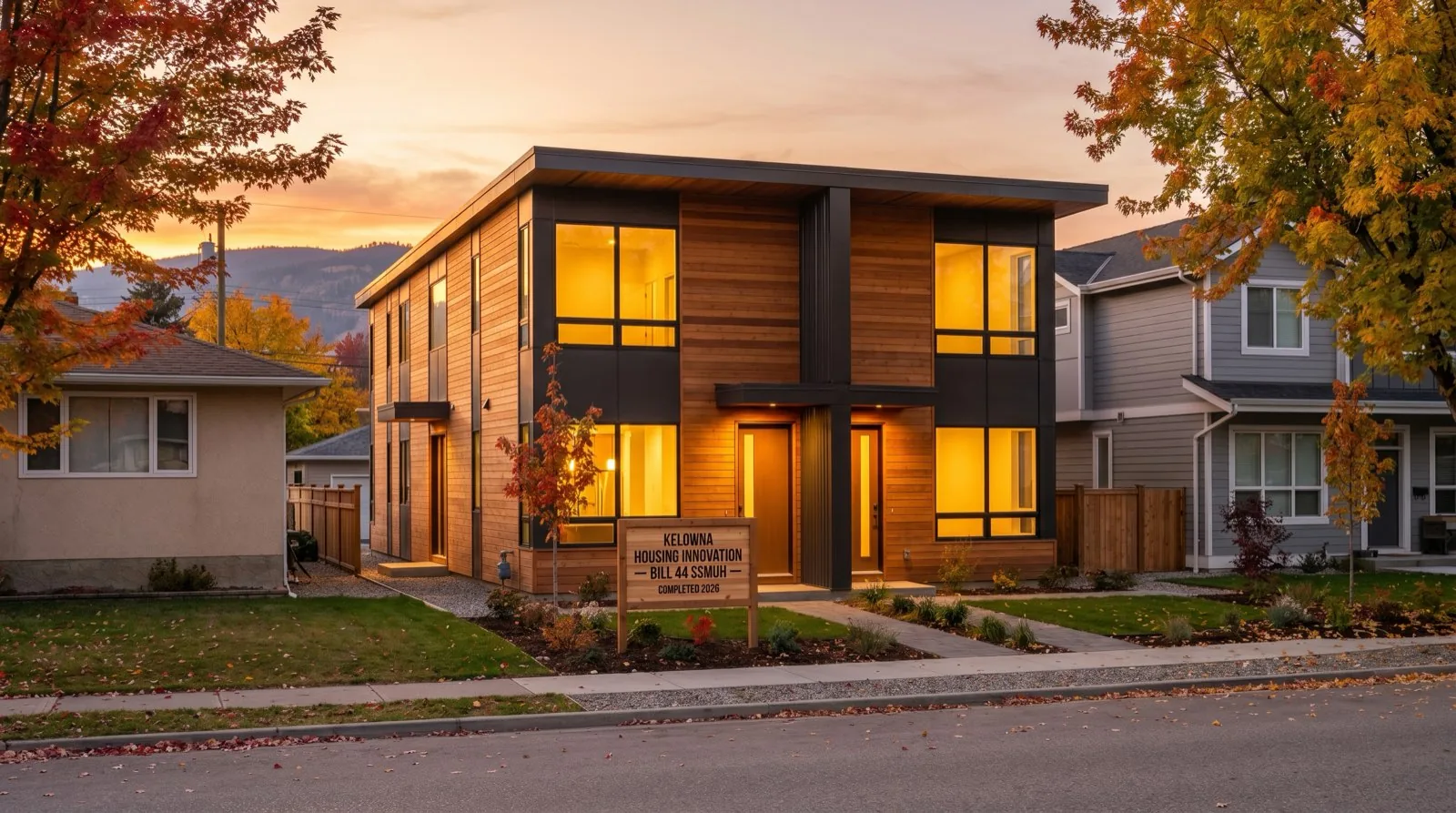
CMHC just closed the financing gap that’s been holding prefab and modular construction back. On May 7, 2026, the Canada Mortgage and Housing Corporation announced two changes that matter for anyone building factory-built multi-unit housing in BC: a new Prefab Plus product for homebuyers, and the expansion of CMHC’s full multi-unit mortgage insurance suite — including MLI Select — to modular construction. The pilot that led here financed 800+ rental homes across five provinces. It worked. Now it’s the program, not the pilot.
For us at VanPlex — and the other builders leaning into prefab and modular — this is the missing piece. Financing the build off-site, before it hits the lot, was the gap that traditional construction loans never wanted to fund. That’s now solved.
What CMHC actually announced
Two products. Both are insurance products from CMHC, which means private lenders can now underwrite the underlying loans with CMHC default coverage attached.
1. Prefab Plus (single-home buyers)
CMHC Prefab Plus is a homebuyer product. The headline numbers:
- Minimum 5% down payment on the value of the factory-built home
- CMHC-insured financing — so participating lenders are protected against default
- Staged funding, up to four draws, aligned with construction milestones rather than a single advance at completion
That last point is the structural change. Most prefab buyers were previously stuck between two bad options: pay the factory up front from savings/HELOC and wait months for the building to land before getting a mortgage, or use an expensive short-term construction loan to bridge the factory phase. Prefab Plus moves the insured mortgage into the factory window itself — money flows in on milestones (deposit on order, fabrication, delivery, installation) instead of all at the end.
For most BC prefab buyers, the four draws will look something like:
- Acquisition / order deposit — at factory order placement
- Fabrication progress — when the home is built but still in-factory
- Delivery to lot — modules transported to the site
- Installation / completion — set, connected, occupancy-ready
Each draw maps to a verifiable milestone, which is how factory-based construction has always preferred to be paid anyway. The product just lets that schedule match what an insured mortgage can fund.
2. Multi-unit modular — MLI Select and the rest
The bigger story for builder-developers is the multi-unit side. CMHC has now extended modular construction eligibility across the full multi-unit mortgage insurance suite, explicitly including MLI Select.
That matters because MLI Select is the program small-builder multiplex projects have been pushing toward since the 5-unit threshold opened up in BC. Before this change, modular multiplex builders had a credibility problem at the underwriting table — even when the project hit the MLI Select scoring thresholds on affordability, accessibility, and climate, the construction method itself wasn’t an explicit fit for the program. Now it is.
For projects we’re underwriting right now, this means:
- Insured construction financing during the factory phase, not just after move-in
- MLI Select scoring (the 50/100 points framework for affordability + accessibility + climate) is available the same way it would be for a stick-built project
- Lender appetite widens — banks and credit unions that wouldn’t quote modular last year will now quote it with CMHC standing behind the file
The pilot proved it works — here’s the case study CMHC named
The May 7 announcement isn’t theoretical. CMHC ran a pilot for the multi-unit modular insurance program and it financed 800+ new rental homes across five provinces. The case study CMHC highlighted in the announcement:
605 Studio West — Calgary, AB
- 84-unit affordable housing complex
- Developer: Attainable Homes Calgary
- Construction method: modular
- Timeline: completed in under one year
- Comparable conventional builds in the same community: ~2 years
A 50%+ schedule compression on a building of that size — without compromising on affordability or unit count — is what closed the case internally at CMHC. The pilot results gave them the confidence to move from “experimental product” to “permanent across the suite.”
Why this matters for BC missing-middle multiplex
The Bill 44 multiplex pipeline in BC has two structural cost problems:
- Construction cost per square foot — small multiplex builds run $500–$600/sqft in Metro Vancouver. The 2025 crossover we wrote about earlier shows the volume is finally there, but the cost-per-door hasn’t budged.
- Site timeline — Bill 44 cut the approval timeline (no rezoning, no public hearing) but didn’t touch construction time. A typical 4–6 unit multiplex still takes 14–22 months on site.
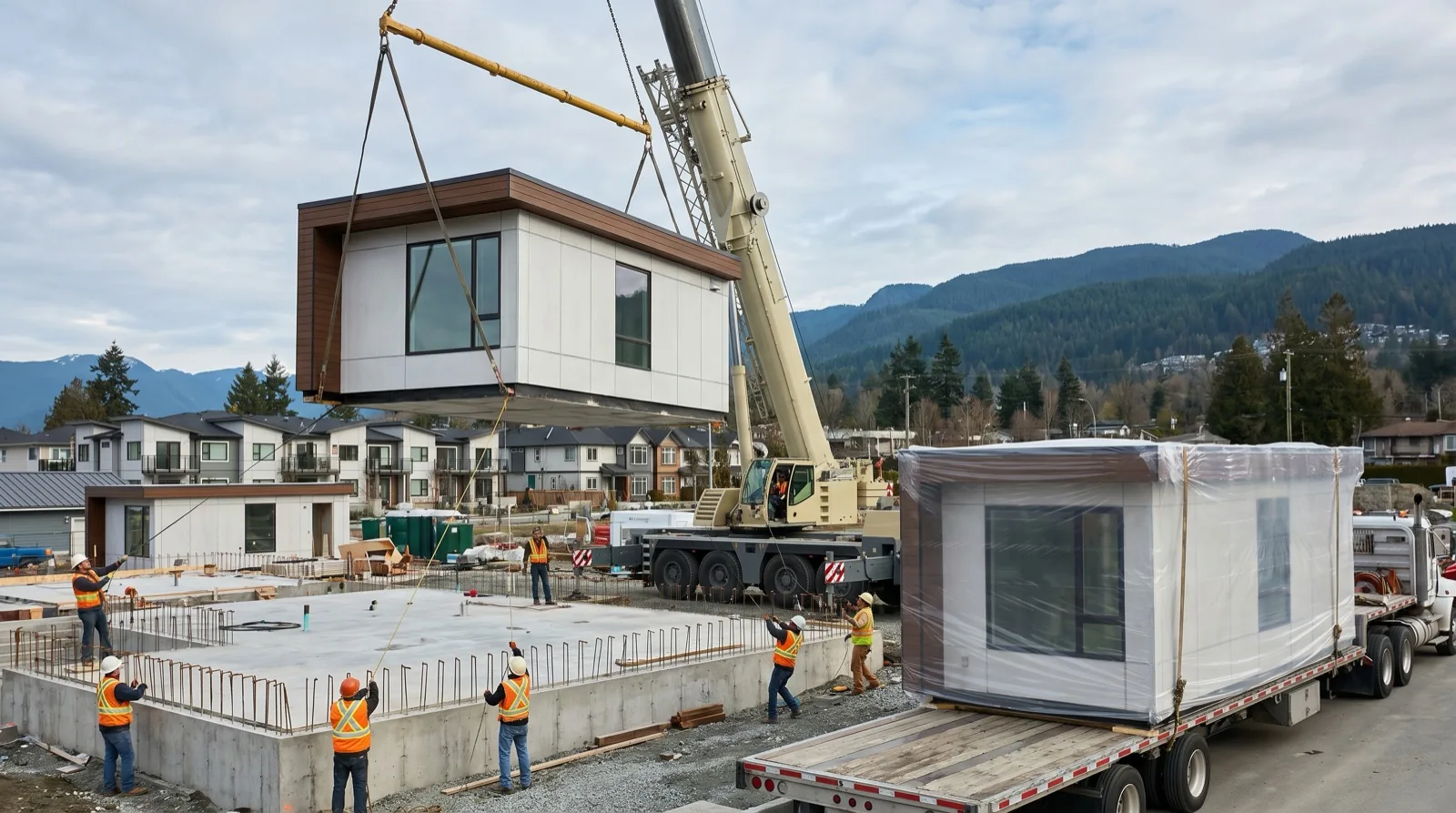
Modular attacks both at once. The factory builds the modules while the site is being prepped and permitted. Foundation, services, and module fabrication happen in parallel instead of sequentially. The Calgary case study compressed 24 months to under 12 — that ratio holds at smaller scale too. A 6-plex that takes 22 months stick-built can come in under 12 months modular if the lot, design, and factory slot are aligned.
What was missing was the financing. A builder going modular had to either:
- Pay the factory deposit and progress payments from equity (huge working capital drag)
- Use a private construction loan at 9–12%+ (which kills the proforma)
- Convince a conventional lender to fund the factory phase (most wouldn’t)
The CMHC-insured multi-unit modular financing closes that door. Off-site spend is now insurable spend.
What hasn’t changed
The product is a financing tool. It doesn’t move regulatory walls:
- Zoning — same as before. Bill 44 still defines what’s allowed. Modular doesn’t unlock units that aren’t already permitted.
- Building code — modular projects still must meet BC Building Code. Most factories are CSA A277 certified and already build to code.
- DCCs, permit fees, and municipal review — unchanged. The City of Vancouver still reviews the design the same way.
- MLI Select scoring thresholds — same 50/100 points framework. Affordability, accessibility, and climate scoring all apply identically.
- Underwriting standards — still need a debt service ratio that works, still need a stabilized rental pro forma that pencils. The insurance product changes eligibility, not whether your numbers are real.
If you walk away from this thinking “modular + CMHC means I can get any project financed,” you’ll be back at the underwriting table within a month. The proforma still has to work.
Our partners working in this space
We’re not the only ones building the BC missing-middle multiplex market. A short list of partners we work with — they each cover a different part of the stack:
Vassi Balatico — Vancouver multiplex REALTOR® & VanPlex partner
Vassi Balatico is one of the few Vancouver REALTORS® who actually underwrites multiplex projects — not just lists them. If you own a lot in Vancouver and want to know what it sells for as a development site (and whether to list it that way or build it yourself), Vassi is the call to make. She brings the buyer side: who’s actually paying for finished multiplex strata units and at what per-door, which is the data the proforma rests on.
Sanj Aggarwal — Icon Projects Ltd. (wemakehomes.com)
Sanj Aggarwal, Owner of Icon Projects Ltd., is a CHBA Master Residential Builder. He recently wrote for us about why single-family construction still pencils on Burnaby premium lots. Sanj is the builder we send owners to when the lot screening says SFH or SFH-with-laneway is the right answer instead of multiplex.
Gary Paul — Coquitlam multiplex REALTOR® (multiliving.ca)
Gary Paul covers Coquitlam, Port Moody, and the Tri-Cities. His contributions on Coquitlam SSMUH fire flow infrastructure constraints are the kind of municipal-detail work that separates a real local specialist from a generic listing agent.
If you’re trying to figure out which of these specialists is right for your situation, start with the proforma — the answer the proforma returns tells you which partner to call next.
What to do this month
If you’re an owner considering a prefab single-family build:
- Talk to your lender about Prefab Plus eligibility. As of May 7, 2026 it’s a CMHC product — that means most CMHC-approved lenders will offer it, but they need to set up the milestone-draw mechanics. Be prepared to walk a less-experienced lender through the structure.
- Get the factory quote in writing with the milestone schedule already broken out. The draws need to map to verifiable factory and on-site events; an opaque “we’ll bill you as we go” arrangement won’t work for an insured-mortgage draw schedule.
If you’re a builder-developer running multiplex or small multi-unit projects:
- Re-underwrite your active and shortlist projects under MLI Select with modular construction. The scoring math doesn’t change, but the construction cost line probably does — and so does the interest carry, because you’re insured during the factory phase.
- Get a quote from a BC modular fabricator on a typical 4-plex or 6-plex envelope. The “modular costs more” reflex from 2023 is no longer reliably true — factories that built up capacity for the multi-family pilot have unit costs that look very different from custom one-off bids.
If you’re a REALTOR® or capital partner working with multiplex owners:
- Add Prefab Plus and MLI Select modular eligibility to the conversation when you’re walking a homeowner through development options. Some owners who were a “no” on conventional construction become a “yes” on modular under MLI Select.
The bottom line
CMHC’s May 7 announcement is the kind of change that doesn’t make headlines on TV but shifts which projects pencil. Off-site fabrication is now insurable spend. The factory phase no longer has to be funded out of equity or expensive bridge debt. For BC builders leaning into prefab and modular — and that list is growing every quarter — the financing gap that’s been holding the model back is closed.
We’re already pulling this into the proformas we run for owners. If you’ve been told modular wouldn’t work on your lot because the financing was off-program, that answer is now stale. Ask again.
Source: CMHC press release — May 7, 2026.