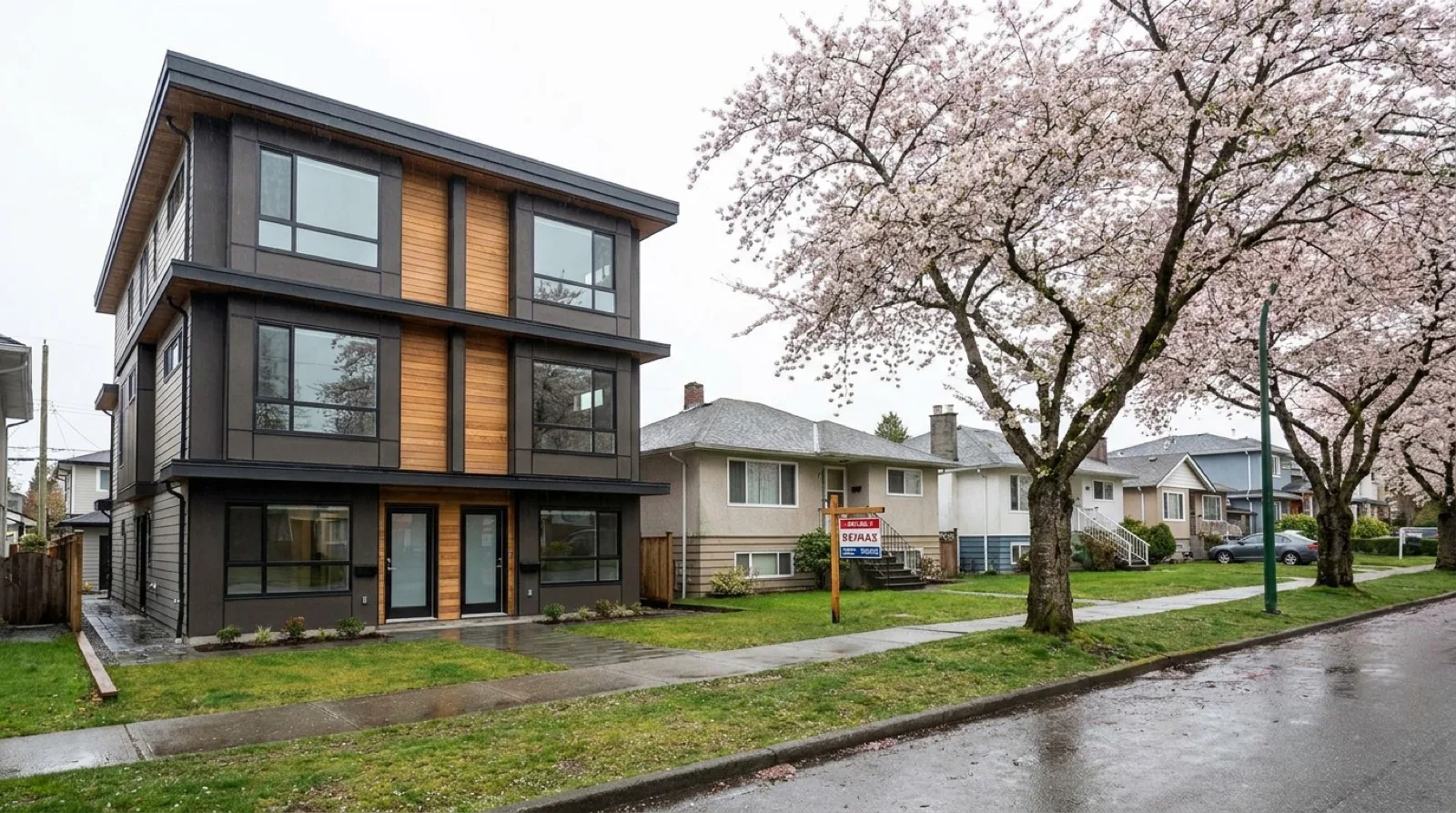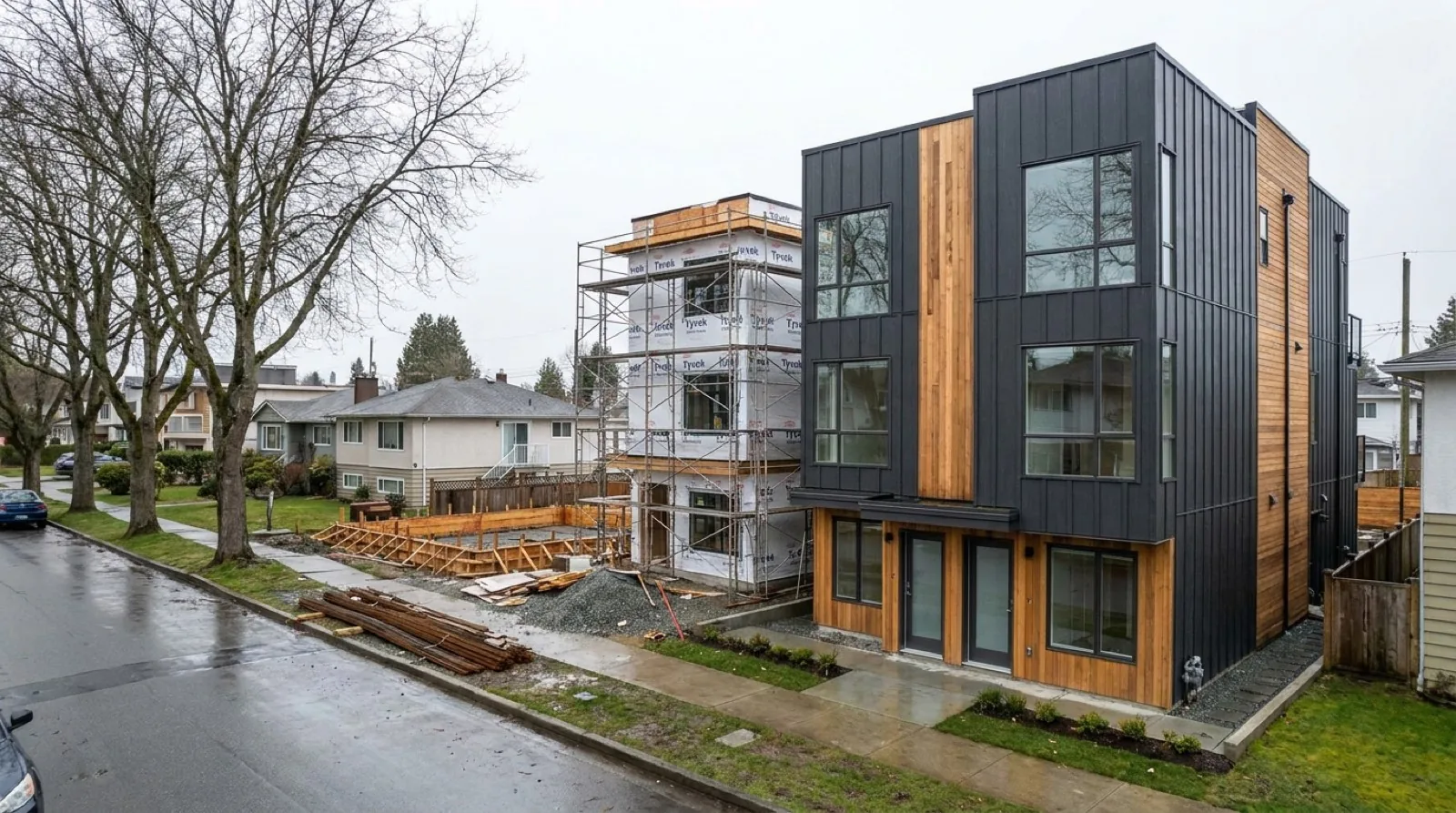

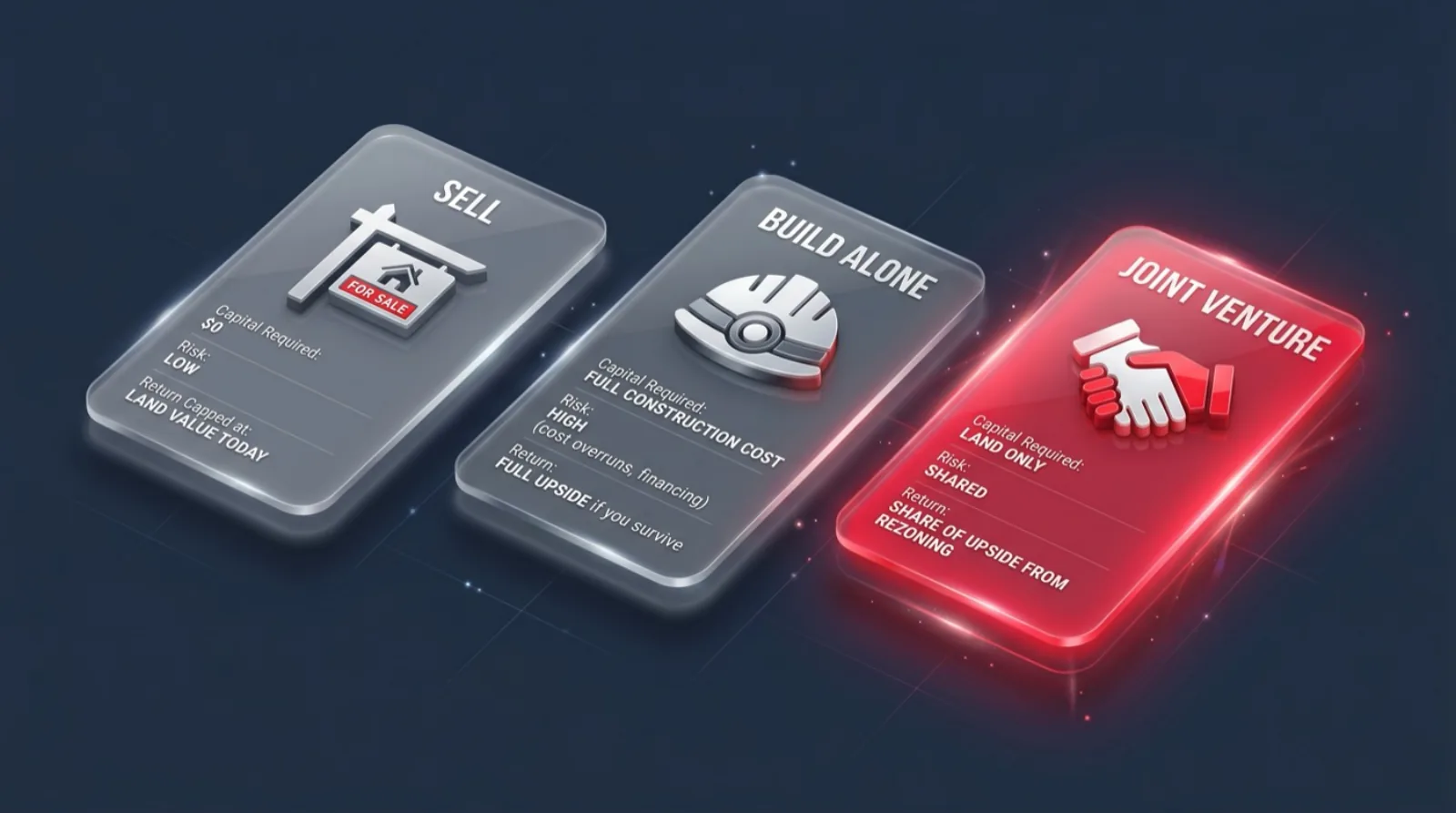
If you own an upzoned lot in BC, you have three real options. Sell. Build it yourself. Or partner with a developer in a joint venture. Most homeowners default to selling because it’s the path they understand. A few try to build alone and underestimate the capital, time, and risk. The third option, the JV, often produces the strongest outcome — but it’s the one homeowners know least about.
Two decisions inside a JV matter more than most people realize. The exit model decides what kind of income you receive and how it’s taxed. The legal structure decides how and when you pay tax on your land contribution. Both get committed early. Most homeowners discover the implications after they’ve signed.
TL;DR
- Three paths: Sell (cap your return at land value today), build alone (capital and risk most homeowners can’t carry), or JV (keep the land as your contribution, share the upside it creates).
- Exit model: In the GVRD, build-to-sell is the realistic exit on most upzoned lots. Build-to-hold works in secondary BC markets and CMHC-financed purpose-built rental, but rarely on a Vancouver multiplex.
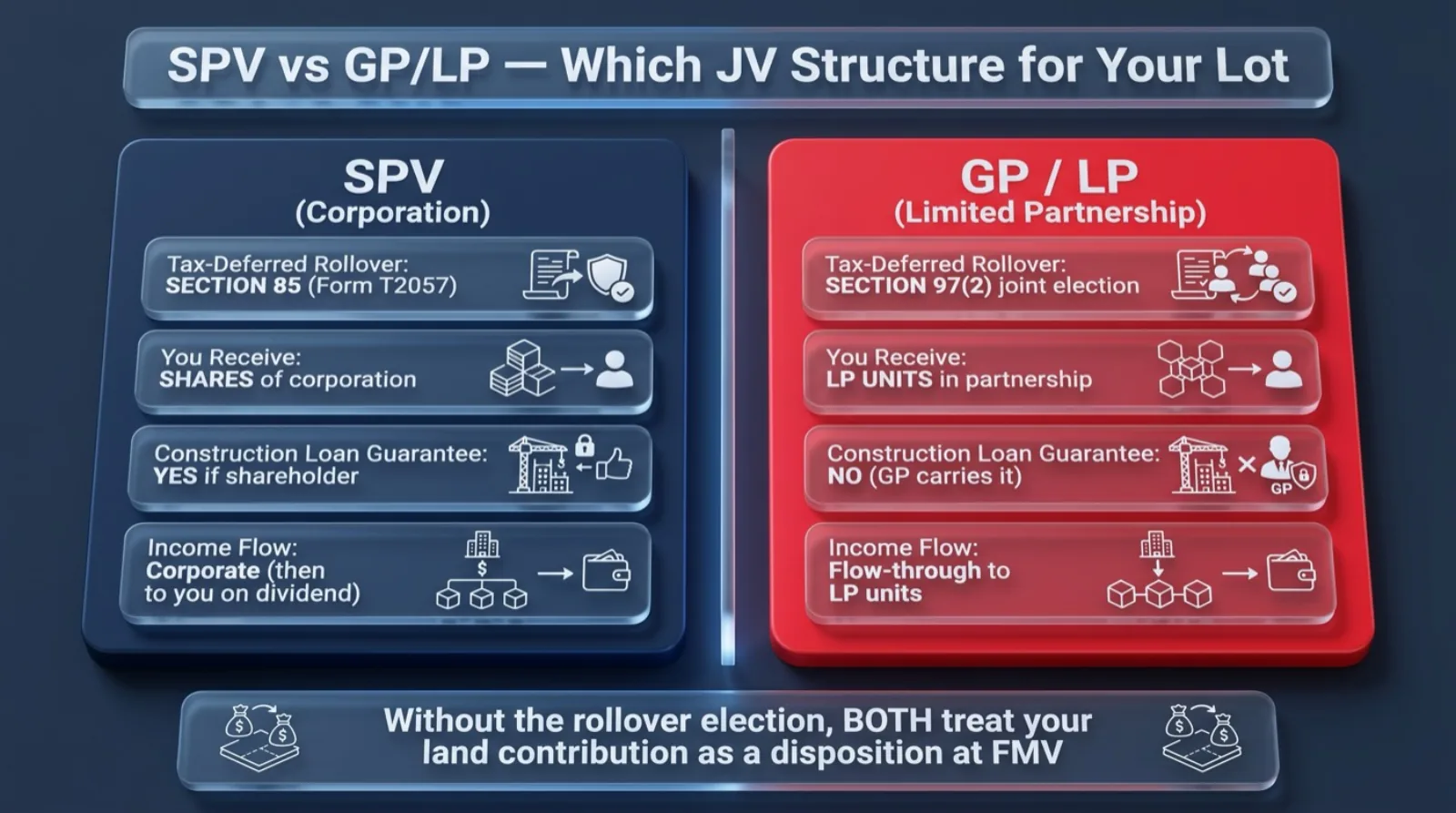
- Legal structure: SPV (corporation) and GP/LP (limited partnership) sound similar. The tax treatment of your land contribution is not. SPV uses a Section 85 rollover election; LP uses a Section 97(2) rollover election. Both require joint elections — neither is the default.
- Principal residence vs rental land: If your lot is your principal residence, the Principal Residence Exemption usually shelters most of the historical gain — the SPV vs LP choice matters less at contribution. If it’s a rental or investment property, the LP rollover defers a gain the SPV would otherwise trigger. A developer who only offers an SPV is making that choice for you.
- Pro tip from David: The higher the probable profit, the lower the risk. Because the highest risk is what you can sell it for in the future.
Pro tip: Before choosing a path, run your address through VanPlex to find out if the lot makes or loses money as a multiplex. The numbers decide which conversation is worth having.
Why a JV beats selling — or building alone
Selling outright caps your return at land value today. You hand the upside to whoever buys the property. Under Bill 44, that upside is often substantial because the buyer is the one capturing the rezoned multiplex value, not you.
Building alone means raising or borrowing the full construction cost, managing trades, navigating permits, and absorbing every cost overrun. For most homeowners, the capital requirement alone makes this unrealistic.
A JV lets you keep your land as your contribution, partner with someone who brings the capital and the expertise, and share in the upside that your land creates. That’s the high-level case. The mechanics are where homeowners get stuck — and where the exit and structural choices either help you or hurt you.
Build-to-sell vs build-to-hold — the BC reality
Before getting to legal structure, the bigger economic question is what happens at the end of the project.
Build-to-sell: project completes, units sell, proceeds get distributed. Dominant model in most BC markets, especially the GVRD. The sale value of the multiplex units is relative to the city it’s in. Land and build costs are high — but so is the sale price, and that’s how the math pencils.
Build-to-hold: project completes, units rent, partners share rental income and eventual appreciation. This works in markets where land plus build cost is more aligned with achievable rents. Some secondary BC markets and specific niches like purpose-built rental with CMHC financing fit here. Most upzoned lots in the GVRD do not.
For most homeowners contemplating a JV, the realistic exit is build-to-sell. Plan around that. Tax treatment, deal structure, and cash flow timing all follow from this choice.
Two ways to structure a JV — and when it matters
The two most common legal structures for a small multiplex JV in BC are a corporation (often called a Special Purpose Vehicle, or SPV) and a limited partnership (GP/LP). They sound similar. The tax treatment of your contribution is not.
Pro tip: If you get serious about this route, engage a registered tax professional with experience in multiplex JV structuring. The overview below is for orientation, not advice.
Option one: the SPV (corporation)
You and the developer set up a new corporation. You transfer your land to the corporation in exchange for shares. The corporation owns the project from land to completion.
The problem is the moment of transfer. In CRA’s eyes, transferring land to a corporation is a disposition at fair market value. You’ve sold the land to the company, even though you haven’t received cash. Capital gains tax can be triggered on the difference between your original cost and current FMV. This matters if the property is held in a corporation, or is a rental property. If it’s your principal residence, the PRE typically protects the historical gain.
The workaround is a Section 85 rollover under the Income Tax Act. It’s a joint election filed with CRA on Form T2057, and it lets you and the corporation agree on an “elected amount” that becomes your proceeds of disposition. Set the elected amount equal to your cost amount and you have no gain on the transfer — the gain rolls into the cost base of your shares and stays deferred until you eventually dispose of those shares. It works, but it adds legal and accounting complexity, and it’s only useful if elected at the time of contribution.
Option two: the GP/LP (limited partnership)
You and the developer form a partnership. The general partner — usually a developer-controlled entity — manages the project. You sit as a limited partner with the land contribution.
Pro tip: As an LP, you don’t have direct exposure to construction loans and you don’t sign loan guarantees. The GP carries that.
You “vend in” your land to the LP in exchange for LP units of equivalent value. The Income Tax Act allows a tax-deferred rollover for property contributed to a partnership in exchange for partnership units under Subsection 97(2). Like the corporate rollover, this is a joint election by the partnership and the contributing partner. With the election, your accrued gain doesn’t get triggered at contribution. It rolls into the cost base of your LP units and stays deferred.
Without the election, contributing to an LP is also a disposition at FMV. The default treatment is the same problem as the SPV. The election is what makes the structure work.
When the structural choice has real teeth
The right answer depends on what kind of property you’re contributing.
If your lot is your principal residence: The Principal Residence Exemption typically shelters the accrued gain on your land up to the point of disposition or change of use. For most upzoned BC primary residences with years of appreciation, the PRE is doing the heavy lifting on your historical gain. The SPV vs LP distinction matters less at the moment of contribution because there may not be much taxable gain to defer. The questions that matter more here: how to handle the change of use from personal residence to income-producing property, and how the development income flows to you during the project.
If your lot is a rental property or held for investment: There’s no PRE. The accrued gain on the land is fully exposed. This is where the SPV vs LP distinction has real teeth. The 97(2) rollover (when elected) defers a gain that the SPV would otherwise trigger immediately at contribution — even with the Section 85 election available, the partnership route can give cleaner flow-through treatment of development income to limited partners. A developer who only offers an SPV structure is making this choice for you, and not in your favor.
A practical note
This isn’t tax advice, and the details are specific to each homeowner. Your accountant and a real estate lawyer who has actually structured a multiplex JV before should walk you through your accrued land gain, your principal residence position, the rollover elections available, and how the development income is expected to flow to you. The right structure depends on your numbers, not on a template.
What matters is that you walk into the conversation knowing the choice exists, that the rollovers require an election, and that the development profit is taxed differently from the land gain.
The mechanics — contribution, split, exit
Whichever structure you use, the moving pieces are the same.
Your contribution: Land at agreed appraised value. That value becomes your equity, whether held as LP units or corporate shares.
The developer’s contribution: Construction capital, development expertise, relationships with trades and lenders, and the operational work of getting the project built. That becomes their equity.
The split: Profits get divided based on the ratio of contributions, sometimes with adjustments for risk and management. Common structures range from straight pro-rata splits to tiered splits where the developer earns more once a return threshold is met.
The exit: In a build-to-sell project, units sell at completion and net proceeds get distributed by share or unit interest. Some homeowners structure deals to keep one or two units rather than take cash — often as a new principal residence or to retain real estate exposure. This is doable, but it changes the math for both sides and needs to be priced in upfront, not bolted on at the end.
The timeline from agreement to handing over keys typically runs longer than people expect. Design, permitting, and construction on a small multiplex in BC is rarely a quick process.
What to look for in a developer partner
This is where most JVs succeed or fail before construction even starts.
- Track record on similar projects. Multiplex development isn’t the same as building a single house or a large condo tower. You want a partner who has actually delivered 4-to-6-unit projects in your region — not someone learning on your land. That said, multiplex is a new category and capable new builders are entering the space, so don’t dismiss a strong builder just because their multiplex count is low.
- Capital position. Ask how the project is financed. The developer signs guarantees on construction financing — you don’t. If your equity is mortgage-free land, the project is in good shape. If there’s an existing mortgage, additional cash equity is needed from you, the developer, or third parties to pay the old mortgage off and make the loan-to-cost or loan-to-value acceptable to the lender.
- Transparency on the numbers. A real partner walks you through their pro forma line by line and explains how returns are projected. It should be easily understandable. If you can’t follow the math, that’s a signal.
- Sophistication on structure. This connects directly to the SPV vs LP question and to your specific tax position. A partner who understands the implications for the landowner — and is willing to set up the structure that works for you rather than the one easiest for them — is the partner you want.
- Aligned incentives. The deal should reward both sides for the same outcome. Watch for structures where the developer earns fees regardless of project performance while your return depends entirely on the sale price.
What a JV doesn’t solve
A JV isn’t a guaranteed return. The project still has to perform. Market conditions still matter. The wrong partner can still produce a bad outcome. The right legal structure can save you tax — but it can’t save a bad project.
What a JV does, when structured properly, is align your interests with someone whose job it is to make the project work, let you participate in the upside that your land creates, and handle the tax treatment in a way that fits your specific situation rather than the developer’s default template.
For homeowners sitting on an upzoned lot, that combination is often the difference between selling early at land value and building real wealth from the rezoning.
Pro tip: The higher the probable profit, the lower the risk. Because the highest risk is what you can sell it for in the future.
Frequently asked questions
What’s the difference between a Section 85 and a Section 97(2) rollover? Section 85 of the Income Tax Act allows tax-deferred transfer of property to a Canadian corporation in exchange for shares (filed on Form T2057). Subsection 97(2) allows tax-deferred transfer of property to a Canadian partnership in exchange for partnership units. Both require a joint election with an “elected amount” — neither is the default treatment of a contribution.
Do I have to give up my principal residence exemption to JV? Not necessarily. If you contribute the land before changing its use to income-producing, the PRE typically shelters historical gain up to the point of disposition or change of use. The mechanics around change-of-use are technical and need a professional to walk through your specific timing.
Can I get one of the units back at the end instead of cash? Yes — some homeowners structure deals to keep one or two completed units. It needs to be priced in upfront, not bolted on at exit, because it changes the cash split and the tax treatment for both sides.
Why is build-to-hold harder in the GVRD? Land basis plus build cost on a Vancouver or Burnaby multiplex usually outpaces achievable market rents on a stabilized basis. The yield doesn’t justify the capital tied up. Secondary BC markets and CMHC-financed purpose-built rental projects can pencil — most upzoned GVRD lots can’t.
Have you done a JV? What went well, what didn’t? That’s David’s open question — drop a comment or DM if you’ve been through one. The lessons from real deals are more useful than any framework.
If you own an upzoned gentle-density lot in BC and want to understand what a JV on your specific property could look like — including whether build-to-sell is the right exit and which legal structure fits your tax position — that’s the conversation we have at VanPlex. We co-develop multiplexes with homeowners across the province and structure each deal around the lot, the homeowner’s goals, and the local market and tax reality. Every conversation starts with running your parcel through PlexRank™ to see what the lot can actually support and where the returns sit.
— David Babakaiff, Co-Founder, VanPlex | PlexRank™ | Profit with Multiplex
Sources: Income Tax Act, Section 85 (Justice Canada); Income Tax Act, Section 97 (Justice Canada); CRA IC76-19R3 — Transfer of Property to a Corporation Under Section 85; CRA IT413R — Election by Members of a Partnership Under Subsection 97(2).