Vancouver · R1-1
The most permissive small-lot zoning in Metro — and what it actually produced
Vancouver went further than its neighbours: up to six strata units, or eight on a secured-rental path, on qualifying R1-1 lots. So Vancouver is the cleanest test of a simple question — does generous density, on its own, get homes built? The answer is in the distribution below.
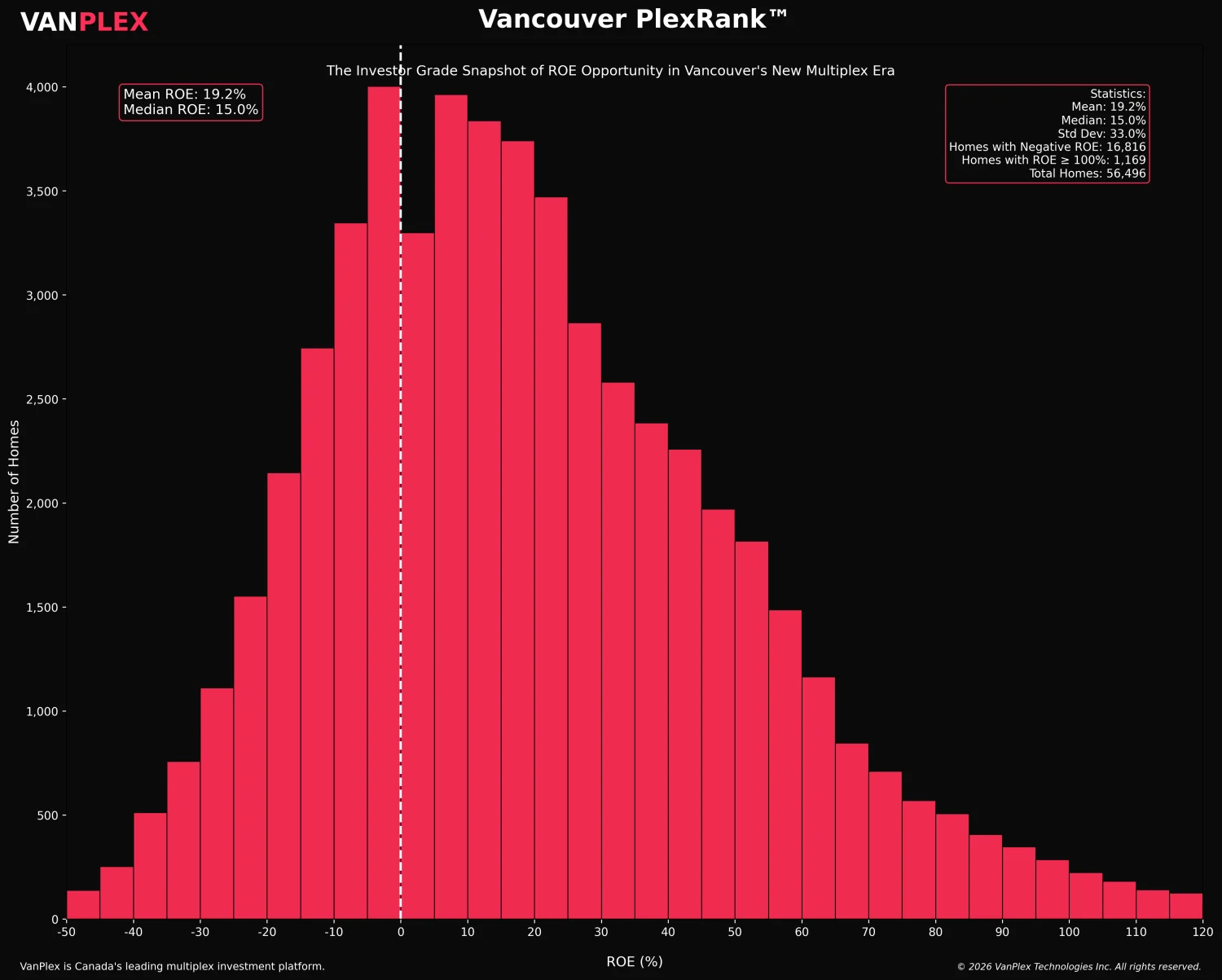
Real VanPlex PlexRank™ analysis of Vancouver R1-1 lots. Each bar is the number of lots at a given projected return; the dashed line is break-even. The mass near and below the line is zoned for a multiplex but does not pencil today.
What Vancouver's distribution tells a planner
Read the shape, not a single number. A large share of R1-1 lots sit at or below break-even — land basis plus construction plus fees outruns what the finished units are worth. Those lots are zoned for a multiplex and will not see one. The lots that get built are the right-hand tail: usually wider parcels that reach five or six units, where the math finally clears a builder's threshold.
That is the gap between zoned capacity and viable capacity. Vancouver's permit uptake will track the viable tail, not the full zoned universe — no matter how permissive the bylaw reads. For a planner, that reframes the lever: the way to add supply here is on the cost-and-density side, not more permission.
How Vancouver set the dial: two R1-1 paths
R1-1 gives an owner a choice between a six-unit strata building and an eight-unit secured-rental building. These are the public rules that shape every Vancouver multiplex proforma — and the reason the rental path, despite two extra doors, is not always the one that gets chosen.
| Rule | 6-unit strata | 8-unit secured rental |
|---|---|---|
| Max units | 6 market units | 8 secured rental units |
| Tenure | Strata; units can be sold individually | Single-title secured rental; no unit-by-unit exit |
| Max FSR | 1.00 standard R1-1 | 1.00 standard R1-1 |
| Density bonus cost | Applies above 0.70 FSR | Waived in the working comparison memo |
| Net-zero FSR uplift | +19% exclusion available | +19% exclusion available |
| Height, frontage, lot size, lane, parking | Same controlling rules | Same controlling rules |
| CMHC MLI Select fit | No | Yes, if project scores qualify |
| City levy treatment | Full DCL exposure | Working memo assumes a major Class B rental waiver |
The lot-width problem
More than any single rule, lot width decides which Vancouver lots get built. The city's housing stock is full of narrow lots, and a narrow lot is where the economics break.
Narrow lot (~33 ft)
Usually does not pencil
Width caps the realistic unit count and the buildable floor area, while the land still costs Vancouver prices. The return often lands at or below break-even — zoned for a multiplex, but not one a builder will start.
Wide lot (~50 ft)
Where permits cluster
A wider lot reaches more units and the secured-rental path, spreading fixed land and design costs over more sellable or rentable area. This is the right-hand tail of the distribution — the lots that actually build.
The two failure modes, in Vancouver terms
Too little, in practice
On a standard 33-foot lot, the unit count and the land basis often leave a project under water. The zoning permits a multiplex; the economics do not. These lots stay single houses.
Too much, in practice
Push density far past servicing capacity and the constraint flips to infrastructure and approvals. Vancouver's lever is not blunt "more units" — it is finding where added density still clears both tests.
How R1-1 got here
Nov 2023
Bill 44 passed
The Province requires municipalities over 5,000 people to allow 3–6 units on most single-family lots.
Sep 2024
R1-1 takes effect
Vancouver folds dozens of old single-family zones into one R1-1 district allowing up to six units citywide.
May 2025
R1-1 update memo
Council reviews how the zone is performing and adjusts rules to improve feasibility and design outcomes.
Jun 2026
Provincial compliance deadline
The final date for BC municipalities to align zoning with the updated SSMUH requirements.
What we monitor for Vancouver
Permit pipeline
Every R1-1 multiplex permit — duplex through six-plex — by status and stage, tracked over time.
Viable-lot share
How many R1-1 lots actually pencil at current rules, and how that share moves with a fee, parking, or unit change.
Neighbourhood pattern
Which areas are absorbing density and which are flat, read against lot width, land value, and transit.
Strata vs secured rental
Whether the 8-unit rental path is being used, or whether owners default to the 6-unit strata route.
Want Vancouver's numbers — or your own city's?
The chart above is the public version. Partner cities get the underlying figures: viable-lot share, permit pipeline, and scenario modeling on the levers that move supply.
- Share of Vancouver R1-1 lots viable at current rules
- Multiplex permit pipeline by type and stage
- Scenario modeling: parking, fees, and unit-count levers
- The same build for your municipality
Go deeper
Vancouver — Official Sources
Vancouver — frequently asked questions
What does R1-1 allow in Vancouver?
Why does lot width matter so much here?
Are most R1-1 lots actually buildable as a multiplex?
So is the R1-1 upzoning failing?
Is the 8-unit secured-rental path being used?
Want this for your municipality?
We already track multiplex permit uptake and lot-by-lot feasibility across BC. Tell us your city and we'll show you what your data says — and how a monitoring partnership works.