By David Babakaiff, Co-Founder of VanPlex and former principal of Alair Homes Vancouver.
Today we’re launching two things: PlexIntel, the data division of VanPlex, and its first publication — the PlexRank™ Index (the BC Multiplex Index), a free monthly report on what BC’s multiplex market is actually doing.
Why we’re publishing an index
Three years into BC’s multiplex experiment, the public conversation still runs on anecdotes and old zoning maps. Cities report permits in different formats, on different schedules, or not at all. Nobody publishes what the housing is worth to build — whether a fourplex actually pencils on a given lot.
We’ve been collecting that data for our own work: 205,047 lots scored across six cities, every Vancouver R1-1 application tracked, build-cost models for five cities. Reporters cite it. Planners ask us for it. Investment analysts email asking for the spreadsheet.
So we’re doing what we should have done earlier: publishing the headline numbers on a fixed schedule, at permanent URLs, with the methodology stated. That’s the index.
What’s in edition #1
The June 2026 edition covers four things:
| Section | What it shows |
|---|---|
| Permit applications | 518+ Vancouver R1-1 multiplex applications since October 2023, 2,200+ units |
| Application mix | Multiplex ~50%, duplex ~30%, single detached ~20% of 2024 R1-1 filings |
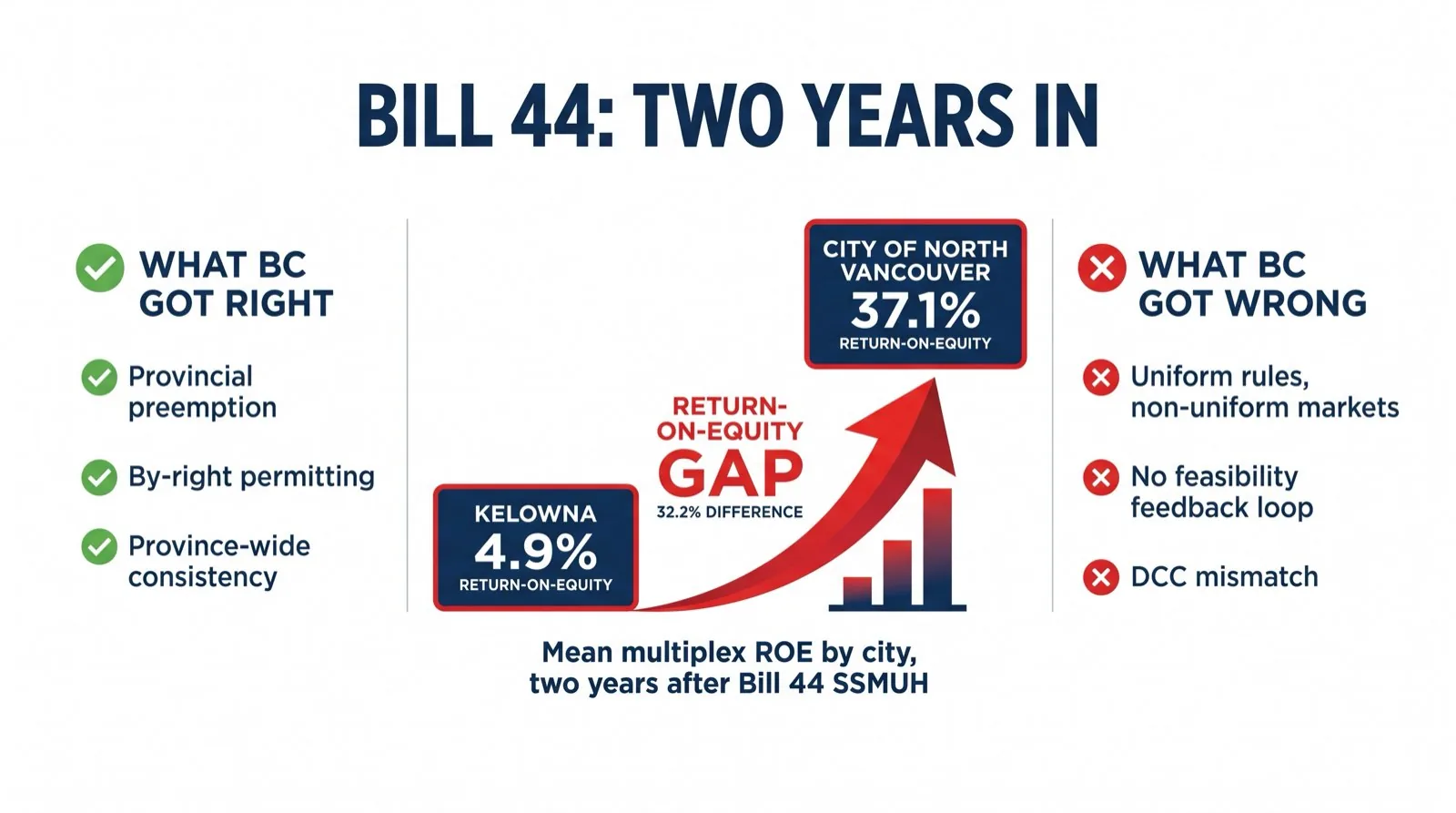
| Viability by city | PlexRank mean ROE: Burnaby 36.6%, North Vancouver 37.3%, Vancouver 19.2%, Kelowna 4.9% |
| Methodology | Where each number comes from, what’s covered directly, what’s coming |
The gap between cities is the story worth following. The province gave every municipality roughly the same zoning. The economics landed completely differently — Burnaby’s distribution says most lots work, Kelowna’s says the market doesn’t yet support what the zoning permits. Watching that spread move month to month tells you more about BC housing supply than any policy announcement.
The rules we’re holding ourselves to
- Fixed schedule. A new edition on the second Tuesday of every month, no exceptions.
- Permanent URLs. Each edition stays at its own address forever, so a figure cited in January still resolves in five years.
- No revisions. Published numbers are never changed after release. Corrections appear in the next edition, flagged as corrections.
- Stated methodology. Every edition says which cities are covered directly, which figures are approximate, and what the model assumes.
What PlexIntel is
The index is the free, public layer. PlexIntel is everything underneath it: the parcel-level PlexRank scores, the permit application lists, the per-city feasibility models, and — as we build them out — permit lifecycle tracking, a data terminal, and API access.
It’s built for the people who asked for the spreadsheet: investment firms screening lots, municipalities measuring whether their rezoning is producing housing, builders and lenders checking the math before committing. If that’s you, request access and we’ll show you the data for your cities.
Where this goes next
The most valuable dataset in housing isn’t a snapshot — it’s history. A permit application is an intention; what matters is whether it becomes an issued permit, a construction site, a completed building, and a sale. We’re building that lifecycle tracking now, city by city, and it will start showing up in future editions as months-of-supply and completion-rate figures nobody else publishes.
The first edition is live today: PlexRank™ Index — June 2026.
David Babakaiff has built homes in BC for 25 years and was formerly principal of Alair Homes Vancouver, whose multiplex work earned HAVAN recognition in 2024. He co-founded VanPlex to put real build costs and real sale outcomes behind Vancouver multiplex decisions.