
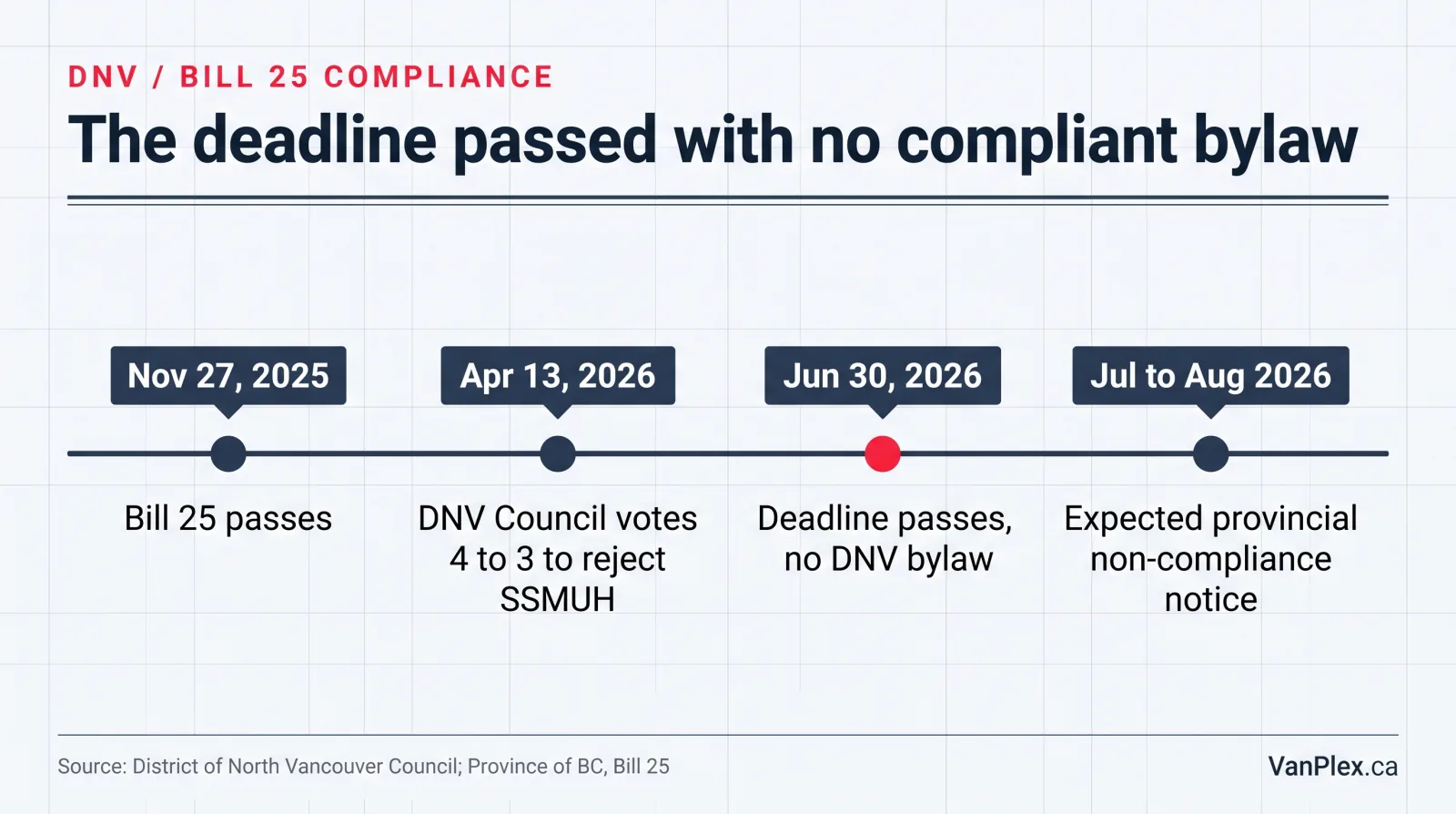
The June 30, 2026 SSMUH compliance deadline has passed. As of the last public record, the District of North Vancouver has not adopted a compliant zoning bylaw. Its April 13 refusal still stands. So the question owners and builders keep asking is simple: what does DNV do now, and what can it actually still choose?
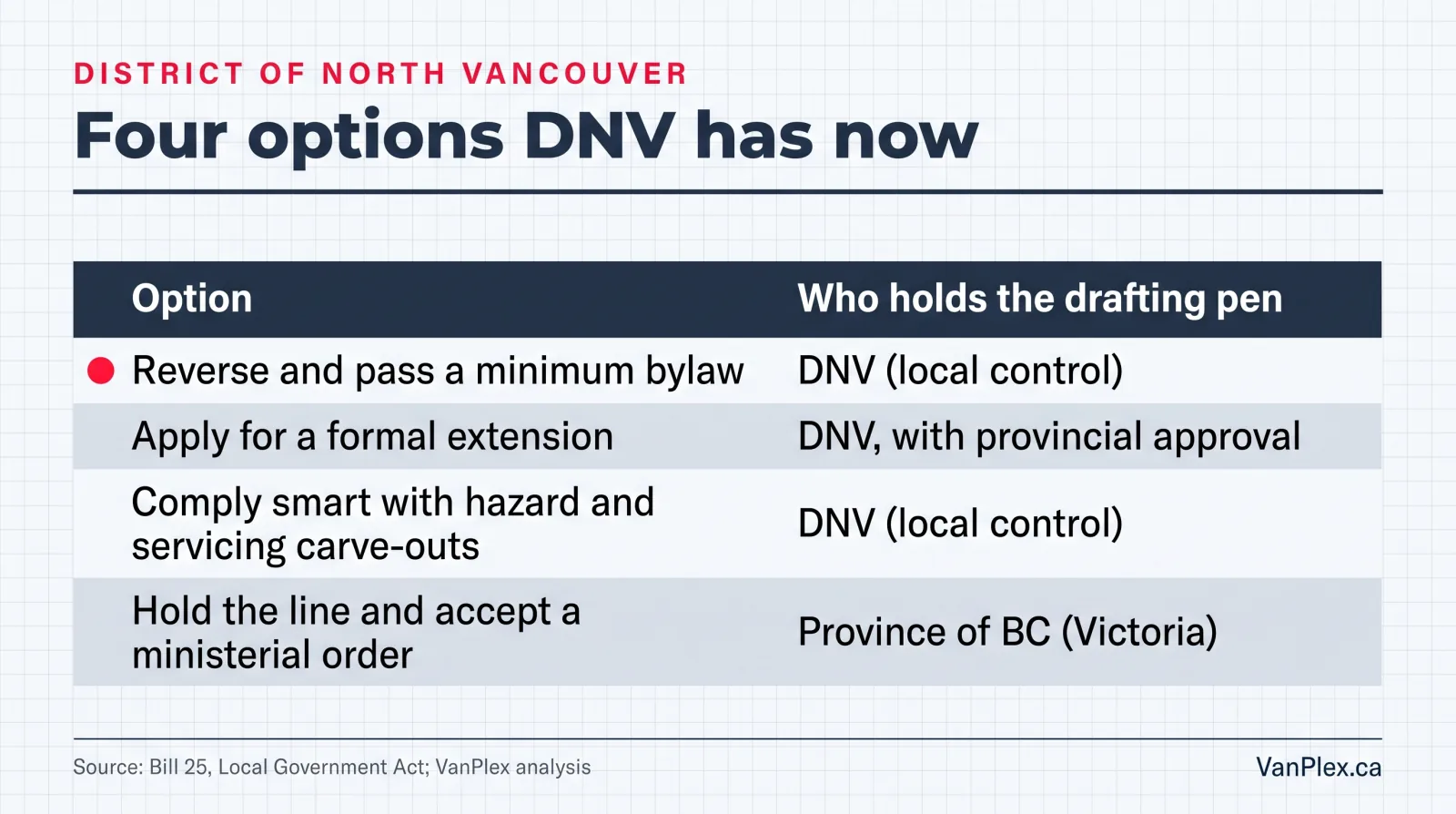
Back in April we said the refusal wouldn’t hold and zoning would exist by Q3 2026 regardless. Nothing since then has changed that. What has changed is the menu. DNV now has four real moves, and only one of them keeps the pen in the District’s own hand.
TL;DR
- The deadline is gone. June 30, 2026 passed with no compliant DNV bylaw on the books. The April 13, 2026 motion to reject SSMUH (a 4 to 3 Council vote) is still the District’s formal position.
- What DNV rejected: zoning that would have allowed roughly 5,000 new units by permitting 3 to 6 units on many single-family lots, the density Bill 25 requires.
- DNV still has four options: reverse and pass a minimum bylaw, apply for a formal provincial extension, adopt a smart-compliance bylaw that uses hazard and servicing carve-outs, or hold the line and let Housing Minister Christine Boyle impose zoning by ministerial order.
- There is a real precedent for what comes next. When West Vancouver missed the June 30, 2024 Bill 44 deadline, the Minister sent a formal non-compliance notice on July 25, 2024. DNV is now inside that same window under Bill 25.
- For owners and builders: the four options only change who writes the bylaw and the exact date. Six-unit zoning is still coming to transit-proximate DNV lots. Don’t pause lot screening or DP prep.
Where DNV actually stands today
Two things are true at once. First, DNV is out of compliance: the province set June 30, 2026 as the hard date to align local zoning with Bill 25, and the District did not do it. Second, nothing about that refusal removes the obligation. Bill 25 amended the Local Government Act so a municipality cannot opt out. It can only stall.
The April 13 vote was close, 4 to 3, which matters. A one-vote margin is not a wall. It’s a position that can flip at a single future meeting if two councillors read the enforcement risk differently. That’s part of why “hold the line forever” was never really on the table.
DNV is also not alone on the North Shore. West Vancouver Council rejected the same mandate. The City of North Vancouver, a separate municipality with its own council, has been on a standard compliance track since it adopted SSMUH rules in December 2025. Same peninsula, three different postures.
What Bill 25 still requires, deadline or not
The refusal doesn’t shrink the mandate. Whenever a compliant bylaw lands, whoever writes it, this is the floor DNV has to hit:
| Lot situation | Minimum units Bill 25 requires |
|---|---|
| Lot 280 m² or smaller | 3 units |
| Lot larger than 280 m² | 4 units |
| Lot larger than 280 m² within 400 m of frequent transit | 6 units |
That last row is the one that reshapes land value on the North Shore. A standard single-family lot near a frequent bus corridor moves from one home to a six-unit multiplex. That is the density DNV’s April motion tried to refuse, and it’s the density that returns the moment any compliant bylaw is in force.
Option 1: Reverse course and pass a minimum bylaw
The cleanest exit is for Council to draft and adopt its own minimum-compliance bylaw. Do the least the province requires, and do it in-house.
The advantage is control. If DNV writes the bylaw, DNV decides how the hazard exemptions are drawn, how servicing conditions are worded, and how the transition rules treat in-stream applications. Every one of those details is worth money to local owners. Hand the pen to Victoria and those choices get made for you.
A 4 to 3 vote is exactly the kind of margin that reverses under a formal provincial notice. This is still the most likely outcome, and the best one for the District.
Option 2: Apply for a formal extension
The province publishes an actual form for this: the Application to Request an Extension to SSMUH Compliance Deadline. DNV has a genuine case to make on it. The District’s own servicing analysis split its single-family lots into roughly 2,900 that are serviceable for multiplex today, about 8,500 that need water, sewer, or road upgrades first, and about 8,600 excluded for natural hazards like slope, creek, and wildfire interface.
An extension request built on that engineering, rather than on a political motion, is a defensible ask. The catch is that DNV had to actually file it, with documentation, instead of passing a refusal. An extension buys time to sequence infrastructure. It does not buy an exit.
Option 3: Comply smart, using hazard and servicing carve-outs
This is the move we’ve argued for since April, and Coquitlam has already shown it works. Bill 25 lets a municipality prohibit or limit SSMUH on specific lots for documented natural-hazard and servicing-capacity reasons. Used properly, that’s not defiance. It’s compliance that protects the network.
DNV’s ~8,600 hazard lots can be legitimately excluded with documentation. On the ~8,500 servicing-constrained lots, the District can require three or four units where the pipes can’t yet carry six, instead of a blanket six everywhere. That’s a per-lot engineering exercise, and it’s the honest version of the infrastructure argument Council has been making. See how Coquitlam mapped fire-flow capacity into its SSMUH bylaw rather than fighting the mandate.
The difference between Option 3 and the April refusal is everything. One is a compliant bylaw with evidence-based limits. The other is a motion the province can simply overwrite.
Option 4: Hold the line and accept a ministerial order
DNV can keep its refusal in place and dare the province to act. This is the weakest option, and here the precedent is concrete rather than hypothetical.
West Vancouver voted against SSMUH zoning on May 27, 2024. It missed the June 30, 2024 Bill 44 deadline. On July 25, 2024, roughly three to four weeks later, the Minister of Housing sent West Vancouver a formal non-compliance notice. That is the documented playbook, and DNV is now inside the same window under Bill 25.
Bill 25 gives Minister Christine Boyle a further tool that Bill 44 didn’t fully have: the authority to impose the SSMUH zoning provisions directly by ministerial order under the Local Government Act. When that happens, the municipal bylaw isn’t supplemented, it’s replaced. Council can vote against the order, hold a press conference, or issue a statement. The zoning is in force regardless. Every hazard line and servicing condition is then drawn in Victoria, not on the North Shore.
We saw a version of this dynamic when the province overrode West Vancouver on the Ambleside file. The lesson repeats: refusal is a message, not a zoning outcome.
So what actually happens next
Based on the West Vancouver 2024 sequence, the near-term path is predictable even though the exact dates aren’t confirmed yet. Expect a provincial non-compliance notice within weeks of the missed deadline, then a short response window, then either a DNV Council reversal under pressure (Option 1 or 3) or a ministerial order (Option 4). We are not asserting the notice has been issued. We are saying the mechanism is loaded and the precedent is only two years old.
For a property owner, the political branch you end up on barely matters. Look at the outcomes:
- Council reverses and writes its own bylaw: six-unit zoning arrives, drafted locally, probably with the most owner-friendly hazard and transition rules.
- Province imposes an order: six-unit zoning arrives, drafted in Victoria, on the province’s timeline.
Both roads end at the same place: SSMUH zoning in force on DNV lots. The only variables are the date and the fine print.
What to do if you own or are buying a DNV lot
Don’t wait for the standoff to resolve before doing the work. The legal reality was locked in when Bill 25 passed. The refusal changed the schedule, not the destination.
- If you own a DNV single-family lot near frequent transit: run a PlexRank screen now. Whatever bylaw lands, six-unit zoning is coming to lots in the serviceable “green” bucket. Knowing your number before the bylaw is public is an advantage, not a risk.
- If your lot is in the servicing-constrained bucket: it isn’t off the table, but budget for a civil review and possible water or sewer upgrades in your underwriting. Model three or four units as your base case, six as upside.
- If you’re on a hazard lot: the math likely doesn’t change. SSMUH probably won’t apply. Laneway, coach house, and the existing home stay your plays.
- If you’re a builder sourcing DNV lots: don’t pause acquisition. A reversal bylaw and a ministerial order both produce real zoning. Price in a zoning-certainty risk window through the end of Q3 2026 and keep moving.
The City of North Vancouver, remember, is on a normal track. If you’re comparing sides of the Second Narrows, see our City of North Vancouver Multiplex Development Guide and our District of North Vancouver development guide for the current lot-level picture.
Check your DNV lot
If you own property in the District of North Vancouver and want to know what’s actually buildable, regardless of which council or minister ends up writing the bylaw, run a PlexRank screen on your address. Two minutes. Real numbers on servicing, hazard status, and unit potential.
The standoff is noise. The land economics are signal. That was true in April, and the passed deadline only makes it more true.
— The VanPlex Research Team PlexRank™ | Profit with Multiplex
Sources:
- District of North Vancouver Rejects SSMUH Mandate (April 13, 2026 Council vote) — Real Estate North Shore
- “Not viable”: North Van council hears report on economics of affordable SSMUH — North Shore News
- West Vancouver council votes to defy provincial housing directives — North Shore News
- Bill 25 SSMUH Policy Bulletin — Province of British Columbia
- Application to Request an Extension to SSMUH Compliance Deadline — Province of British Columbia